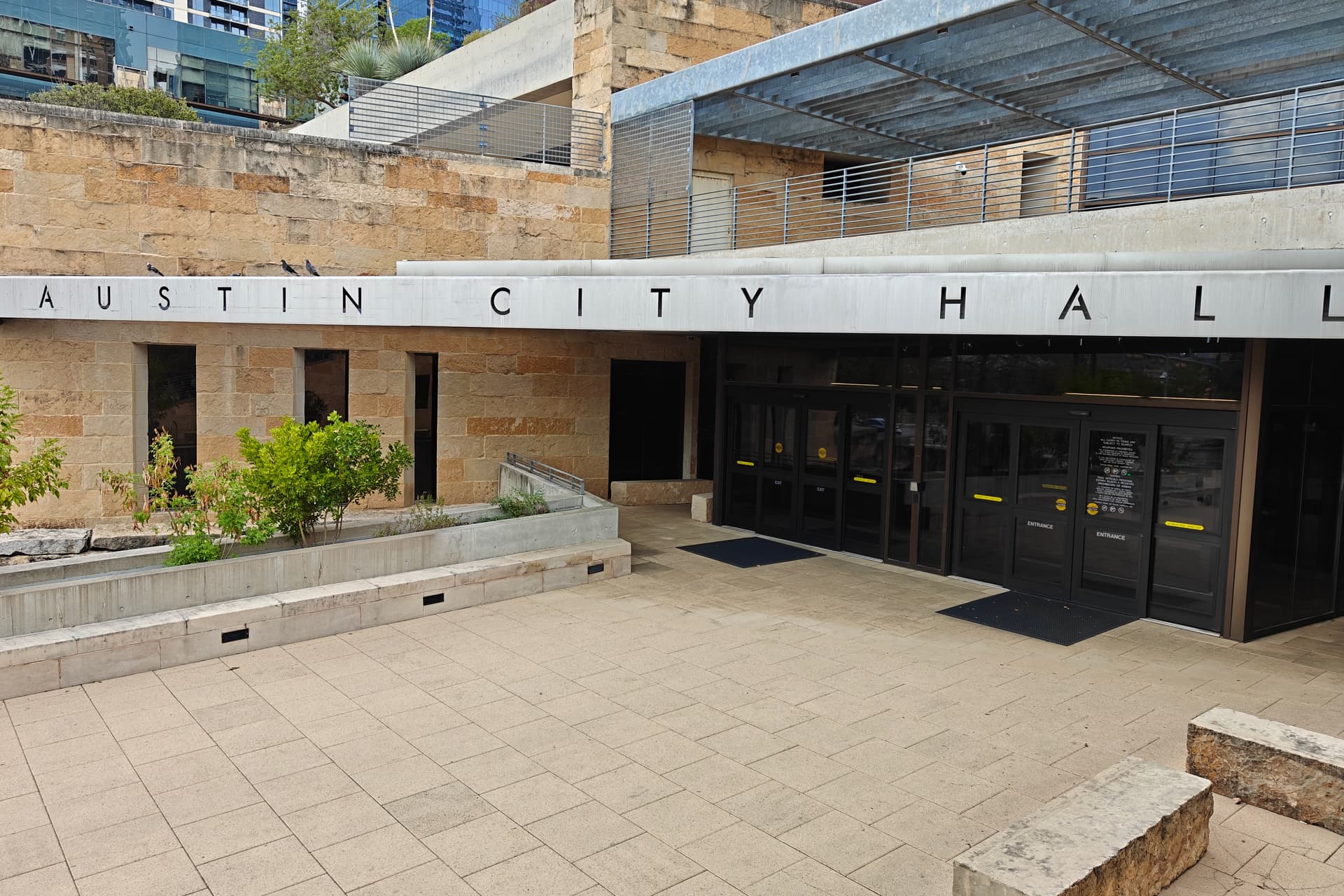
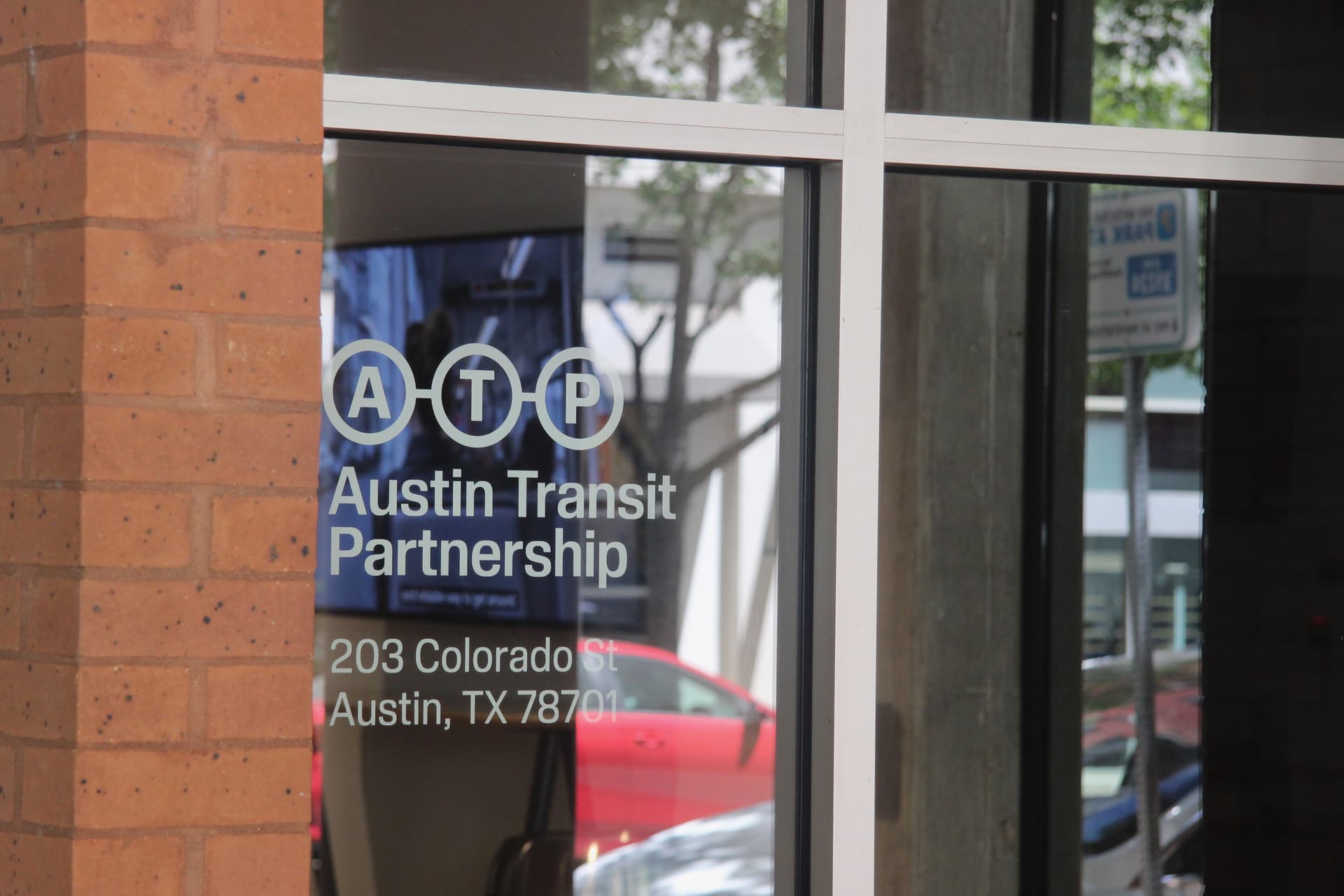
The Austin Transit Partnership is seeking new offices as light rail development ramps up and it outgrows its current space on Colorado Street downtown. (Ben Thompson/Community Impact)
A decision on the transit planning organization's next home could come in September, months after officials declined to approve a $32 million luxury office lease downtown following opposition from Mayor Kirk Watson.
"The agency was not as clear, was not as transparent, and was not as open about why it was making decisions when it announced and we were going to vote on space. And as a result of that, I think it puts the agency in a situation where it has at least some credibility issue," Watson, who serves as vice chair on the ATP board, said during an Aug. 19 discussion.
The big picture
The nearly 10-mile light rail plan is advancing under ATP following Austin voters' 2020 approval of a tax rate increase to fund the Project Connect transit initiative.
ATP has recently cleared project milestones like authorization for several major contracts ahead of rail construction and an initial federal program review. However, Project Connect's local tax-based financing structure faces challenges in court—litigation that'll continue on appeal following an August district court hearing—and ATP hasn't yet secured an anticipated federal commitment for roughly half of the rail's multi-billion dollar price tag.
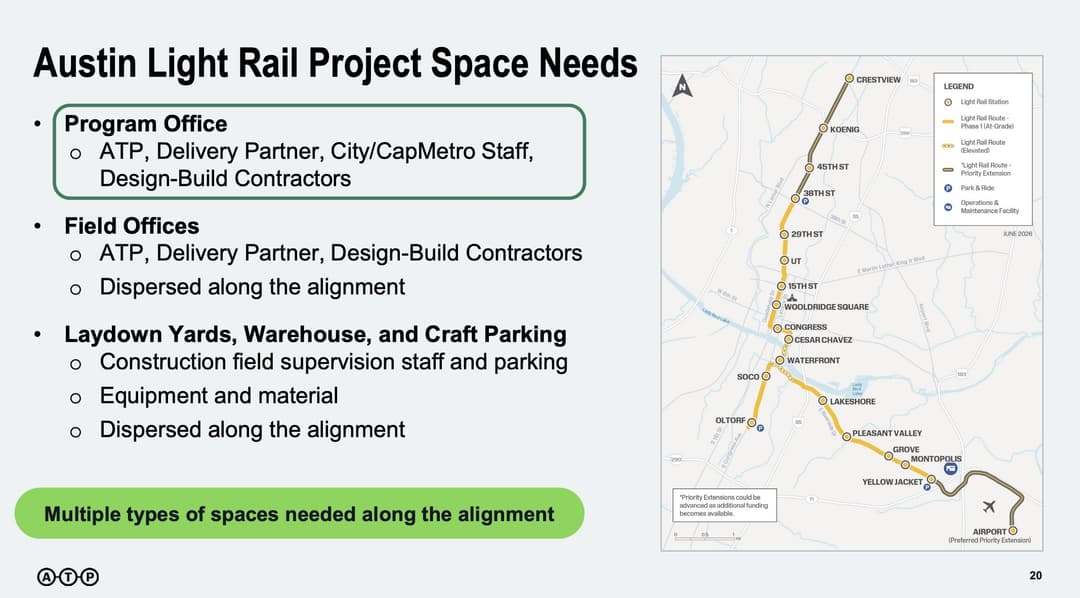
For now, ATP and its partners are working to complete initial plans for the rail network, train cars and system maintenance facilities before officially starting construction in 2027. The organization is outgrowing its current 32,000-square-foot office at 203 Colorado St., officials said, and are planning for a new home before its lease for that space ends.
ATP may also seek smaller field offices and other facilities like warehouse space in the future, although the search is now only focused on a new headquarters. Officials could approve a new lease in September, alongside a vote on ATP's next budget.
Austin Transit Partnership is searching for a new program office near the future Austin Light Rail system. (Courtesy Austin Transit Partnership)
Zooming in
This spring, ATP's board was presented with the $32 million lease for more than 50,000 square feet of Class A office space at 100 Congress Ave. That plan was tabled after Watson raised objections to its financial impacts, and given residents' ongoing affordability concerns.
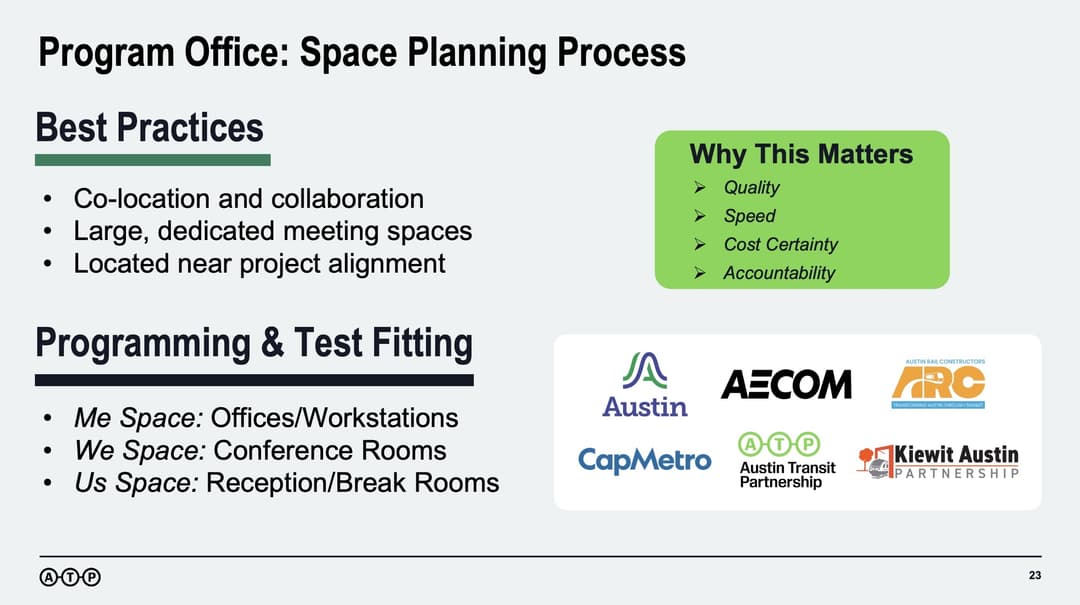
Office options, including ATP moving into space owned by Capital Metro, remain under evaluation. No final locations or expected costs were presented during the transit partnership board's Aug. 19 meeting, but staff said they're working to align with best practices that'd house both ATP staff and light rail contractor employees together in a larger shared space.
“We’re kind of on the precipice of the peaks of our personnel needs for the next few years, and so we’re thinking—and we always do thoughtfully think—about our space and right-sizing it for the period that we’re in of this project," said Casey Burack, ATP's executive vice president of business and legal affairs.
Austin Transit Partnership is pursuing collaborative office space as Austin Light Rail development continues. (Courtesy Austin Transit Partnership)
Contractor representatives also told the ATP board that co-locating near the future rail line would be ideal for bringing technical experts together for more efficient planning and decision-making; improving work speed and lowering costs; and reducing response times to any incidents that might arise during construction or future rail operations.
What they're saying
Watson acknowledged the desire to have ATP follow industry best practices related to office needs. But, he also pressed staff on whether their current approach aligns with a framework he's promoted to reduce risks to both the overall rail plan and Austin residents.
"As I listen to this, it feels like the risk assessment is on one side. And not on the side of, ‘What is the risk to the taxpayer that ends up having to pay for all this?’" he said. "We’re talking about a lot of cost, we’re talking about a lot of people ... it’s an enormous amount of square footage, it’s an enormous cost, and it comes at a time when we face very real risks to the taxpayer."
Following his recent votes against the city's bond package and budget, Watson also suggested ATP leaders should run all their decisions through a lens of affordability and said that bar hasn't been met in the office space search. Jeff Travillion, Travis County commissioner and ATP board member, said he agreed given current political realities.
“I think people expect us in government to tighten our belts as well. They expect to be able to see us demonstrating that we’re saving here, we’re saving there, we’re saving everywhere we can," he said. "It is important for the public to see us working as hard as they are working to make things effective, but cheaper too."
What else?
While ATP's office selection and budgeting are still in progress, Burack noted federal funding for Austin Light Rail—if secured—could help cover those expenses through future reimbursements.
“We are a delivery organization. So almost all of the costs that we incur ... are attributable to the project itself, to the capital costs of the project, and that generally includes our monthly lease expenses," Burack said.
ATP isn't counting on that outcome though, and more expensive locations aren't being pursued. Given some legal and funding uncertainty, ATP staff also said options like shorter-term leases or subleases could be used to reduce risk if needed.
Watson, who'd previously proposed having ATP staff work from existing CapMetro property, also referenced some internal resistance or rivalry between the agencies and said they should still consider joint spaces as an option.
“It’s called Austin Transit Partnership. Why the partners can’t co-locate and collaborate in the same place is beyond me," he said.
Where Central Austin’s road, bridge and trail projects stand in October