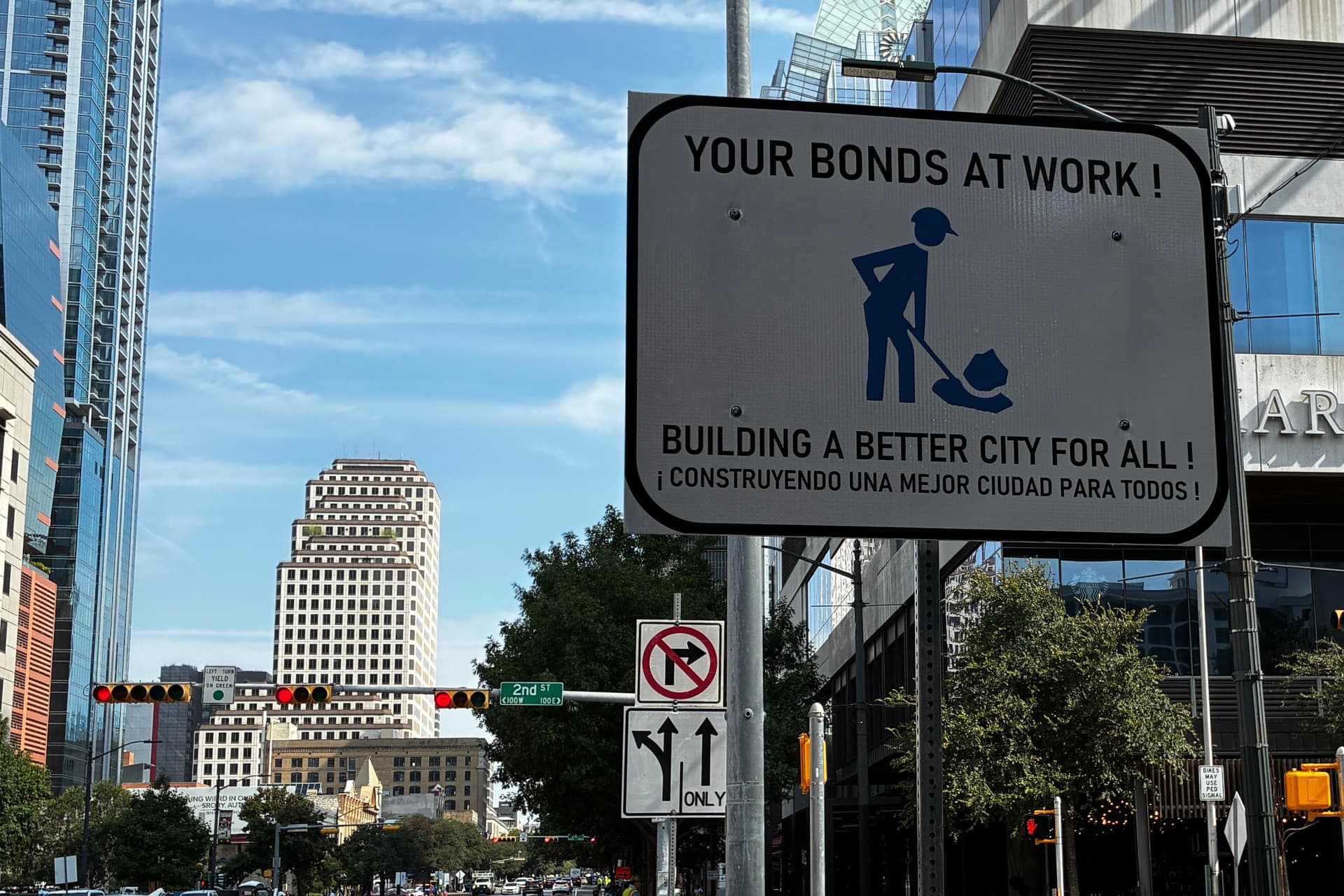
City leaders advanced two bond propositions totaling nearly $300 million for the November election. (Ben Thompson/Community Impact)
Editor's note: This story was updated to correct the projected homeowner tax impact from the bonds.
A total of $295 million in bond propositions for Austin parks and libraries will be on the ballot this November. The election stems from some residents' and city officials' requests to fund a new round of public investments, but conflicts with city policies and staff's advice to wait at least two years until another bond.
The big picture
Two bond measures will be placed on the city ballot this fall:
The $260 million Proposition A for a slate of Austin Parks and Recreation initiatives
The $35 million Proposition B for two Austin Public Library branches
If approved, the propositions would add a projected $41.60 to the typical homeowner's annual property tax bill by 2033 once all new debt is issued. Every $100 million of debt is now estimated to carry an annual tax impact of just over $14; the city anticipates issuing about $49 million annually from the new bonds over six years, resulting in an accumulating impact on tax bills over that period.
More than two dozen proposed parks updates would build, equip and improve facilities such as pools, playgrounds, trails and recreation centers. Funds would also go toward acquiring future park property. A list of prioritized projects can be viewed in the city's election ordinance, and itemized project costs weren't available as of press time.
Library funding would be split between two projects, with $20 million to improve and expand the current Hampton Branch at Oak Hill in Southwest Austin and $15 million to develop a future branch for Colony Park in East Austin.
The propositions are the result of the bond creation process initiated by City Council in 2024 that identified nearly $3.9 billion worth of capital needs across Austin. A resident-led task force spent months hearing public feedback before forwarding separate $766.53 million and $436 million bond proposals this year, which council members considered before seeking a program of $390 million or less.
Those outlines were used to develop the final package. The propositions don't include some funding areas from the recent recommendations like affordable housing, drainage infrastructure or homeless shelter, and were adjusted to add priority projects for some council members' districts.
The context
The 2026 bonds will be the first considered by Austin voters since they approved $350 million for affordable housing in 2022. The last comprehensive bond program covering a range of departments' needs was held in 2018.
City finance officials have promoted returning to a regular cycle of comprehensive bond elections only every six years, without subject-specific measures in interim years that have become more common in Austin. They've also told city officials that 2026 could be too soon for the city's next comprehensive bond program under financial policies related to Austin's debt capacity.
The city now has almost $2.4 billion in outstanding debt obligations, while hundreds of millions of dollars remain unspent from past bonds. Finance staff said resident tax impacts for debt service are already expected to continue rising through the early 2030s, a trend the new bond packages would extend.
“That’s the fundamental reason why staff has pretty much held consistent with our recommendation," City Manager T.C. Broadnax told council. "It’s not about the projects, which they’re all worthy ... there are billions of dollars worth of need out there. The issue is really the cost curve juxtaposed to even the operating side that we’re trying to balance when it comes to the overall tax impact.”
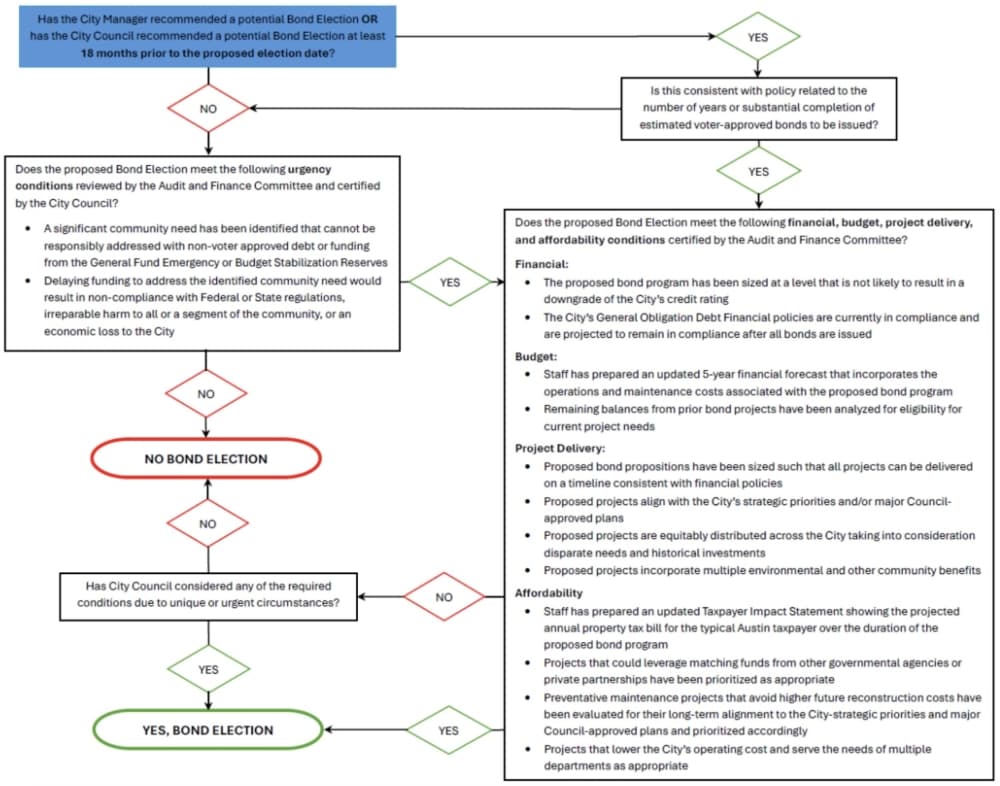
The choice to call a 2026 election also doesn't align with City Council's newly adopted "decision tree" to inform bond election planning.
City Council adopted a formal framework for calling bond elections in early 2026. (Courtesy city of Austin)
On the ballot
The two bond propositions will appear on the ballot alongside eight proposed amendments to Austin's city charter. Five council districts will also be electing their representatives to City Hall this fall, four of which feature incumbent candidates seeking to hold their seats.
Those in favor
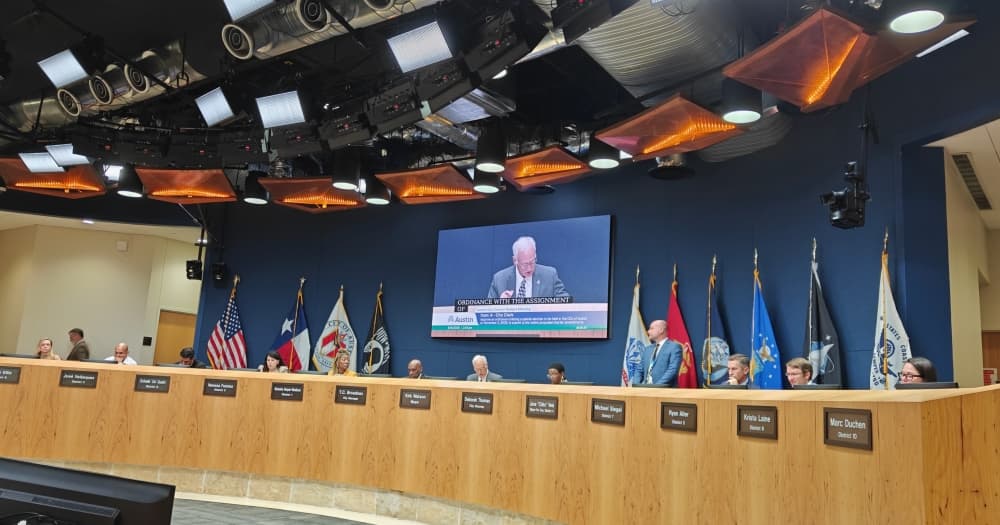
A council majority moved the bond election forward in an 8-3 vote Aug. 4. Most said citywide park and library upgrades are overdue, and some officials also highlighted the inclusion of long-awaited projects in their districts as reasons for their support.
“We don’t have a lot of city buildings in Southwest Austin, and so the only way that we’re really going to get these detailed and prioritized investments is to specifically name where it is that we’re going to invest those dollars," council member Paige Ellis said. "I’m firmly committed to making sure that the dollars that are going into the city budget ... are reinvested in the parts of town that don’t always get that level of investment."
Council member Natasha Harper-Madison agreed, saying Proposition B commits needed funds to her district.
“For far too long, Colony Park and Far East Austin communities have lacked real essential public assets," she said.
Council member Mike Siegel said the propositions effectively focus on the city's top needs, like adding more open space to serve a growing population, with fair divisions across council districts. And after previously standing against a new bond, council member Krista Laine said she strongly supports the revised parks proposition due to funding for projects in her district.
“I don’t think we’ve seen a bond package that would deliver this substantially to the far north and northwestern corner of Austin since most of the area was annexed," she said.
Regardless of the election outcome, Mayor Pro Tem Chito Vela is seeking $32 million in certificates of obligation—non-voter-approved debt—to fund a new round of safety and active mobility projects as past transportation mobility bond dollars expire. He also said the city must keep up with its existing needs.
“The longer we go without investing in our facilities, the greater the operating expenses. And to me, that’s not good governance. We’ve got to invest in our facilities to make sure that we have newer, well-run, efficient facilities, and not aging facilities that require lots of repairs and maintenance," he said.
Local parks advocacy nonprofits came out in favor of Proposition A after council's August vote. Zilker 351's co-founder said the proposal is a milestone for city parks and Alyssa Vargas, advocacy manager for the Austin Parks Foundation, said the funds would help the organization support investments across the parks system.
"This decision advances the opportunity for every community in Austin to see direct investment in the green spaces they depend on. This package is about keeping pools operational and delivering park improvements in every district, not just our most popular spaces," Vargas said in a statement.
Those opposed
Mayor Kirk Watson and council members José Velásquez and Marc Duchen said new bonds this year are financially irresponsible and would overburden taxpayers who'll already see higher city costs next year.
Watson sharply criticized council's decision as undisciplined and based around district-level earmarks, rather than following established policies and the two-year bond development process.
“Instead of asking what the process produced, we’ve begun asking what projects can be added to assemble enough votes on council. Instead of listening to the recommendations of the professional staff about the best financial approaches, we’ve started asking staff to create ways to satisfy specific districts. Instead of evaluating proposals through established criteria, we’re hearing new arguments appear after the process has largely concluded," he said.
The city is already lagging on project delivery and fatiguing voters with regular elections, Duchen said, and the final propositions don't reflect broader community desires.
“I’m also concerned that the conversation has shifted to, how can we cobble together the bare minimum of votes that we need to pass a bond by focusing on certain district priorities, rather than keeping a focus on the big picture and our energy on consideration for what’s best for the entire city and future Austinites," he said.
While noting a "history of disinvestment" in East Austin, Velásquez said he didn't support the bonds given negative impacts on his constituents.
“This is about more than just financial metrics; people are struggling," he said. "I find it difficult to ask voters for more while we’re fighting tooth and nail within our current budget to preserve social services—the same social services that these families rely on every day."