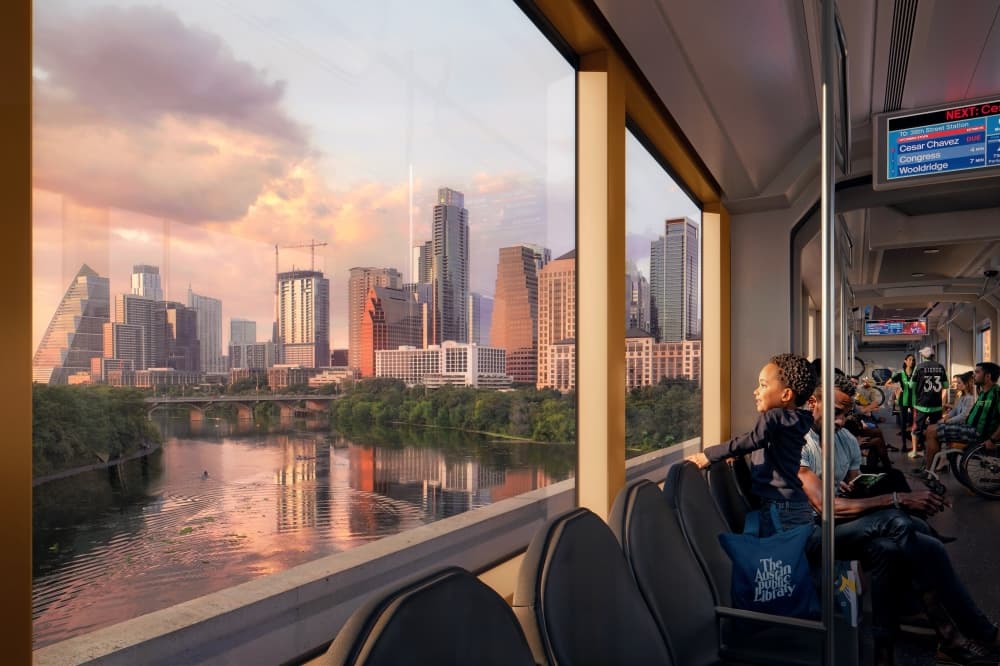
The Austin Light Rail system includes a bridge across Lady Bird Lake. (Artist conceptual visualization courtesy Austin Transit Partnership)
Local transportation officials are making progress on the Austin Light Rail project, after the Austin Transit Partnership board advanced a $60 million design-build contract for the first phase of the project Feb. 18.
The initial agreement with Austin Rail Constructors, or ARC—a joint venture between Stacy Witbeck and Sundt Construction—represents one piece of the several billions of dollars of contracts anticipated for Austin Light Rail. The transit initiative is now on track to begin construction in 2027, ATP CEO Greg Canally said.
"We said 2026 was going to be a big year for us, hitting major milestones, and this is the second major milestone we've hit since January," he said in a Feb. 19 interview. "We're looking forward to advancing the design work and even doing some pre-construction activities out in the field, doing some testing and utility testing work. So I think people are going to see boots on the ground here in the upcoming months."
The update
ARC will help shape and build "nearly every aspect" of Austin Light Rail, including the transitway, tracks, systems, stations, bridges, traffic signals, utilities, drainage structures and streetscape improvements, according to ATP. The construction venture was one of three finalists shortlisted by the transit partnership last year after it opened bidding for the rail project's development. Funding is included in ATP's fiscal year 2025-26 budget.
Members of the ARC team have previously worked locally on McKalla Station and Austin-Bergstrom International Airport, and on other major rail projects in Arizona, Hawaii and Utah. Canally cited that history with large infrastructure initiatives as one of the reasons ARC was chosen for Austin's rail project.
"What we found with this joint venture ... is not only a lot of experience in doing this type of work, this complex infrastructure work, but also commitment to using local businesses. ... That was a unique approach that they came up with," he said. "I think they just got the sense of a system that we want to work for Austin, that is kind of well-designed and well-thought, and becomes part of our urban fabric."
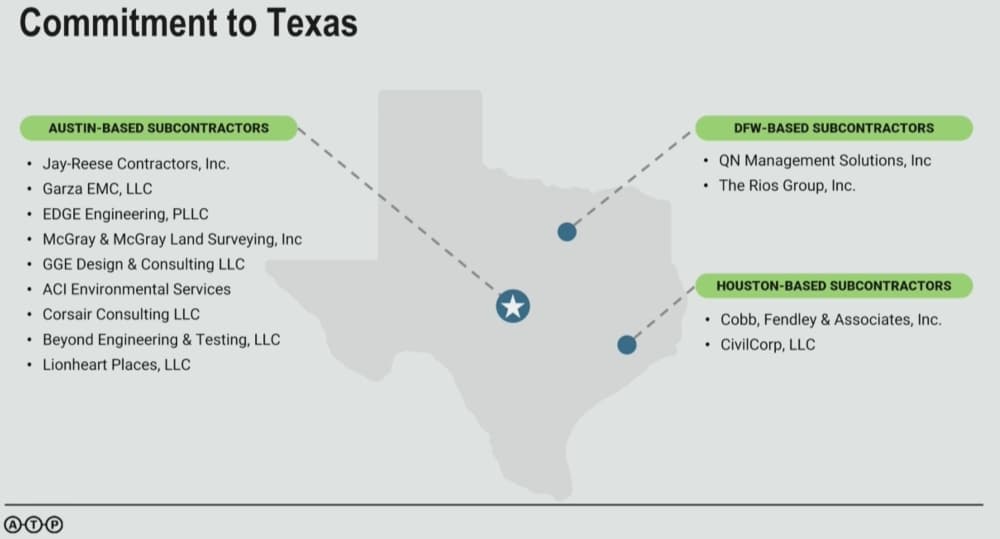
Transit partnership officials also said they've hoped to see the rail line build out with local jobs and a focus on in-state support. Several Texas-based subcontractors are represented on the ARC team.
"We told the public that we wanted to make sure that not only do we build useful things and help public transit, but also that we included local businesses, ... that local bond dollars should create local jobs as well," ATP board member Jeffrey Travillion said. "I think that [ATP] have set the groundwork in a very effective way."
Transit planners said they've aimed for Texas-based businesses to support Austin Light Rail's Phase One construction. (Courtesy Austin Transit Partnership)
When local officials authorize major contracts, that action can often be followed by extended negotiations between government staff and the contracted company. Canally said this month's update was unique in that the ATP-ARC contract was already finalized based on industry discussions throughout last year's solicitation process, and that preconstruction activity will begin almost immediately.
"We were very transparent about our contract and we learned things that would work, things that wouldn't work," he said. "We were able to come to a place where only a few days after a board award here, on Monday, we're going to have members of this new team, our new partner, here in the office. Butts in the seats, pencils down, working with us to start advancing this design."
The board also authorized $1 million for relocation agreements with private utility companies Feb. 18. That planning for potential utility relocations along the rail project's alignment is "another strong signal" that ATP is nearing construction, Canally said.
About the project
The 10-mile Austin Light Rail is one part of the overall Project Connect transit program approved by voters in 2020. Federal grants are anticipated to support about half of its $7.1 billion cost, with other funding sources including the increased city taxes authorized in the 2020 election, Project Connect revenues and bonds, and federal infrastructure loans.
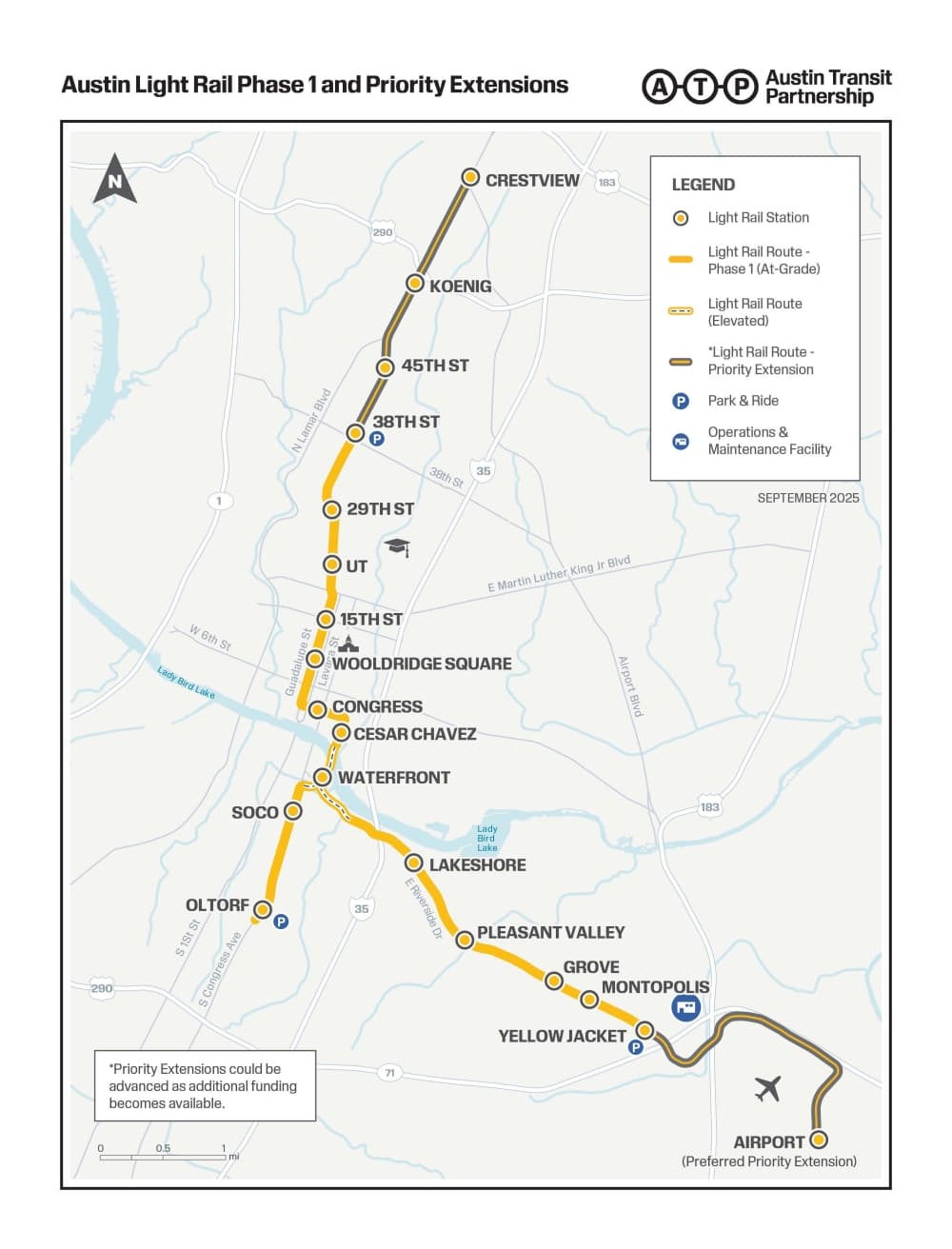
The rail system will initially feature 15 stations along the alignment and all-electric trains running every 5-10 minutes throughout most of the day, according to ATP. Future extensions could see rail lines reach east to the airport and north to the Crestview area.
The first phase of Austin's light rail project will extend north to 38th Street, south down Congress Avenue and east along Riverside Drive. Future extensions east to the airport and north to the Crestview neighborhood are planned. (Courtesy Austin Transit Partnership)
"We got that [FTA] rating, a medium-high rating, which was the highest rating that was given out. We've got the [National Environmental Policy Act, or NEPA] process and the record of decision done in less than 2 years," Canally said. "I think what it reflects is that we are very much in sync with this administration about delivering infrastructure in a streamlined way."
Looking ahead
The ARC contract is only for the first portion, or Phase 1A, of preconstruction work for the light rail system. The ATP board plans to authorize Phase 1B activities to finish the remainder of final design by late spring or early summer, followed by multiple contracts for construction work beginning in 2027.
"As we get ready for the construction packages themselves, they'll be kind of chunked up in different packages. And it’s a new, unique strategy that we think is a more cost-effective way and it's a more rational way to approach a major infrastructure project," Canally said.
Both Canally and Lindsay Wood, executive vice president of engineering and construction at ATP, said the public and the partnership's board can expect further progress updates as planning, design and other development work continues.
"This is not the last time you will hear from us; we will be giving regular updates and building in your input along the way," Wood said. "We're extremely excited that this process, through the procurement, has set us up to be ready with our new partners to hit the ground running."