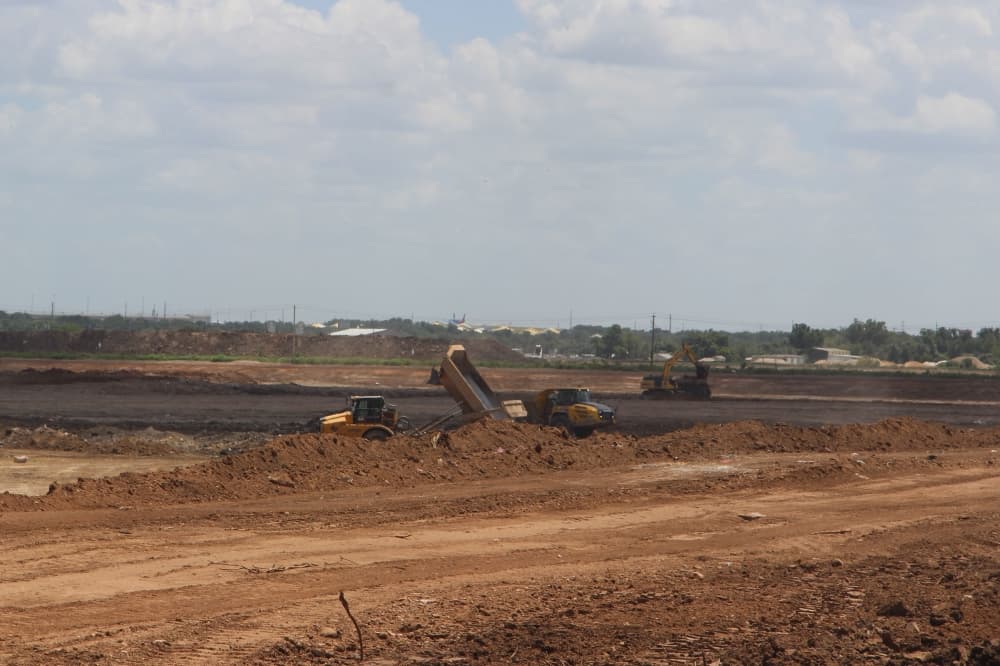
A 300-acre Amazon robotics manufacturing project would be the first new addition in the Dog's Head in East Austin. (Ben Thompson/Community Impact)
Austin officials are reviewing the potential impacts of decades of proposed development in the Dog's Head before their upcoming vote on a tax-backed financing plan to support its build-out. City leaders also revealed an Amazon robotics manufacturing project is lined up as the Dog's Head's anchor industrial tenant.
What you need to know
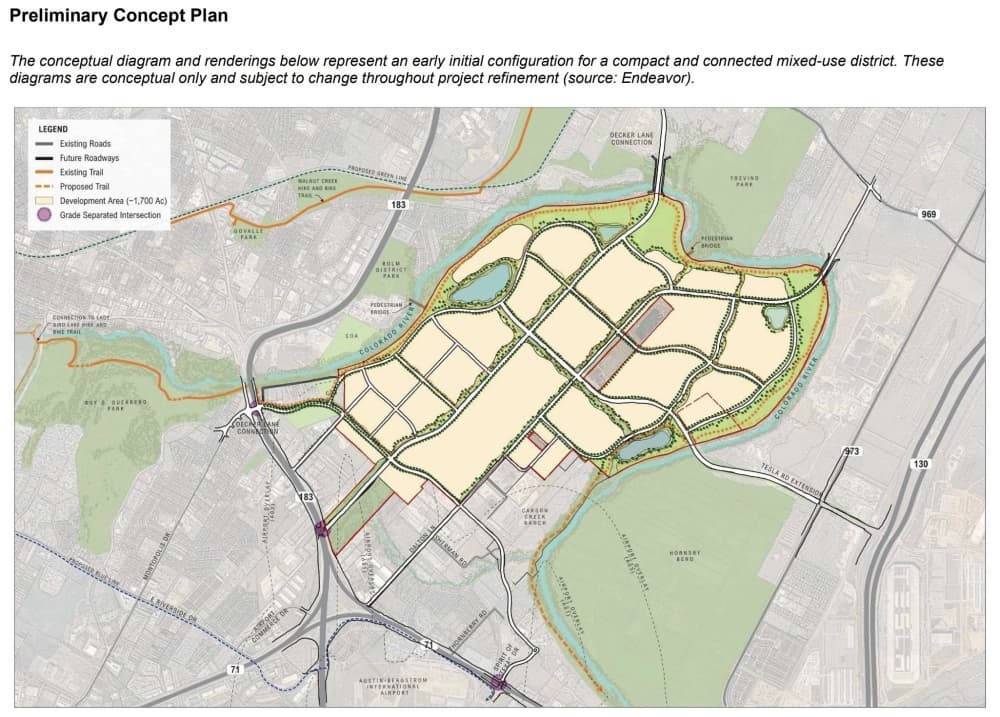
The Dog's Head covers more than 2,600 acres along the Colorado River, and was quickly annexed into city limits alongside City Council's approval of a long-term development agreement in May.
Endeavor Real Estate Group is overseeing planning for the district, which could draw more than 20,000 new residents and add millions of square feet of commercial, industrial and hospitality space by the 2060s. As the area is largely undeveloped today, additions like roads, utility lines and flood controls would be needed to facilitate the new mixed-use community along the Colorado.
Through the summer, Austin and Travis County leaders have considered the creation of a Dog's Head tax increment reinvestment zone, or TIRZ, to reimburse a share of those significant infrastructure needs. County commissioners declined to join the TIRZ plan in mid-July, citing the need for more details and assurances from Endeavor, while City Council members are scheduled to vote on the financing plan July 23.
Endeavor representatives have also committed to build miles of riverside trail, add hundreds of acres of new open space and reserve a share of new housing in the Dog's Head at affordable levels.
Conservative estimates by city finance staff show the Dog's Head adding nearly $27 billion in property value over the 35-year term of the TIRZ, generating more than $2 billion in taxes for Austin and Travis County in that time. Hundreds of millions of those dollars would be used to reimburse planned infrastructure costs like a new street grid and bridges across the Colorado.
Austin Financial Services Director Kim Olivares framed the TIRZ as a major benefit that'd raise new public revenue, attract major development and employers, create new jobs, and address local food and healthcare access issues.
“There is a lot of nothing that would occur without this, but there’s a whole lot of opportunities that will take place," she said. "This is absolutely a good deal for the city.”
If the county doesn't join a TIRZ alongside the city, Olivares said development and infrastructure upgrades may be greatly reduced in scope. And if a TIRZ isn't established, the Dog's Head would likely be deannexed and placed into unincorporated Travis County, removing closer public oversight and any city involvement. In that case, Olivares said Austin would have "zero role, zero revenues."
The breakdown
During a July 21 council work session, Assistant City Manager Eric Johnson announced Amazon as the prospective first major arrival in the Dog's Head. The company is planning a 300-acre advanced robotics manufacturing facility, previously known only as Project Toaster.
The robotics center would add hundreds of jobs paying an average of $75,000-$150,000, Johnson said, and could open by late 2027. A site is already being readied for new construction.
Holly Sullivan, Amazon's vice president for worldwide economic development, confirmed the company is considering the Dog's Head for its manufacturing project.
"Austin and Texas are great locations to do business, which is evidenced by the over 86,000 jobs and $100 billion in investments we’ve made across the Lone Star state," Sullivan said in a statement. "If we move forward on with the project, we plan to create approximately 300-500 jobs and we look forward to working with the community, the County, and Council on this innovative project."
Overall, the city projects around 25,000 people could live around the Dog's Head once it's fully built out. That growth would come with rising public service needs and related resources: an estimated 50 more police officers, 16 firefighters and 12 emergency medical services personnel. A new EMS and fire station, library, parkland and other community spaces would also be needed, coming with tens of millions of dollars of new costs.
Other updates provided by staff and council members in July included:
Endeavor has committed to funding a community needs assessment tied to development-related displacement and gentrification risks.
Endeavor is working with Capital Metro and the Austin Transit Partnership on potential future transit extensions into the Dog's Head.
Reclaimed water lines now in place near the Dog's Head would be extended throughout the area, and Austin Water is discussing the potential use of reclaimed water at Amazon's robotics site.
Council member José Velásquez, whose District 3 borders the Dog's Head, also said he wants to see public displacement monitoring, clear affordable housing plans, guarantees related to flood risks as new development takes place, and public outreach throughout decades of disruption from construction activities in the area.
“I support creating homes, jobs, trails and river access. I think our job on this dais is to ensure that this works for everybody," he said.
“To annex the size and scale of land that the council approved is a monumental feat in the world of American cities," he said. "If this were to not happen ... in the world of economic development I think the message across the country and the world is, ‘City deannexes 2,700 acres and stalls in its economic development strategy.’”
Elected officials have expressed varying levels of support for the proposal's economic and growth prospects, alongside skepticism about its impacts on residents and the environment. Council member Mike Siegel, one of several city leaders who pressed for environmental and housing benefits in the Dog's Head, said it represents a financial opportunity for Austin that must still come with positive outcomes.
“I want this deal to be a good deal. At the same time, I don’t want to kill the deal," he said in a July interview. "To have a safety net locally, to have the quality of programs and services locally that so many people depend upon, we have to have new revenue sources. So this is an opportunity to strengthen the city’s finances, so I take that opportunity seriously, but I also want to make sure the city’s getting the best deal possible.”
Thousands of residences and millions of square feet of industrial, commercial and hotel space are envisioned throughout the Dog's Head. (Courtesy city of Austin)
Community members including east-side residents have been largely opposed to the plans, saying the process has been rushed without public review and could result in harms from resident displacement to ecological damage.