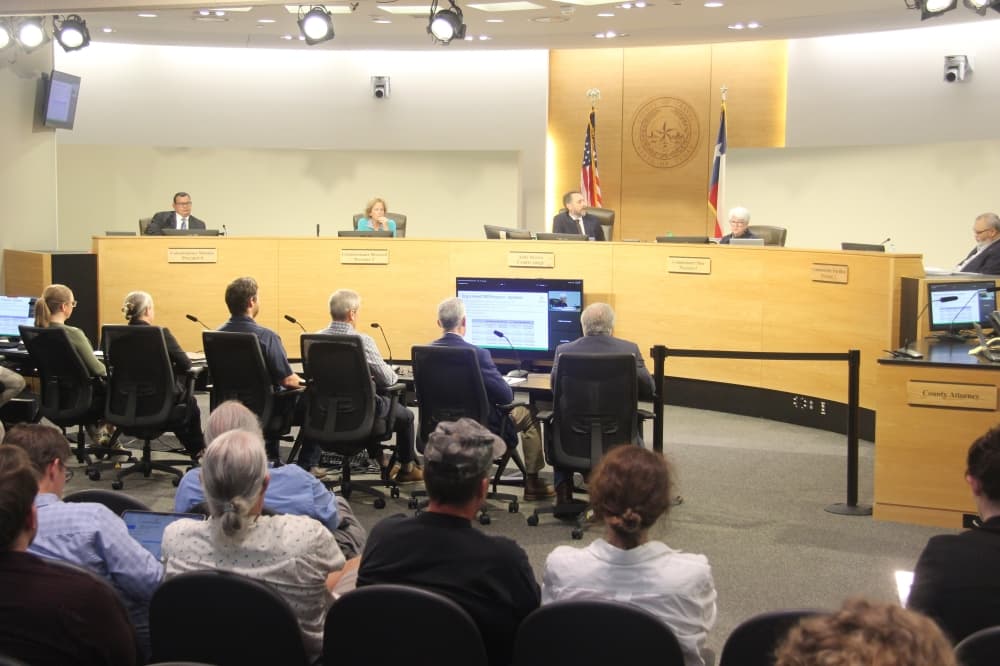
Travis County commissioners are considering a proposed tax increment financing plan for the Dog's Head. (Ben Thompson/Community Impact)
Travis County leaders declined to take action on a financing plan in the Dog's Head that could use more than a half billion dollars of county tax revenue to support public infrastructure in the 4-square-mile area.
County Judge Andy Brown said officials need more time, information and assurances around plans there before a final vote. Austin City Council is now scheduled to consider the tax financing proposal July 23.
“It’s a very exciting possibility, and we would really like to support a project that reflects our values," he said. "Something that has guarantees for affordability, for community input, environmental protections, robust economic growth, great transportation access and more. And something that’s going to make Austin and Travis County residents, businesses, developers, migratory birds, proud."
The big picture
The Dog's Head sits in eastern Travis County along the Colorado River. Austin leaders annexed the land into city limits and authorized a 45-year development agreement for the district in the spring.
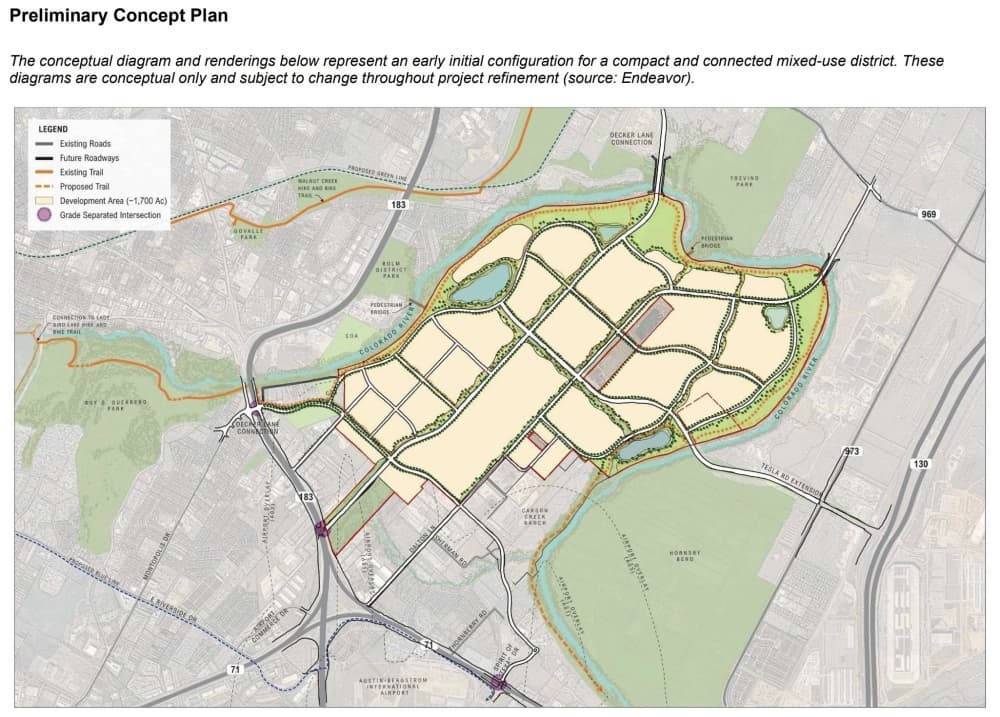
Endeavor Real Estate Group anticipates building out the Dog's Head over decades. City and county officials are now weighing long-term tax increment financing to support the extensive new roadways, utility lines and drainage features needed alongside that growth. Austin's preliminary Dog's Head tax increment reinvestment zone, or TIRZ, plan outlines construction including:
6,195 homes
6,200 apartments
4 million square feet of industrial space
2.5 million square feet of retail space
1.5 million square feet of offices
1 million square feet of hotels
Future development throughout the Dog's Head hasn't been fully detailed, although hundreds of acres are being prepared for its first major industrial tenant. Initial grading work has continued for "Project Toaster," which Endeavor representatives say will be an advanced manufacturing site from a major company, while the city works out a new mobility network for the area.
After that first industrial project is added, infrastructure would continue to be placed around the more than 2,600-acre district while future tenants and new construction are planned.
Thousands of residences and millions of square feet of industrial, commercial and hotel space are envisioned throughout the Dog's Head. (Courtesy city of Austin)
By the numbers
If a TIRZ is created, a portion of tax revenue generated in the Dog's Head would be set aside for public infrastructure. Projects would all be privately funded upfront, with some public TIRZ revenue covering roughly 30% of those final costs.
Dog's Head's properties are appraised at just over $17 million today and projected to reach nearly $27 billion by the early 2060s, meaning billions of dollars of new tax revenue could be generated by both Austin and Travis County in that period. An estimated $5.63 billion of improvements like roads and sidewalks, water and electric lines is anticipated.
The TIRZ outline presented to Travis County leaders this summer would set aside 50% of county property tax revenue from 2027-61, projected at $520.2 million, for infrastructure reimbursements. Larger shares of Austin's property and sales tax collections—75% for the first 20 years and 66% for the next 15 years—would total a projected $1.18 billion for contributions to the TIRZ.
Aside from those totals for public projects, the city and county combined would also take in a combined $1.09 billion in tax revenue for their general operations.
Put in perspective
Austin Financial Services Director Kim Olivares told county commissioners that a TIRZ is necessary for the large-scale plans, which could shift to focus mainly on lower-impact housing without public financing. Residential construction without a broader mix of uses or larger projects could also cost Austin more in the long run due to added requirements like public safety, she said, while the Dog's Head may "struggle to develop."
“This TIRZ creates not only a catalytic development to serve this region, it also creates a better means for the city and the county to provide services to our residents," Olivares said.
County officials said a final plan must include more details and protections than were available July 14. Commissioner Brigid Shea said it'll be "critical" to include stronger flooding protections and equity around the funding of major projects, while commissioner George Morales requested more information about potential displacement risks for residents within several miles of the Dog's Head.
“An area should not have to gentrify in order to get investment. I want to make sure that we are protecting the neighbors that are there, and giving teachers and giving public employees the opportunity to purchase homes as well," commissioner Jeff Travillion said.
What they're saying
Austin and Travis County residents, including several living in or near the Dog's Head, have largely turned out to challenge recent approvals and the overall approach to Dog's Head planning. Opposition has included Austin's Environmental Commission, which recommended a slate of guardrails and postponed TIRZ votes, while some City Council members are also seeking added benefits as construction takes place.
Public testimony at the latest county review was almost fully against the proposed TIRZ and Endeavor's plans in the Dog's Head. Residents continued to criticize the rapid pace of local governments' reviews of the plans, potential ecological impacts of large-scale construction and industrial projects along the Colorado, and TIRZ financing viewed as a handout for wealthy developers and corporations.