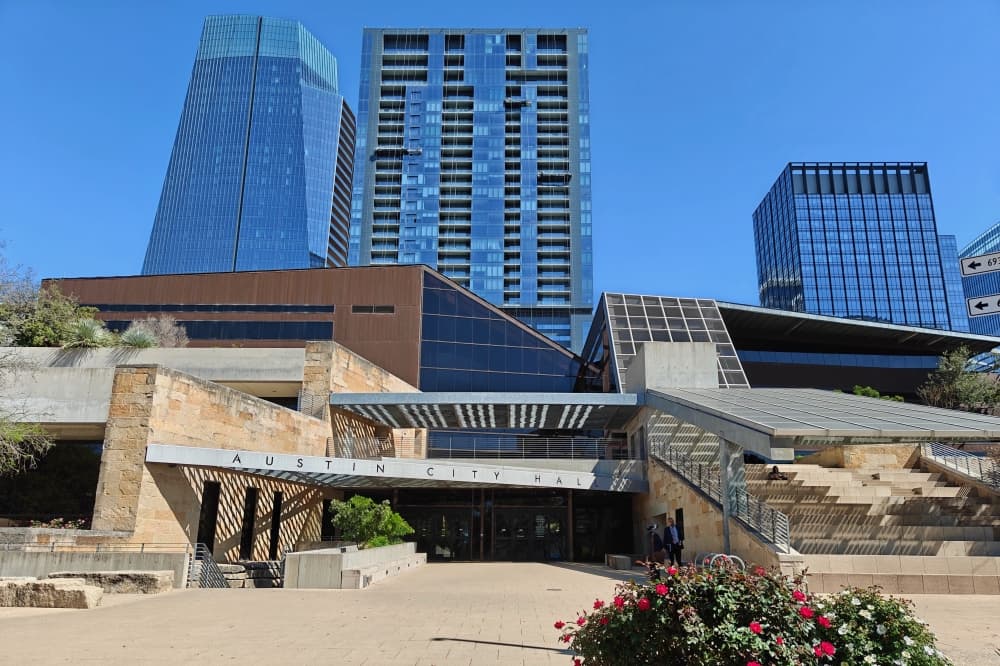
City leaders are working to lay out a new economic development roadmap for Austin. (Ben Thompson/Community Impact)
Austin leaders are working to lay out an economic roadmap to continue developing the local economy, draw major projects to the area and expand the city's global presence amid a recalibration of market conditions.
"We need to reintroduce Austin as a leader in balanced economic development. We need to let the world know Austin is open for business and we are ready to do some work," said Assistant City Manager Eric Johnson, who oversees city economic and development initiatives.
The setup
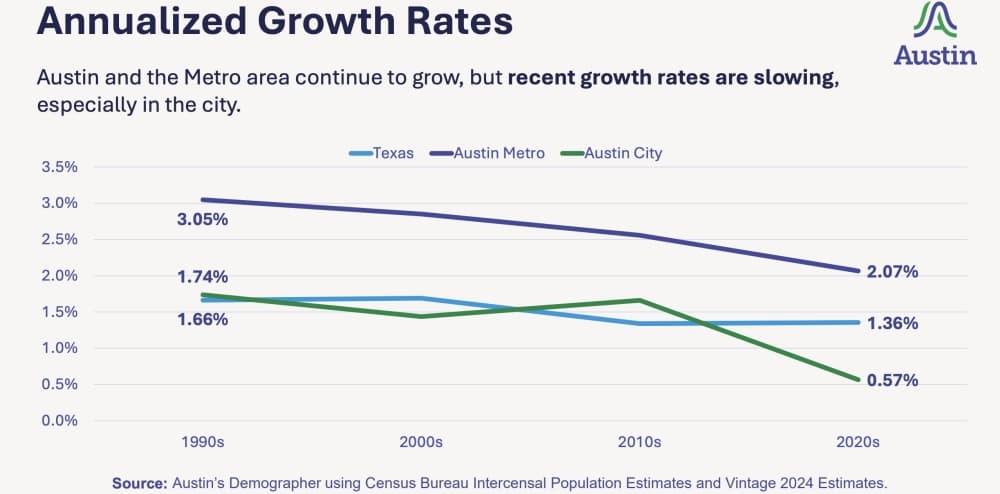
Austin experienced a population and economy boom through the 2010s and COVID-19 pandemic, which Johnson referred to as a "hyper-growth" period. Although the city maintains a diverse economy that's drawing people and investment, planners are now looking farther ahead as that growth slows.
Johnson highlighted the city's ongoing infrastructure makeover, or "reurbanization," and stiff competition from surrounding Central Texas communities as among the reasons for current shifts. He added that the city likely hasn't previously faced a similar collection of issues at once, including:
An "affordability wall," or rising cost of living relative to similar national destinations than in years past
Cooling in the local technology sector, including layoffs and stalled hiring
A "suburban siphon" pulling residents from Austin proper to surrounding communities
Strained infrastructure and fatigue with constant construction
Austin remains a key driver for Central Texas overall, but Johnson noted the city's property and sales tax trends are stalling in comparison to suburbs. There, tax trends are stabilizing or outperforming expectations as more residents consider living and shopping outside the urban core.
“The foundation is strong, but we are actually heading into an environment that is in flux. ... It’s an environment of slow growth and increased suburban competition," he said. "We’re still one of the leading creative cities in the country, still working to drive investment, but we have to be intentional about what we do."
New residents continue to arrive in the Austin area but at a slower rate than recent years. (Courtesy city of Austin)
The approach
With those changes in mind, Johnson said the city is moving to finalize its playbook to keep Austin competitive into the future. The process is also meant to take advantage of a projected recovery in national development activity as more new projects are expected to get underway through the late 2020s.
A new economic development roadmap is aimed at spurring growth and job creation, promoting the city as a destination for both large and local business, improving city permitting and regulations, and launching innovative economic programs to test new strategies.
"We must move from a passive ‘wait-and-see, we’re Austin’ kind of approach to a more aggressive stance toward economic development that basically strengthens our tax base and strengthens our competitive advantage," Johnson said. "We can no longer grow by accident; we’re going to have to grow by design.”
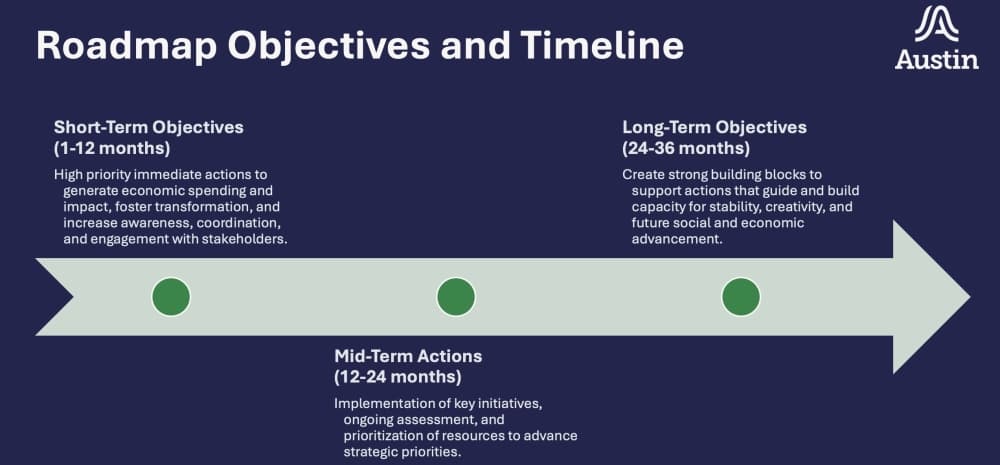
The plan has a three-year timeline involving both internal planning, and outreach to residents and the business community. A final report on the initiative is expected later this spring.
Austin is development a new economic development roadmap. (Courtesy city of Austin)
The impact
The new blueprint is coming together after past major economic deals have generated hundreds of millions of dollars in local benefits and significant workforce gains, according to reporting on a sample of Austin's agreements under Texas' Chapter 380 business development program.
The city provided about $160.5 million in incentives across six active or completed Chapter 380 projects, including deals with Apple, Samsung and Visa. To date, that's resulted in:
At least $5.1 billion of reported capital investment
Nearly 9,000 new jobs created and 4,671 jobs retained
At least $341.5 million in city property tax revenue and $30.72 million sales tax revenue
$614,375 contributed to the city's affordable housing fund
Anthony Segura, Austin Economic Development deputy director, said the city should continue using such incentives based on those recent outcomes—as long as they carry stronger underwriting, community benefit benchmarks and evaluation.
"Overall, the Chapter 380 portfolio demonstrates that Austin can realize meaningful fiscal and economic returns when projects perform, while also reinforcing the need for disciplined program design, consistent oversight, and modernized policy standards," Segura wrote in a March memo.
More internal reporting on Austin's use of Chapter 380 agreements and further review of the city's incentive policies is expected as the new economic roadmap comes together. The city's Chapter 380 compliance reporting is available online.
Study shows less rainfall is reaching Lakes Travis and Buchanan