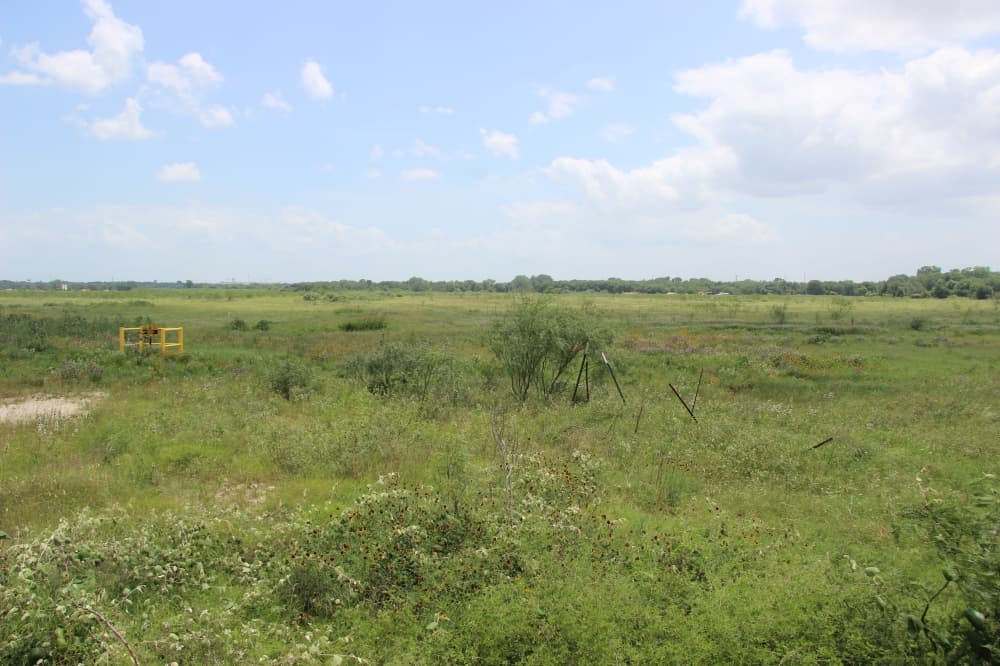
City Council advanced the annexation of the 2,614-acre Dog's Head on the Colorado River in East Austin on May 21. Officials also voted for a 45-year development agreement with Dogs Head Land JV Ltd., an entity registered to Endeavor Real Estate Group that owns land across the area.
Assistant City Manager Eric Johnson called the "mega-site" project a major economic opportunity for Austin to pursue. The city would partially support development with a Dog's Head tax increment reinvestment zone, or TIRZ, a financing tool to reserve some tax collections there for local public improvements.
The decades-long agreement outlines standards for new construction granting wide-ranging authority to the Dog's Head developer, with several deviations from typical city requirements. And it sets public benefits like 20% affordable housing, the preservation of 260-plus acres of parkland and a more than 6-mile trail near the river.
Mayor Kirk Watson said Austin's ability to add the amount of new land, and future revenue, in the Dog's Head represents a rare situation for a large city.
“My guess is none of us are going to consider this to be a perfect development," he said. "But it creates an opportunity—again, a unique one—where there’s no question it will be better than what it could be and probably would be if it’s on the outside of our jurisdiction, if for no other reason than we wouldn’t get any of the tax base.”
The specifics
Future development around the Dog's Head could feature a mix of housing, retail spaces, offices, entertainment venues and more. Dozens of possible uses would be permitted under the city deal. Endeavor Managing Principal Andy Pastor told council the mixed-use project on a "completely blank canvas" could end up resembling downtown.
"It’s unlike anything we’ve had the opportunity to do," he said.
A Fortune 100 company is expected to be the initial anchor tenant. Attorney and lobbyist Richard Suttle, representing Endeavor, said it plans to bring an advanced manufacturing project to the site. Addressing council and public questioning, he also said it won't be a large-scale data center or tied to the defense industry.
Uses like semiconductor manufacturing and large-load data centers—which officials may be seeking to limit this year—could be allowed. Autonomous car and boat testing, and industrial operations like mining and concrete batching, are permitted.
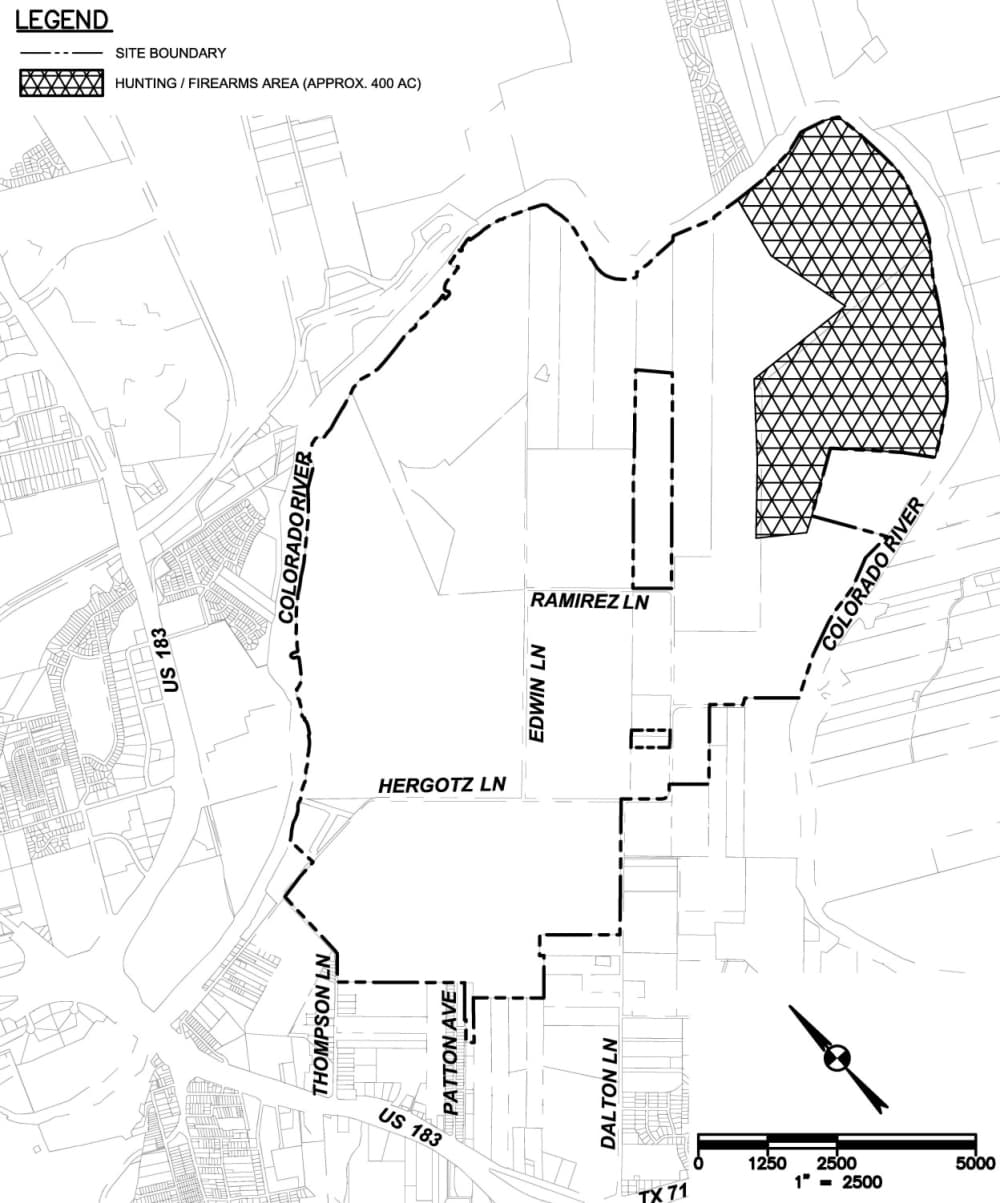
Initially proposed uses like pawn shops and detention facilities were removed from the plan, and an amendment from council member Mike Siegel blocked any "military installations." A riverside portion of the Dog's Head will also be reserved for firearm uses like hunting, limited to pistols, shotguns and bows, only until the public trail is constructed through that area.
A riverside portion of the Dog's Head is being reserved for hunting and firearms uses. (Courtesy city of Austin)
The approach
Property tax funds set aside in the city TIRZ would be used for infrastructure and city services to support the Dog's Head as it grows. A final outline of what projects could be funded, and how much of Austin's property tax collections would be reserved under the zone, will be determined this summer.
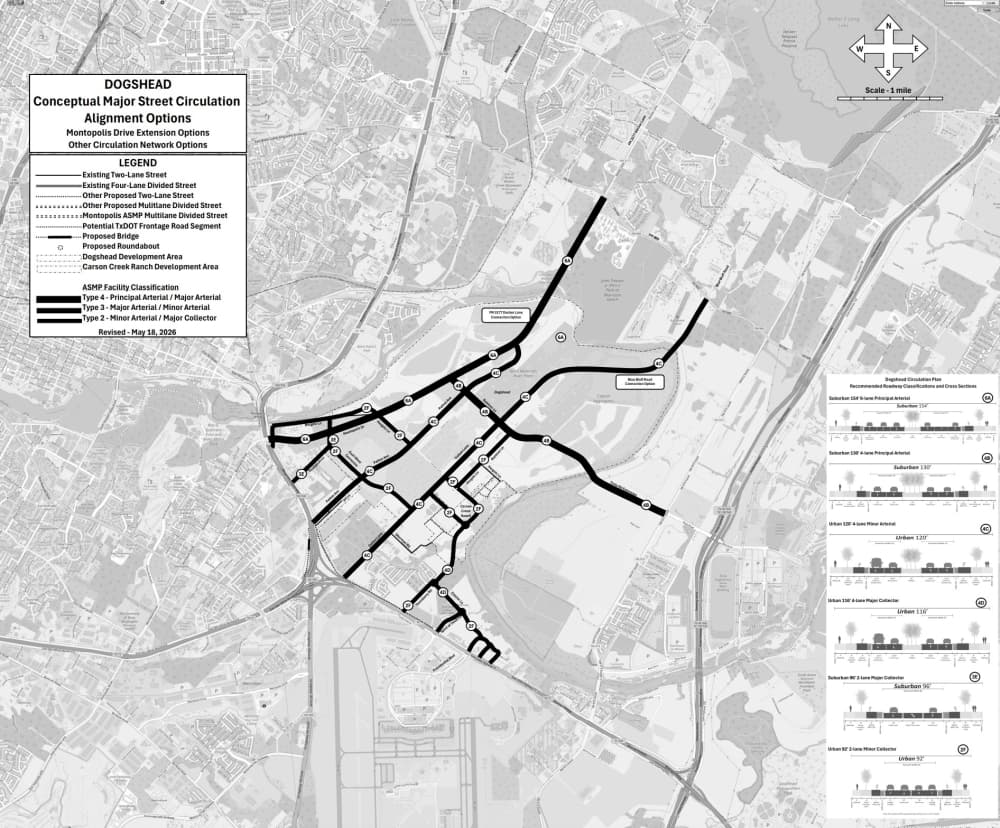
An initial concept plan envisions a new major street grid around the Dog's Head connecting to highways to the south and west. It also features three potential bridges across the Colorado River; crossings could link to FM 969 to the north or Tesla Road near Tesla's Gigafactory to the east.
Officials also noted that by annexing into Austin, the Dog's Head could receive Capital Metro bus service and potentially tie into a future Austin Light Rail extension to the airport.
Development of the Dog's Head would include a new road grid and Colorado River crossings. (Courtesy city of Austin)
The development agreement states authority for TIRZ projects and local regulations will be "determined solely" by the Dog's Head builder. Residents and some council members questioned those provisions, and changes to many city standards included in the plan.
Building height, lot sizing and other design standards won't apply for the Dog's Head. New development also won't be subject to any limitation on impervious cover, or surfaces like buildings and driveways that can't absorb rainfall. Pastor said Endeavor plans for less than 90% impervious cover at full build-out, which he expects would last well beyond the 45-year city agreement.
The property is situated along the Colorado in some Federal Emergency Management Agency floodplain areas, and city staff said it's "undergoing active reclamation" that could shift flood risks as new construction takes place. The developer will submit any floodplain changes to FEMA.
Suttle said development will connect to Austin Water's Purple Pipe program, or reclaimed water system, and feature "innovative" water quality and drainage features. Endeavor is committing to environmental improvements as the site undergoes reclamation.
“When you take a site that’s been mined for 70 years and been dug out, it’s kind of hard to make it any worse. We are going to make it better," he said.
Austin will be required to create internal permitting and long-range planning teams to handle ongoing Dog's Head project review. Final decisions on potential variances from the development agreement would be privately decided by city officials, rather than in public zoning reviews.
Put in perspective
The significant annexation and long-range development deal don't have a similar recent precedent, according to city staff, and came together due to the complex scope of Dog's Head plans.
Most residents testifying to council in May were opposed to significant city commitments in the Dog's Head without more public details available. Many criticized the annexation and development agreement items for appearing on the May 21 council agenda with limited time for community education and outreach.
“You are surrendering council authority for 45 years," Monica Guzmán, policy director for the east side advocacy group Go Austin/Vamos Austin, told officials. "You’re compromising community equity in an area that has experienced years of disinvestment and environmental injustices. And you’re giving developers tax breaks that many people cannot afford to do. They can pay for it.”
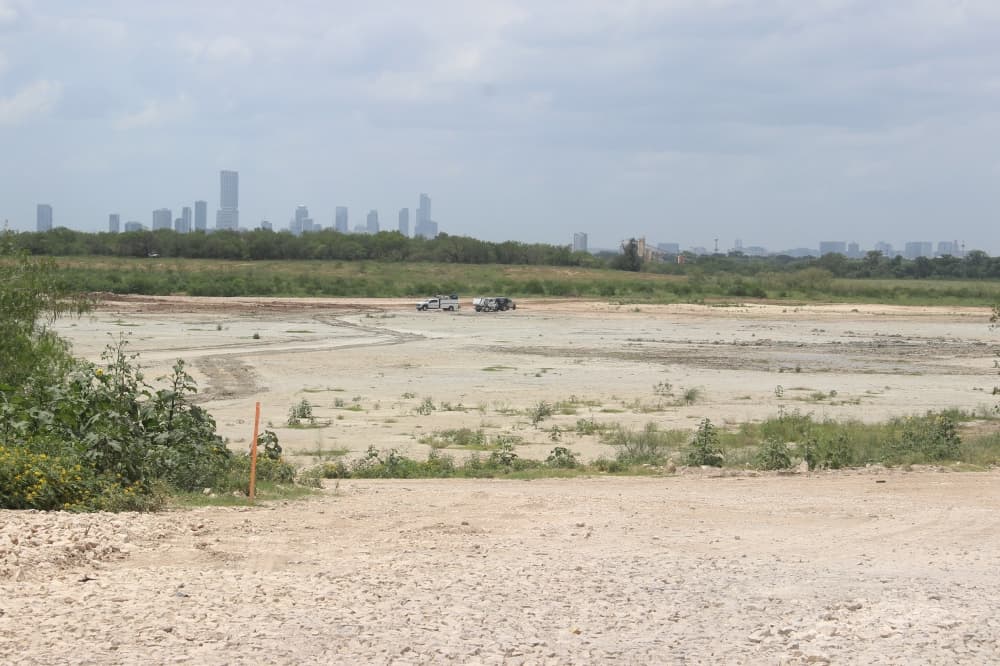
Austin may annex around 4 square miles of largely undeveloped land along the Colorado River just north of the airport. (Ben Thompson/Community Impact)
Some noted the lack of opportunity for city land-use and environmental commissions to review the framework before officials' voted. And residents who live around the Dog's Head also said they weren't notified about the expansive building plans and potential impacts in their area.
“This annexation proposal does not reflect a transparent or inclusive public process," Hergotz Lane resident Kim Vasquez said.
Longtime Dalton Lane resident Dennis Kerwin said he's concerned about a surge of new traffic and the potential for industrial operations near housing, but stated his general support.
“I’m excited to see the Dog’s Head finally get developed to its full potential, and I’m 100% for it," he said.
Also of note
The Dog's Head annexation is anticipated to be effective in early June. That will place the area under city jurisdiction, but it remains unclear which City Council district it will belong to. Less than 10 people are estimated to live in the mostly industrial area today.
Staff previously said more legal and demographic review could be needed before the Dog's Head's council representation is determined. A city spokesperson said the resident-led Independent Citizens Redistricting Commission, which previously set new council boundaries based on the 2020 census, will make that decision.