A new affordable housing report by Root Policy Research shows that housing cost burdens have increased for renters and owners in McKinney. (Courtesy Adobe Stock)
A new report on affordable housing in McKinney shows that housing cost burdens have increased for owners and renters in the city.
The firm was asked to expand their efforts and assess current and future housing needs in McKinney, Housing and Community Development Director Margaret Li said. The report, which is attached to the agenda, includes a current assessment of McKinney’s affordable housing needs and strategy recommendations.
City staff will use key findings and recommendations from the report to form a targeted goal for affordable housing, she said. Staff will develop a three-to-five-year affordable housing strategy for council’s consideration.
“The intention is to develop clear priorities, implementation steps and measurable performance metrics to continue moving the needle forward on affordable housing,” she said.
Diving in deeper
Housing cost burdens have increased for renters and owners between 2015 and 2023, according to Bueno’s presentation. Cost burden is defined as any household that spends more than 30% of its income on housing costs, Bueno said.
“That means there is less income left over for education, health care, transportation, food, child care and other necessities,” she said. “There’s also less disposable income for the household to just spend in the local economy.”
A total of 12,473 renter households and 9,748 owner households were cost burdened in 2023, according to the report.
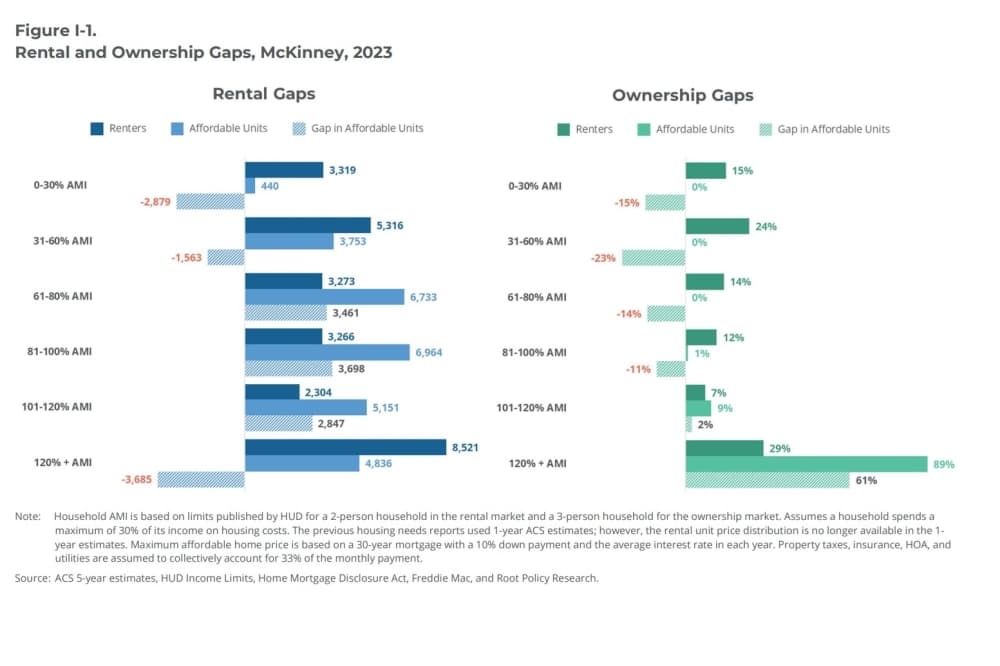
Bueno’s presentation also included a graphic depicting the number of available affordable units compared to the number of renters and owners. For renting households that earn between 0%-60% of the area median income, there is a shortfall of more than 4,400 affordable units, according to the report.
“There’s way more households at those income levels than units available for them,” Bueno said. “And these households are not homeless. They are cost burdened. They’re paying a significant amount of their income in housing costs.”
The graphic also noted an affordability gap for renting households that earn 120% of the area median income; however, they are not cost burdened, she said. Renters in that income category spend less than 30% of their income on housing and are occupying units that could be affordable to lower-income households, Bueno said.
“This is where the market rate production, especially on the multifamily side and starter homeownership product could free up some of those units for those lower-income [households],” she said.
Root Policy Research's report also included a graphic depicting the number of available affordable units compared to the number of renters and owners. (Screenshot courtesy city of McKinney)
Looking ahead
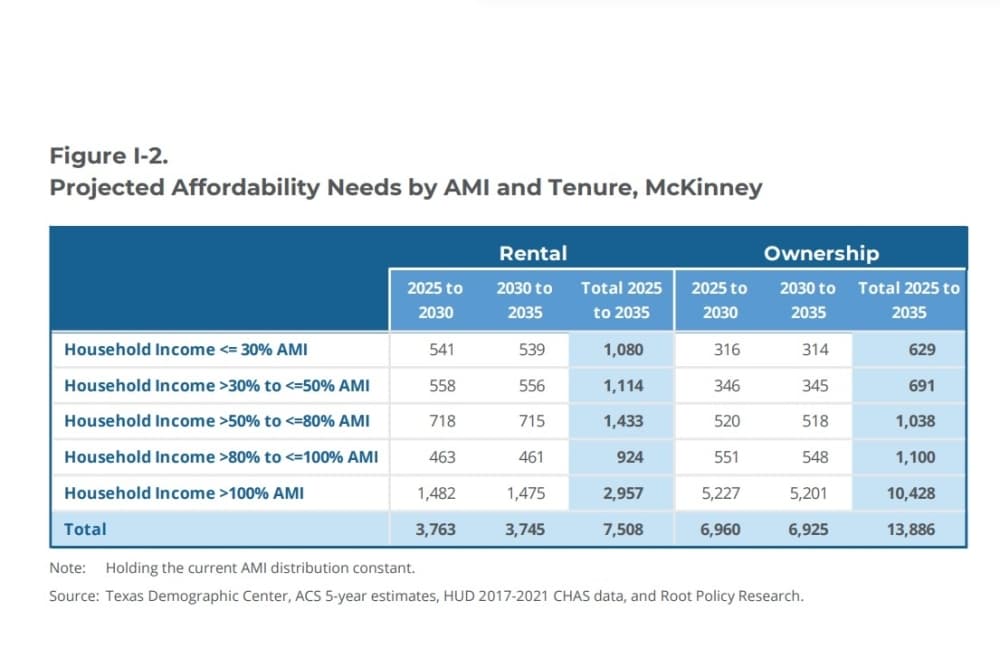
Root Policy Research’s report also included projections for affordable housing needs. The projections indicate more than 7,500 affordable rental units are needed by 2035 for a variety of incomes, according to Bueno’s presentation.
More than 13,800 affordable ownership units are needed by the same year.
Root Policy Research’s report also included projections for affordable housing needs. (Screenshot courtesy city of McKinney)
Projections are based on the Texas Demographic Center’s population forecast and assumes little change to the income distribution, Bueno said.
“That means that, if the city doesn’t want to displace all of your lower-income residents, you’d have to add a significant amount of rental units at the 0-100% AMI," Bueno said.
Next steps
Root Policy’s report included several recommendations for continuing to address affordable housing. The recommendations were separated across three tiers:
Tier 1: high impact and capacity expansion
Tier 2: continuation of core efforts
Tier 3: strategic expansion
Some recommendations may directly result in new affordable housing units, and some are foundational that will support long-term housing production, Li said.
“Recommendations should be considered together as a coordinated strategy rather than stand-alone initiatives,” she said.
32-acre townhome, commercial development proposed for northwest McKinney