Updated 10:35 a.m. Aug. 19
Rep. Richard Peña Raymond, D-Laredo, asked state agencies to compile information about how much water each proposed data center would use and whether those projects would need to purchase water from public systems or could reuse sources such as brackish water, which is a mixture of salt- and freshwater.
Robert Sadlier, deputy director of the Texas Commission on Environmental Quality's water quality division, said that data centers and other facilities are not required to state how much water they need when applying for TCEQ permits. The Public Utility Commission is the only agency currently collecting that data, according to Temple McKinnon, water supply director for the Texas Water Development Board.
In June, PUC officials told a separate House committee that just 28 companies representing less than 100 facilities had responded to a survey on data centers' water use. The PUC is expected to share that information with the TWDB, TCEQ and state lawmakers by the end of the year.
McKinnon said in June that about 17% of 341 surveyed data centers had responded to a separate TWDB survey about water use. She noted Aug. 19 that the response rate had grown to 29% in the past two months.
The TWDB only surveys existing facilities and does not look at proposed projects, McKinnon said.
Updated 9:30 a.m. Aug. 19
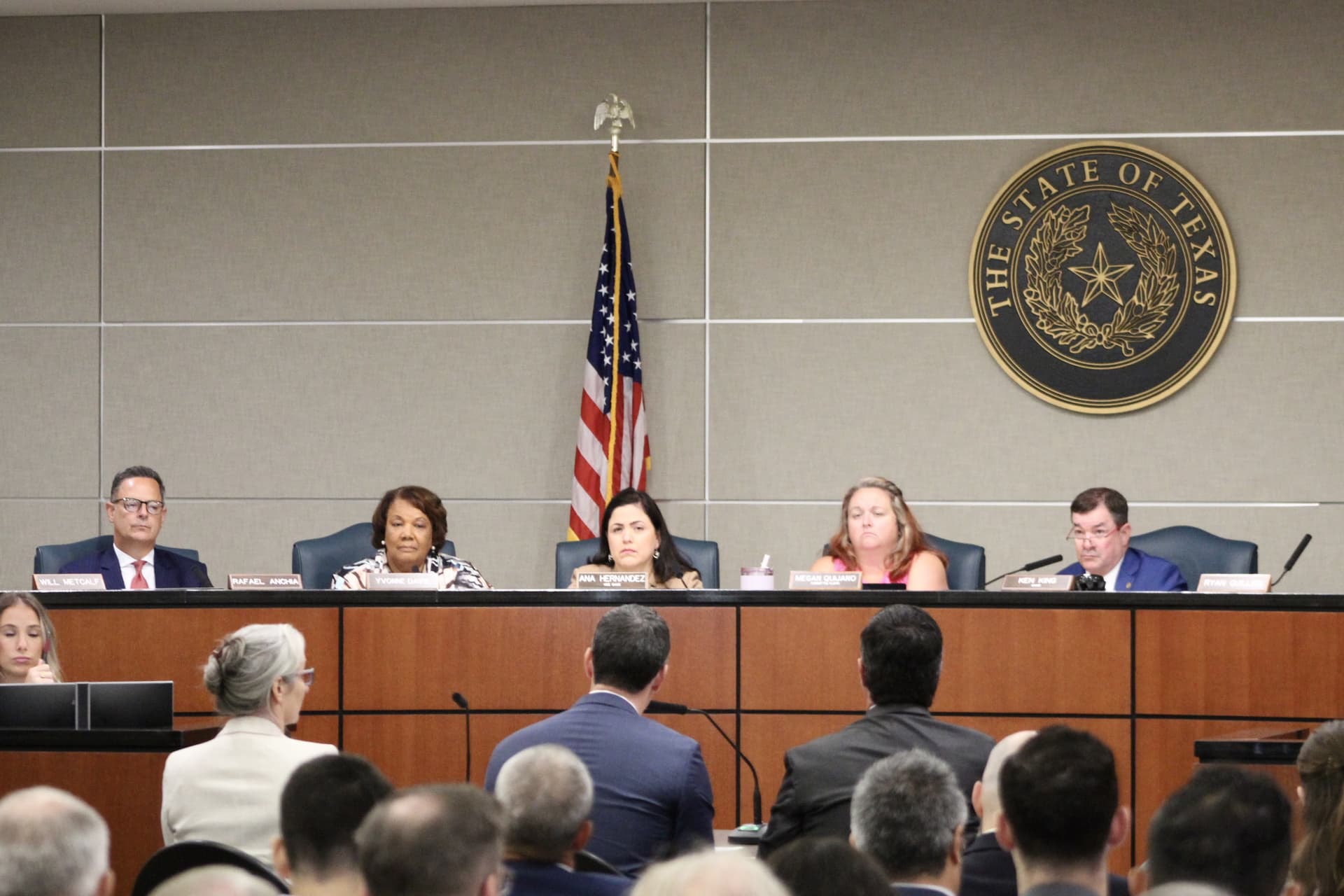
The Aug. 19 House State Affairs hearing kicked off with testimony from state grid officials and energy regulators. Lawmakers also invited other state agencies; data center companies and industry representatives; local government officials; cybersecurity experts; and utility companies to speak. Public testimony on data centers will be capped at six hours, and the committee is alternating between panels of invited and public speakers, committee chair Rep. Ken King, R-Canadian, said.
Pablo Vegas, CEO of the Electric Reliability Council of Texas, echoed remarks made by other agency officials last week. It will take the grid operator several months to audit about 200 gigawatts of data center proposals, he said Aug. 19, and ERCOT will request information from all large and medium-sized data centers that are expected to use at least 25 megawatts—or 0.025 gigawatts—of electricity.
"You'll get descriptive statistics out of that [on] how much the tax abatements are, how much water [they're using], and then from that we can come back to you all, given your policy priorities around potential legislation or other things based on that information that you all may see as necessary as we're trying to bring on these data centers," PUC chairman Thomas Gleeson told lawmakers Aug. 19. "That's really the goal, as we understand it from the governor's directive, is to gather that information ... so it can help inform decisions going forward."
ERCOT anticipates completing the audit in late November or early December, Vegas said. Officials will then launch a separate "batch study" to determine how much electricity each prospective data center would need, how much it would cost to serve each data center and if additional transmission lines must be built to serve these facilities. ERCOT originally planned to launch its batch study in September, according to previous Community Impact reporting, but it was postponed while the agency works on the data center audit ordered by Gov. Greg Abbott.
"This batch concept came about because we were seeing a very high volume, a very rapid increase in the number of connection requests, particularly of data centers, and we recognized that there was a risk in how that was being processed," Vegas said. "They were effectively kind of jumbling and getting on top of each other as each study was done to evaluate whether it could be connected safely to the grid."
Originally published 7 a.m. Aug. 19
In early August, Gov. Greg Abbott ordered a “comprehensive verification and audit” of all data centers seeking to connect to Texas’ power grid, halting the approval of new data center projects.
Texas House lawmakers are set to hear invited and public testimony during a wide-ranging data center hearing Aug. 19, marking the first legislative hearing about the booming industry since the audit was announced.
Community Impact will update this article throughout the hearing.
What to expect
Topics before the House State Affairs Committee will include:
- How Texas data center development contributes to competitiveness and national security
- Economic and workforce growth related to data centers
- State data center regulations and the role of local governments in planning and managing growth
- The Electric Reliability Council of Texas’ approval process for data centers
- How data centers impact the state power grid
- Plans to build large high voltage transmission lines, known as 765-kV lines, from East to West Texas
The 765-kV plans are pending before the Public Utility Commission of Texas amid pushback from landowners and some state lawmakers.
The hearing is scheduled for 8 a.m. Aug. 19 in room 140 of the John H. Reagan State Office Building in Austin, according to the meeting notice. Those interested in speaking to the committee must register at kiosks outside the hearing room before 10 a.m., and written comments can be submitted here until the hearing ends.
Other data center-focused hearings this summer have included testimony from state regulators, energy executives, data center developers, landowners and residents from across Texas.
The background
Under the audit ordered by Abbott, proposed data centers in line to join the ERCOT grid must provide the state information about their electric and water use; water resource impacts; how they plan to mitigate effects on nearby communities; the tax incentives they are receiving; and who owns each proposed facility, Community Impact reported.
Dozens of data centers have released statements expressing support for the state audit and Abbott’s standards. The Data Center Coalition, which advocates for the industry, also supports his approach, Abbott announced Aug. 18.
ERCOT plans to audit between 250-300 proposals for large facilities, most of which are data centers, as part of the process, officials said during an Aug. 14 PUC meeting. The agency was already planning to evaluate large projects under a scheduled “batch study,” although it postponed that process and moved audit requirements “to the front of the line” under the governor’s order, according to Chad Seely, ERCOT’s general counsel and chief compliance officer.
It will take ERCOT “several months” to audit roughly 200 gigawatts of “potentially eligible large loads,” Seely told the commission. That prospective demand is more than twice ERCOT’s recent demand record of 91 gigawatts, which was set on July 22.
“We want to kind of be holistic and grab as much information as possible to get back to the PUC, to the legislature and the governor,” Seely said Aug. 14. “From a holistic standpoint, having all that community impact information on how [data centers] are handling water technology and power deliverability gives a better perspective to the state as we see these loads start to come onto the grid over the next several years.”
ERCOT will present more detailed information about how the audits will work and how long they will take during PUC meetings this week, Seely noted.
More context
Recent Community Impact articles on the Texas power grid and the data center debate at the legislature include: