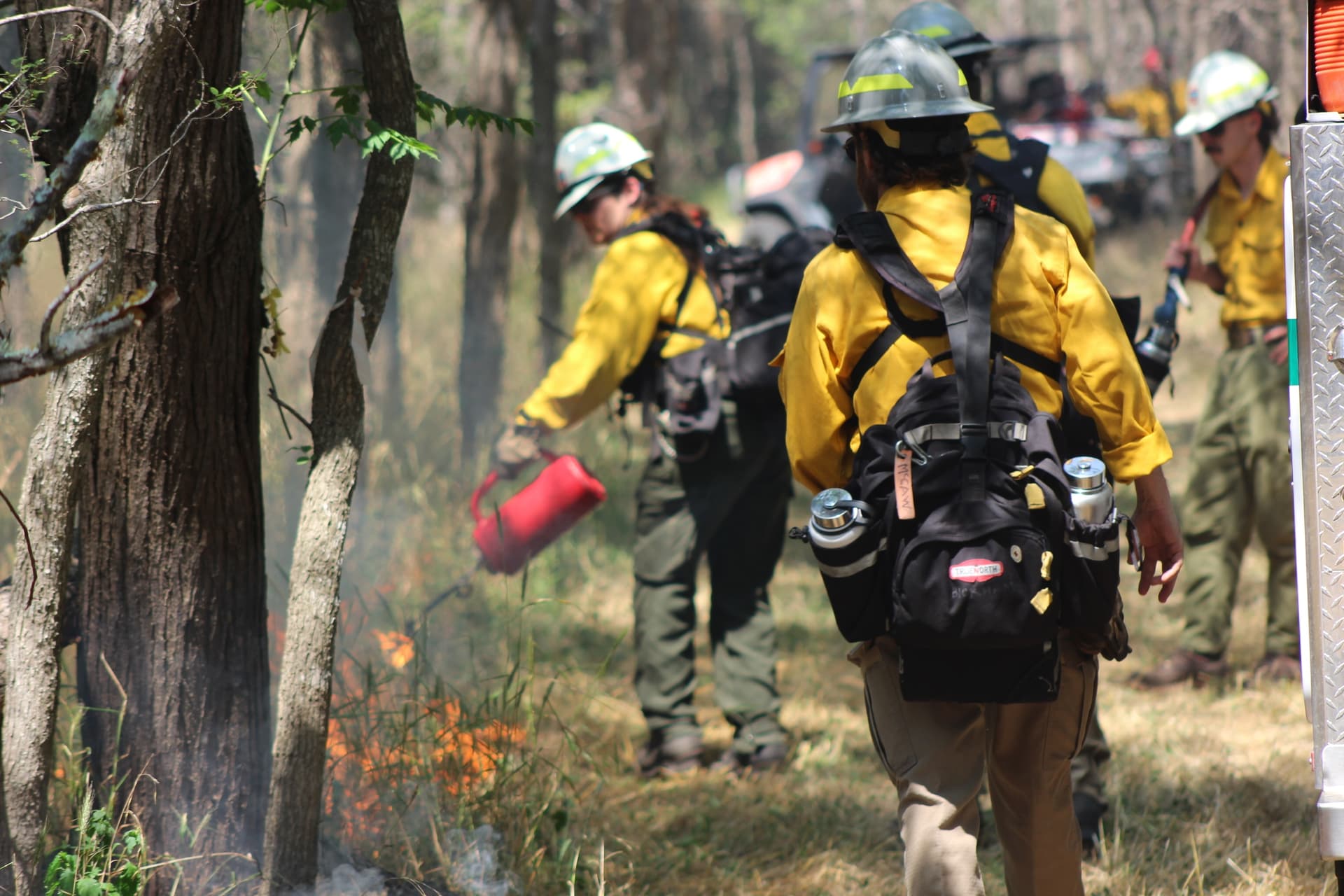
Travis County firefighters complete a prescribed burn to mitigate wildfire risk at Southeast Metropolitan Park in 2025. Texas is now the second most wildfire-exposed state in the nation, according to Wildfire Prevention Co. (Haley McLeod/Community Impact)
Hundreds of wildfires are currently burning across the United States, including a handful in Texas, according to U.S. Forest Service data from Aug. 12.
While a majority of the active wildfires are concentrated in the northwestern part of the country, wildfire potential is rising across Texas due to hot, dry conditions, the Texas A&M Forest Service said on Aug. 10. At least 140 of the state’s 254 counties are under burn bans.
Texas’ peak wildfire risk occurs between February-April, when dry grasses and high winds can cause fires to spread, and August-October, when high temperatures and droughts contribute to fires, according to the Western Fire Chiefs Association, although the state is fire-prone throughout the year.
Ahead of the 2027 state legislative session, lawmakers are looking into ways to better prevent wildfires from happening and prepare communities to respond when fires do start.
The largest wildfire in state history, the Smokehouse Creek Fire, ignited in early 2024 and burned more than 1 million acres of land in the Texas Panhandle. The blaze killed three people and over 15,000 cattle, according to a report issued that spring by a Texas House investigative committee.
Texas’ deadliest wildfire to date occurred in Hutchinson County in 2006, while the most destructive fire took place in Bastrop County in 2011, destroying nearly 1,700 homes.
In 2025, state lawmakers passed Senate Bill 34, which required the Texas A&M Forest Service to create a statewide database of firefighting equipment; established a council to improve emergency communications between local, state and federal agencies; and increased funding to help rural volunteer fire departments purchase equipment from $30 million to $40 million.
Sen. Kevin Sparks, a Midland Republican who authored the law, said more work needs to be done to increase wildfire preparedness across the state.
“The legislature has taken meaningful steps to strengthen our state's wildfire preparedness, response capabilities and mitigation efforts,” Sparks said during an Aug. 11 hearing of the Senate Natural Resources Committee, which he chairs. “As we move forward, our focus should be on a more proactive approach that prioritizes prevention and mitigation alongside response preparedness.”
Lawmakers considered bills aimed at improving communications for first responders and helping the state purchase more firefighting aircraft last legislative session, although those proposals did not become law, Community Impact previously reported.
“We’re in such a better position to handle the next [Panhandle fire], and then the work we're continuing to do on the next flood,” Rep. Ken King, R-Canadian, told state agency leaders during a November House hearing on wildfire preparedness. “I'm not saying we're not making progress. What I'm saying is the work is not done, and I want to give you the tools to do the job.”
What’s happening
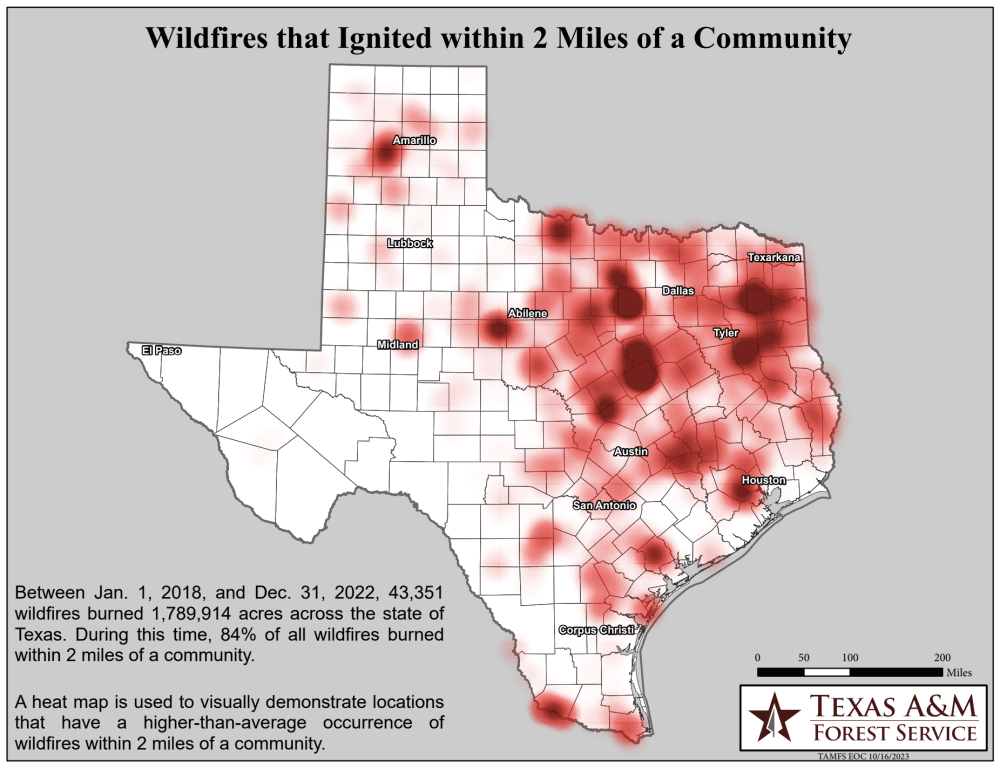
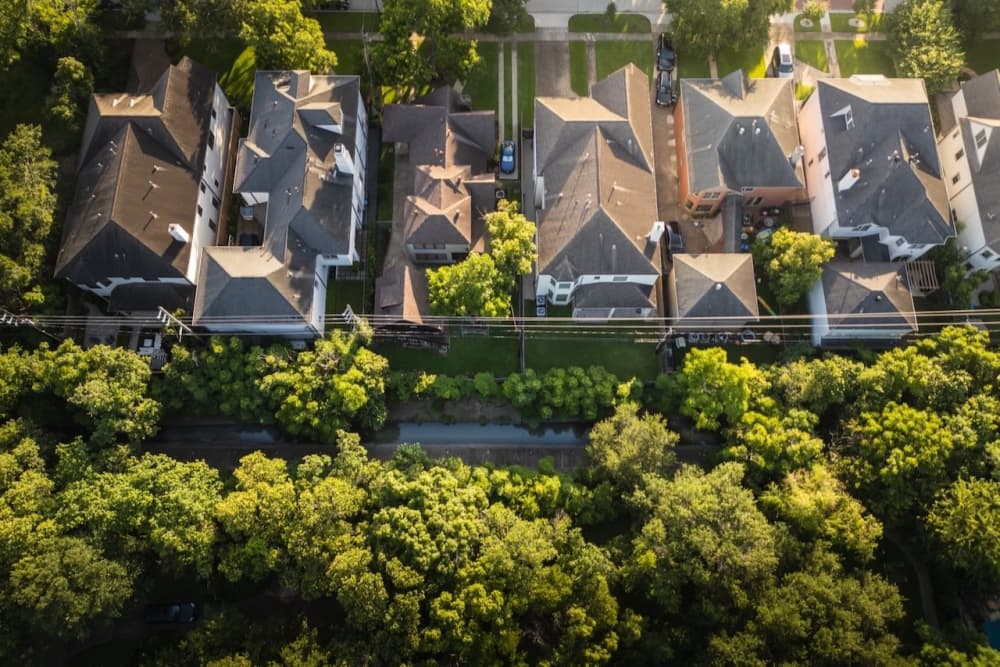
As Texas’ population grows, with more people moving to suburban and rural areas, the threat of wildfires to communities is also increasing, forest service data shows:
From Jan. 1, 2018, and Dec. 31, 2022, more than 43,000 wildfires burned nearly 1.8 million acres of land.
84% of those fires ignited within two miles of a community
About 84% of recent fires ignited within two miles of a community, Texas A&M Forest Service data shows. (Courtesy Texas A&M Forest Service)
“Texas is now the second most wildfire-exposed state in the nation,” said Alex Foster, chief operating officer for Wildfire Prevention Co., which provides fire protection services to Texas homes and businesses. “The U.S. Forest Service counts nearly 7 million buildings exposed to wildfire in Texas—more than any other state, including California.”
Looking ahead
To mitigate future wildfire risk and improve state and local preparedness for fires, experts and community members who testified during the Aug. 11 hearing asked lawmakers to:
Provide funding to expand communities’ capacity to implement prescribed burns, which are planned, controlled fires used to clear flammable materials from fire-prone land
Increase resources for volunteer fire departments
Ensure Texas can purchase and maintain its own fleet of firefighting aircraft
Create grants to help residents harden their homes against wildfires
Strengthen standards to prevent fires caused by damaged utility infrastructure, such as the Smokehouse Creek Fire
Improve emergency communications between various government agencies
“Texas is a wildfire state. While we cannot prevent every wildfire that appears in the state, we can significantly reduce the risk of catastrophic loss,” said Erin O’Connor, who leads the mitigation and prevention department at the Texas A&M Forest Service. “Consistently implementing proven, reliable, and effective mitigation strategies is not only cost-effective, but it's critical for the future of the state.”