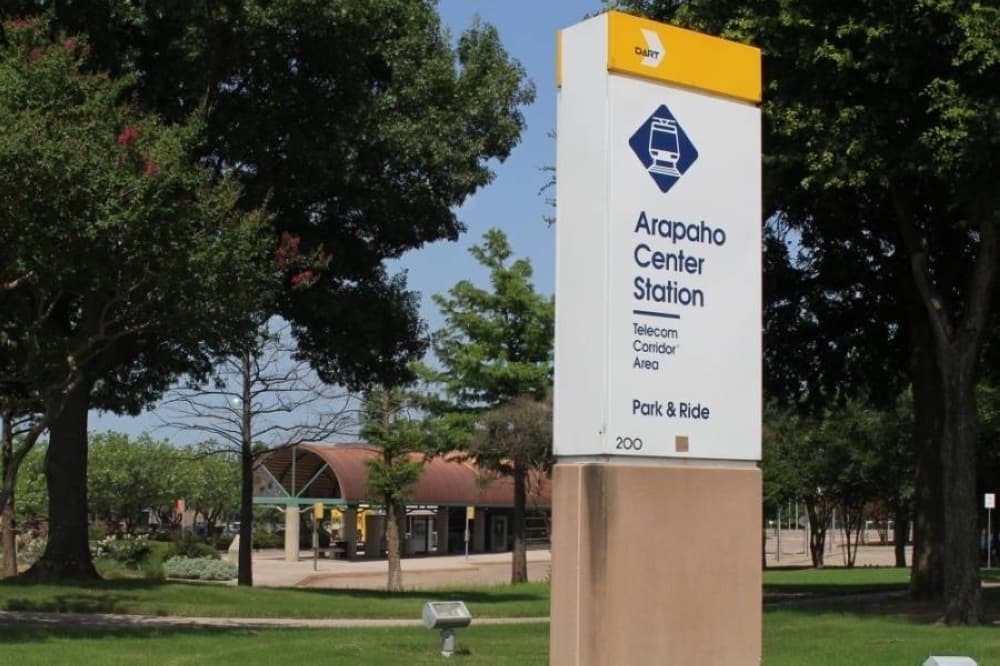
The planned redevelopment at Arapaho Center Station in Richardson is on pause due to funding concerns, City Manager Don Magner said.
The mixed-use development would have covered roughly 30 acres around Dallas Area Rapid Transit’s Arapaho Center Station.
“We believe at this point in time it’s not prudent to try to force this process because the market conditions just aren’t right,” Magner said.
The big picture
Magner said market conditions are currently not favorable for development of this nature.
“The cost of the capital that’s needed to build out the core infrastructure, as well as to finance the initial phases, is still too high,” Magner said. “We’re really trying to force something that the market is telling us isn’t ready.”
Magner said the city would need to provide significant incentives to close the gap between the cost of the planned development and the market reality, which he said is not feasible as the city eyes potential budget cuts anticipates a shortfall budget in the coming years.
The background
Plans for a mixed-use development of the station’s 14.47-acre property have been in the works for four years, Magner said, with initial plans including residential, office, retail and public space components.
However, Magner said the property was not large enough to attract the interest the city expected from potential development partners.
Richardson recently put 14 additional acres under contract immediately to the south of the DART property to bring the redevelopment property to 30 total acres, Magner said. The city received several proposals from developers for the 30-acre property, he said, but did not find any financially viable.
“We’ve got willing property owners. DART’s been willing and tried something with us that they’ve never tried with anybody else. All of those things, and it still isn’t coming to fruition,” Magner said. “I think you’ve got to take the signs. You’ve got to acknowledge the market’s stronger than any of those factors.”
A closer look
Magner said the city also does not want to make the financial commitment to the development ahead of the upcoming state legislative session, where he said a number of new policies could worsen the city’s financial situation and restrict the economic development funding tools at its disposal.
Some incentives that the city could provide, such as funding for core infrastructure, would be funded through certificates of obligation, a form of debt that some state legislators have sought to restrict in past legislative sessions, Magner said.
“If the magnitude of the incentives in our current situation is daunting, I don’t think it’s prudent to spend more time and energy, or ask developers to spend more time and energy, to progress projects without knowing what’s going to happen in the next legislative session,” Magner said.
Looking ahead
Starting in June, the city would have to pay to keep the additional 14-acre property under contract, so Magner said the city will not hold on to that piece of property. Any future development project would be on just the original 14.47-acre DART property.
Magner said the city plans to keep an eye on economic indicators to judge when market conditions might make the project feasible again.
“We still think that this is a very valuable project,” Magner said. “We think that it’s got a ton of potential, but you can’t force certain things.”