Editor's note: This article has been updated to correct the number of students who left certain public school districts to participate in the Texas Education Freedom Accounts program.
Ahead of Texas' 2027 legislative session, the state comptroller's office has asked lawmakers to double funding for its $1 billion education savings account program. The program gives participating families taxpayer dollars for private education and homeschooling, and officials said at least $2 billion is needed to maintain current participation in the program.
Meanwhile, some Texas families are raising concerns about their local school districts losing money as students leave public schools to participate in the program, known as Texas Education Freedom Accounts.
Stacy Harrell, a Pflugerville ISD parent, said 149 students who otherwise would enroll in PfISD have accepted program funds, which have resulted in an estimated loss of $1.2 million in funding.
"That lost funding will add to budget cuts that are already affecting Pflugerville ISD families. Four elementary schools [are closing], with the possibility of more. ... It is so dire that Pflugerville ISD denied the purchase of frogs for the seventh-grade dissection project—a minimal $300 fee per school," Harrell said.
What you need to know
Texas public schools are funded through the Foundation School Program and other state sources, while the $1 billion for the TEFA program comes from a separate pot of money in the 2026-27 state budget. However, because public schools are funded based on student attendance and enrollment, districts receive fewer state dollars when students leave the district for any reason.
Before Texas House lawmakers passed the law creating TEFA in April 2025, bill sponsor Rep. Brad Buckley, R-Salado, said he did not think public schools in other states had been harmed by similar programs.
“When you are providing services and you're meeting the needs of children, we know that [many] parents will stay in their public school,” Buckley said at the time. “I do know that this opportunity that we will provide will not hurt our public schools. It'll just create another lane or another option for parents.”
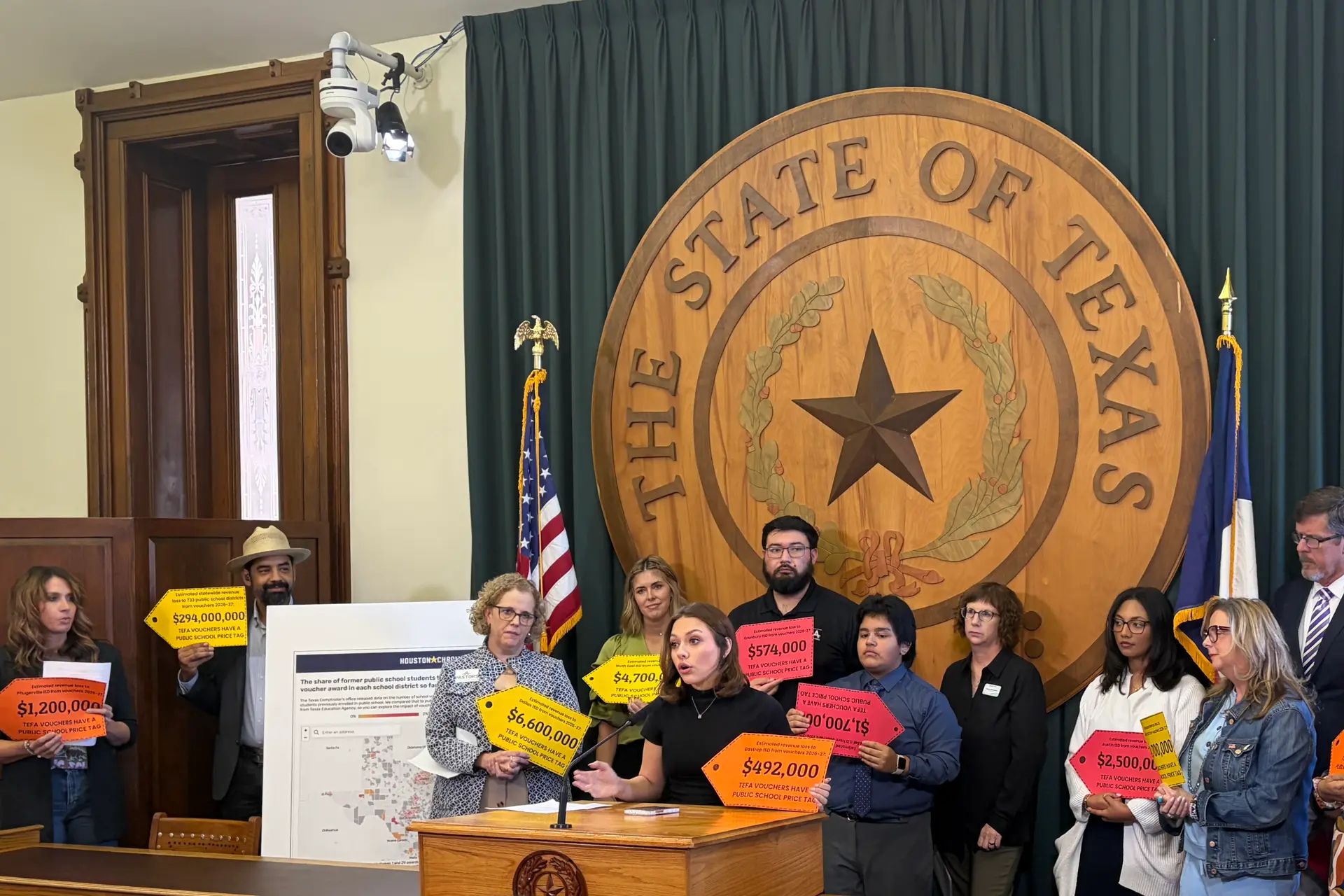
During an Oct. 7 news conference, students, parents and educators from several Texas school districts pushed back on that assertion. Public schools could lose up to $294 million after students left their districts to use TEFA funds, according to an analysis from two organizations that oppose the program, the Texas Center for Voucher Transparency and Every Texan.
The groups requested information on the number of students who left their local public schools to participate in the TEFA program and shared those data with Community Impact. Based on the data and estimates shared at the news conference:
Fort Worth ISD is expected to lose $4.7 million due to 576 students leaving the district for TEFA
North East ISD in San Antonio is expected to lose $4.7 million 570 students who previously attended the district accepted TEFA funds
Garland ISD is on track to lose $2.6 million due to 312 students leaving the district for TEFA
Austin ISD could lose $2.5 million after 301 students who previously attended the district accepted TEFA funds
Alief ISD in Houston is expected to lose $1.7 million due to 211 students leaving the district for TEFA
Pflugerville ISD is slated to lose $1.2 million after 149 students who previously attended the district accepted TEFA funds
Abilene ISD could lose $623,000 due to 76 students leaving the district for TEFA
Granbury ISD is expected to lose $574,000 after 70 students who previously attended the district accepted TEFA funds
Bastrop ISD is slated to lose $492,000 due to 60 students leaving the district for TEFA
Bryan Holubec, board president for Thrall ISD in eastern Williamson County, said officials in his community don't know how the TEFA program is impacting them just yet, as state data "shows that we have not lost any students to the voucher program."
"We know that's not, in fact, the case," Holubec said Oct. 7. "From some internal indications and rumors in the small community, you know there are people that have taken their students elsewhere, but we don't have any solid feedback that we can use for our [budget] planning."
More details
Earlier on Oct. 7, discussion in a Senate Education Committee hearing focused on the implementation of the first-year program, the demographics of participating students, safeguards to prevent fraud and the experience of two Texas private schools that accept students under the program.
"This program still has room to grow, [and] when we run our next application cycle for families, we expect the demand for education freedom will continue to increase," said Travis Pillow, the comptroller's interim TEFA program director. "We look forward to working with the legislature to keep expanding the freedom Texas parents, students and educators deserve."
In 2025, state lawmakers allocated $1 billion for the program's launch in the 2026-27 school year. Doubling that funding to $2 billion is necessary to keep the program's over 116,000 participants enrolled, officials said, although it would cost at least $4 billion to accept roughly 160,000 students who are on the program waitlist or have expressed interest in applying next year, Community Impact reported.
"One of the things that I'd like to see you guys produce before anyone entertains any expansion would be to see how much the program is costing our public school districts," Sen. José Menéndez, D-San Antonio, told Pillow. "This is not in a vacuum, because all the school districts [that I represent] have lost about $26 million."
Zooming out
Critics of the TEFA program have also expressed concerns that state dollars would largely go to students already enrolled in private schools and wealthy families, according to previous Community Impact reporting.
Aug. 10 data from the comptroller's office shows that of more than 118,000 students who had been selected to participate in the program at the time, about 70% of students had attended a private school in the 2024-25 school year and 30% of students were previously enrolled in a Texas public school. About 64% of those selected were considered low-income. Not all of the students represented in these data are currently enrolled in the program.
Austin parent Graciela Gonzalez told the committee Oct. 7 that due to financial strain, she and her husband decided last year to move their three daughters from a local Catholic private school to a nearby public school.
"We knew that [a public school] wasn't the best choice academically," Gonzalez said. "Then TEFA was announced, and we cried together. It was a blessing."
Sen. Donna Campbell, a New Braunfels Republican who leads the education committee, said helping families who cannot otherwise afford a private education or homeschooling is the goal of the TEFA program. According to previous Community Impact reporting, participating students are receiving $10,474 each for private education and related expenses, while homeschool families can receive up to $2,000 per eligible child and students with disabilities are eligible for up to $30,000 each.
"We've always had school choice—if you're rich enough and you're mobile enough, you move your child where you want," Campbell said. "Why don't we give the less fortunate [an] equal opportunity to have the choice where they want to educate their child? ... This is not for the rich. It's for the less fortunate."
State law required the comptroller's office to give priority to students with disabilities and applicants from low-income families. Data from Aug. 3 shows that the roughly 248,000 applicants who were deemed eligible for the program were prioritized in the following order:
Tier 1 includes students with disabilities whose annual household incomes are at or below 500% of the federal poverty line—about $165,000 for a family of four—and their eligible siblings. About 12% of applicants and 39% of awardees were in the first tier.
Tier 2 includes children with household incomes at or below 200% of the federal poverty line, which is about $66,000 for a family of four. About 32% of applicants and 60% of awardees were in the second tier.
Tier 3 includes families earning between 200%-500% of the federal poverty line. About 29% of applicants were in the third tier, although less than 30 students in this tier were participating in the program as of July 29.
Tier 4 includes families above 500% of the federal poverty line. About 27% of applicants were in the fourth tier, although none had been accepted into the program.