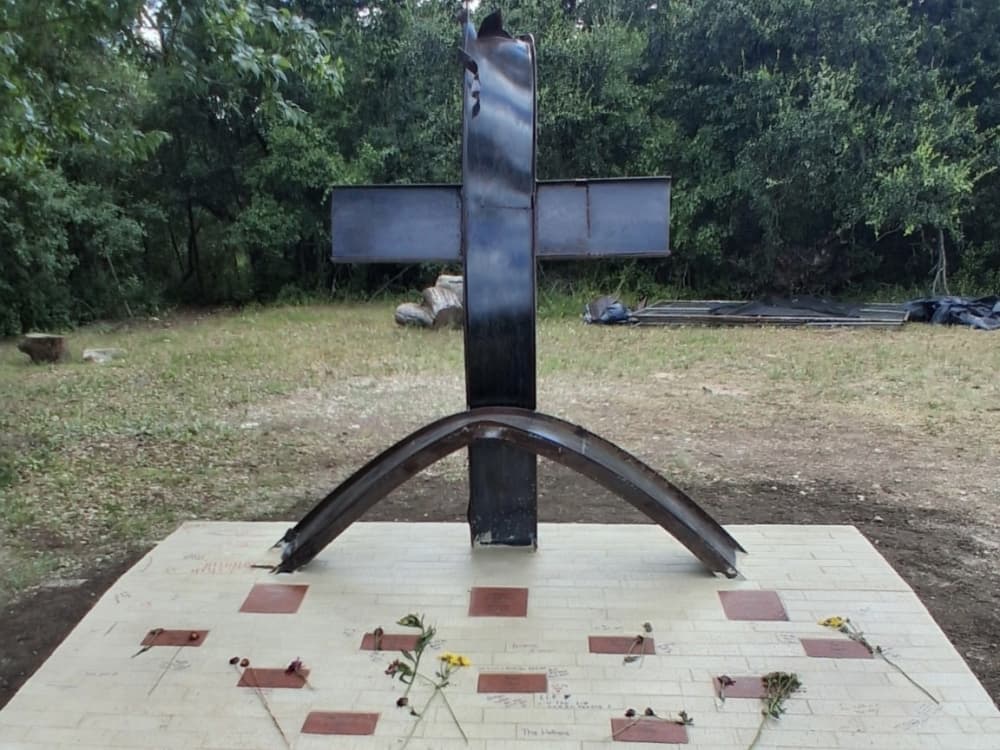
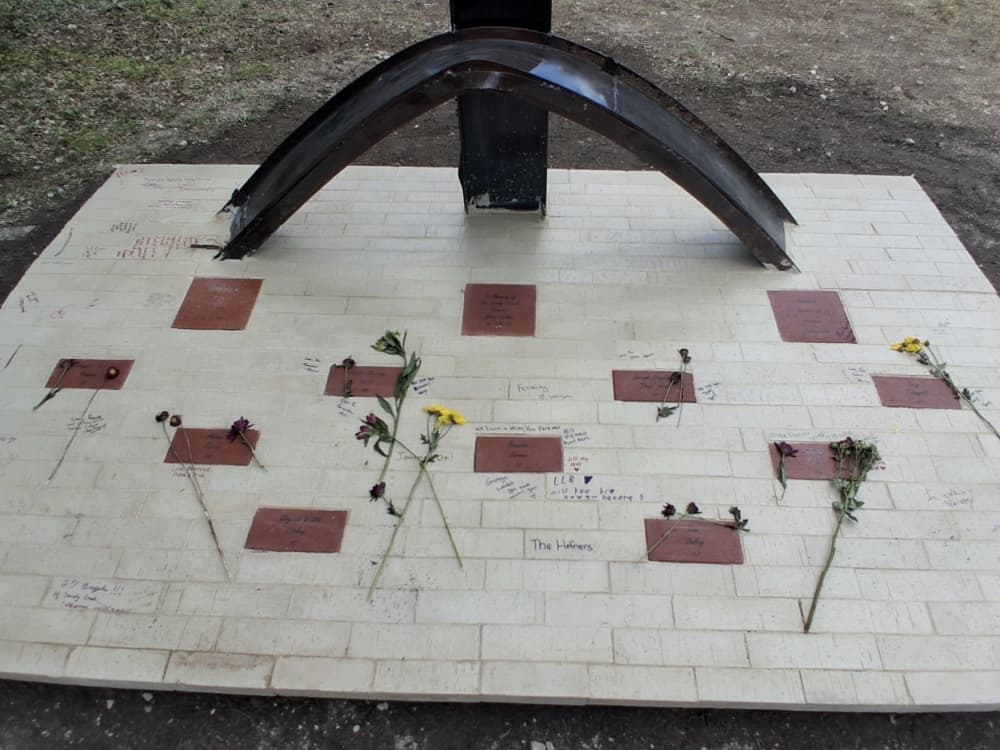
A memorial in Sandy Creek commemorates the lives of nine residents who died after a "wall of water" swept through their neighborhood on July 5, 2025. The memorial is made of metal collected from flood debris with the names of flood victims engraved below. (Courtesy Amanda Ward)
Sandy Creek resident Georgia Bishop was out of town for a concert when 22 inches of rain fell on parts of northwest Travis County over the July 4, 2025, weekend. When Bishop returned home days later, her community was significantly changed.
Residents of the hard-hit Sandy Creek neighborhood described a “wall of water” that tore through their community last July, washing away homes, cars and roads. Nine people died in the flooding, including Bishop’s best friend, 16-year-old Felicity Jarmon.
Bishop described her friend as a talented artist and a kindhearted person who loved animals and enjoyed playing video games.
“She was super funny,” Bishop said. “She had a really good sense of humor—I could literally call her crying, and then I would hang up the phone laughing.”
Bishop said that Felicity had “a really tight bond” with her younger brother, Braxton. The two siblings were in their Sandy Creek home with their father, Jermaine Jarmon, and their stepmother, Alissa Martin, when the house was swept away by floodwaters on July 5, 2025. Only Jermaine survived.
What’s happening
One year later, residents of the unincorporated Travis County community are still working to rebuild from last July’s catastrophic flooding. Bishop and her mother, Amanda Ward, are renting a house after the storm damaged their roof and caused parts of their home to be covered in “a literal blanket of mold.” Ashlee Willis and Brandy Gerstner are living in mobile homes, they told Community Impact, and Jermaine Jarmon also lives in a camper, Bishop said.
Central Texas has seen two straight years of intense, deadly flooding in July, leaving some residents on edge as they recover from last year’s disaster and mourn lost loved ones.
Fifty-seven percent of Central Texas flood survivors reported that after last year’s storms, they now feel anxiety, fear or stress during bad weather, according to a survey of 258 adults directly impacted by the July 2025 floods. Twenty percent of flood survivors said were still displaced and living in temporary housing, while about 65% said they knew people who were still struggling emotionally or financially, according to a survey conducted in May and June by Extreme Weather Survivors, a national organization designed to bring together people who have been affected by natural disasters and help them advocate for change.
Residents of communities that flooded spoke of limited support from local and state officials, noting that they relied on their neighbors and outside organizations, rather than the government, for support after last year’s disaster.
“When the flood happened, it was my neighbors who were checking on each other and pulling each other out from their homes,” said Kylie Nidever, whose neighborhood along the Guadalupe River in Hunt flooded last year. “In the days and weeks that followed, being out in the neighborhood, I never saw firsthand any government officials, with the exception of someone from the [Texas] Department of Wildlife, who came in one evening and was measuring the water lines on the exteriors of everyone's houses.”
Nidever’s home was not damaged by the July 4, 2025, flood, which killed 119 people in Kerr County. She told Community Impact that her experience helping her neighbors rebuild motivated her to advocate for her community at the state and national levels.

“Before the flood, I had no interest in politics whatsoever,” Nidever said in a July 13 interview. “I really tried to avoid it at all costs, but I have a very vested interest in all these random things now. I got involved with [Extreme Weather Survivors] less than a month after the flood.”
Bishop is also involved in the advocacy organization. Both women traveled to Washington, D.C., earlier this year to meet with other disaster survivors and lobby for increased disaster preparedness and recovery policies at the national level.
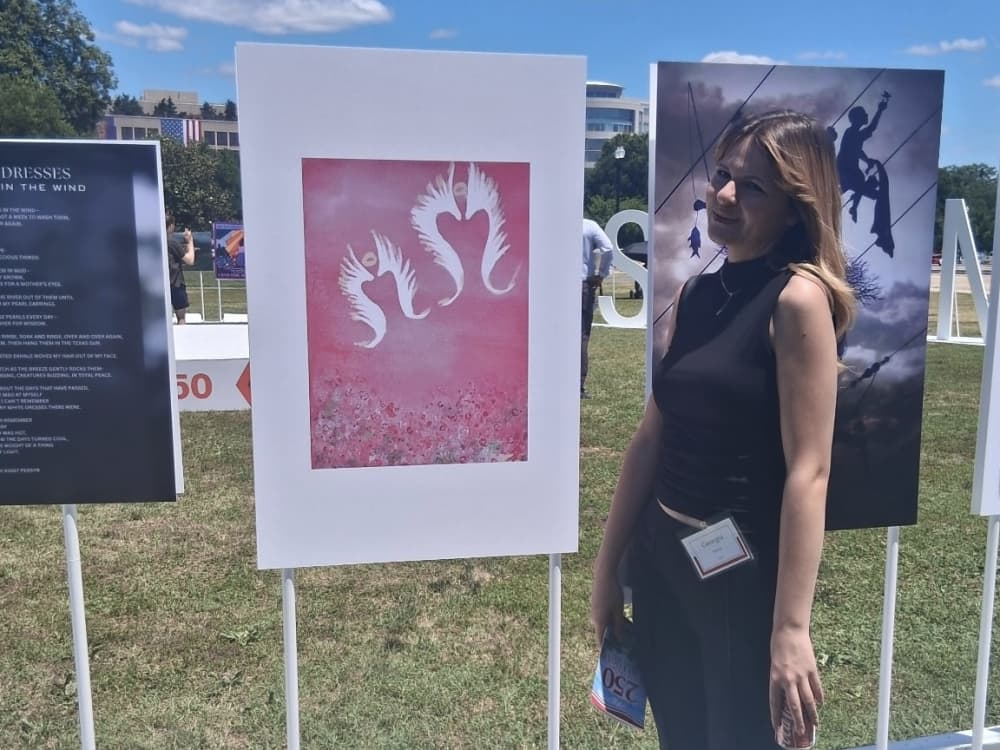
In Washington, D.C., Georgia Bishop stands in front of her painting, titled "Angels Watch Over," which she created to honor those who died in the July 5, 2025, flood in Sandy Creek. Bishop and other natural disaster survivors traveled to the nation's capital in June to advocate for increased federal disaster protections. (Courtesy Amanda Ward)
Bishop and Nidever spoke with Community Impact on July 13—days before heavy rainfall hit large swaths of the state, dropping more than 20 inches of rain and causing parts of the Guadalupe, Nueces and Pedernales rivers to rise significantly on July 15 and 16. Officials confirmed two deaths due to this year’s floods: A man in Kerr County was swept away in his RV and another man was swept away by floodwaters while driving in Uvalde County.
While Travis County was not hit hard by the storms, the Lower Colorado River Authority reported that it was opening floodgate dams July 18 after Lake Travis reached full capacity for the first time in seven years.
Zooming in
Bishop said she still remembers what it felt like to learn that her best friend was missing after Sandy Creek flooded on July 5, 2025. She told Community Impact that she tried calling and texting Felicity, but nothing went through, so she reached out to another friend to ask if she knew anything.
“My friend, she said to me, ‘Georgia, their house is gone. The house is gone. Everything down the road is gone, and they're missing,’” Bishop said. “I really remember the drop in my stomach. ... I completely broke down after I was told that because a part of me knew that she was gone.”
Access to her home from outside the Sandy Creek neighborhood was blocked for days, as Big Sandy Bridge was partially washed away by floodwaters and was impassable. Bishop said she was “gobsmacked” when she returned home and “understood the severity of what had happened and what my neighborhood and my community were going through.”
“It was hot. It was humid. It was just awful,” she said July 13. “I remember the thought of my best friend being out there, just laying out somewhere in the heat. ... It made me viscerally sick. I remember just having the fear [of] what if they can't find her?”
Bishop said that search and rescue crews were not immediately sent to Sandy Creek, so community members and the families of those deemed missing went out to look for their loved ones. Felicity’s body was not recovered and identified until July 11, six days after the flood, Bishop said.
“What just made me really upset was that there were family members looking for their family, like my best friend's older sister,” she told Community Impact. “She was out there with her grandma and her older brother, and they were looking for her.”
Residents have argued that bureaucratic barriers slowed last year's flood recovery and restricted outside help, according to previous Community Impact reporting, with former Leander Mayor Christine DeLisle writing on social media that resources sent by the city were initially turned away.
“There were just too many times to count that I felt that, along with probably many, many other people who lived in Sandy Creek, that we just weren't prioritized [by government officials],” Bishop said.
More details
On July 5, 2026, community members gathered at the Round Mountain School and Community Center to honor the nine Sandy Creek residents who died one year earlier. During the event, organizers unveiled a memorial monument made of metal from flood debris that was fashioned into a cross. The names of those who died in the flood are engraved in bricks below the monument.
“It hit me that day that it's been officially a year since I've called [Felicity], since I've talked to her, since I've hugged her, since I've laughed with her,” Bishop said. “It's officially been a year of me not having her. She was taken just way too soon. I want people to remember her story as an example of why we can't let [anything] like this happen again.
The names of Sandy Creek residents who died in July 5, 2025, flooding are engraved in bricks as part of a memorial monument at the Round Mountain School and Community Center. Community members wrote messages to their loved ones and left flowers at the memorial during a July 5, 2026, event. (Courtesy Amanda Ward)
The latest
On July 17, Gov. Greg Abbott signed a disaster declaration to request federal support for “response and recovery efforts [that] exceed the capabilities of the State of Texas and affected local governments” in 28 impacted counties.
Last July, at least 137 people died from severe flooding in Central Texas, including 119 deaths in Kerr County and nine deaths in Travis County. Kerr County officials said that while this year’s flooding was less deadly, property damage this July was “much worse,” which Kerr County Judge Rob Kelly attributed in part to a lack of trees and vegetation serving as a barrier along the Guadalupe River.
“A year ago, we didn't know what was coming,” Kelly said during a July 20 news conference in Kerrville. “We didn't know what hit us. We didn't know how to survive from the losses that we suffered.”
This year’s rainfall and subsequent flooding occurred over multiple days and in a larger area, giving officials and residents more time to prepare.
“Did it stop the devastation? No, it did not,” Kelly said. “But were we better prepared? Yes, thanks to not only the systems the state provided, but our local friends, [the Upper Guadalupe River Authority].”
Kelly said emergency management officials in Kerr County began tracking this year’s storm more than a week in advance, whereas he and other county leaders were asleep or out of town when the Guadalupe River began to rise during the early hours of July 4, 2025, according to previous Community Impact reporting.
“Everyone was far better prepared [this year],” Abbott said July 20. “But let's be honest about something else: Even though we got more rain in this event, this was a different event than last year because we had the ability this year to see the rainstorms come in for days before the heaviest of the flooding occurred, as opposed to last year, which was far more sudden and far more concentrated.”
Looking ahead
Abbott told reporters July 16 that last year's floods were a "warning" that led to an “aggressive” response from state agencies and first responders this month.
“What happened last year was a warning to people on or near rivers, as well as to communities around those rivers [and] to the state, that no one can be complacent when rain falls and waters rise," he said. "We all have a sense of urgency with the rise in water.”
During special legislative sessions last summer, state legislators approved new laws aimed at increasing safety requirements and boosting emergency preparedness at Texas summer camps after 27 young girls died at Camp Mystic’s Guadalupe River location. Leaders of the private Christian camp, which has been under intense scrutiny for their response to the July 4, 2025, flooding, announced in April that they would not reopen a separate camp location this summer.
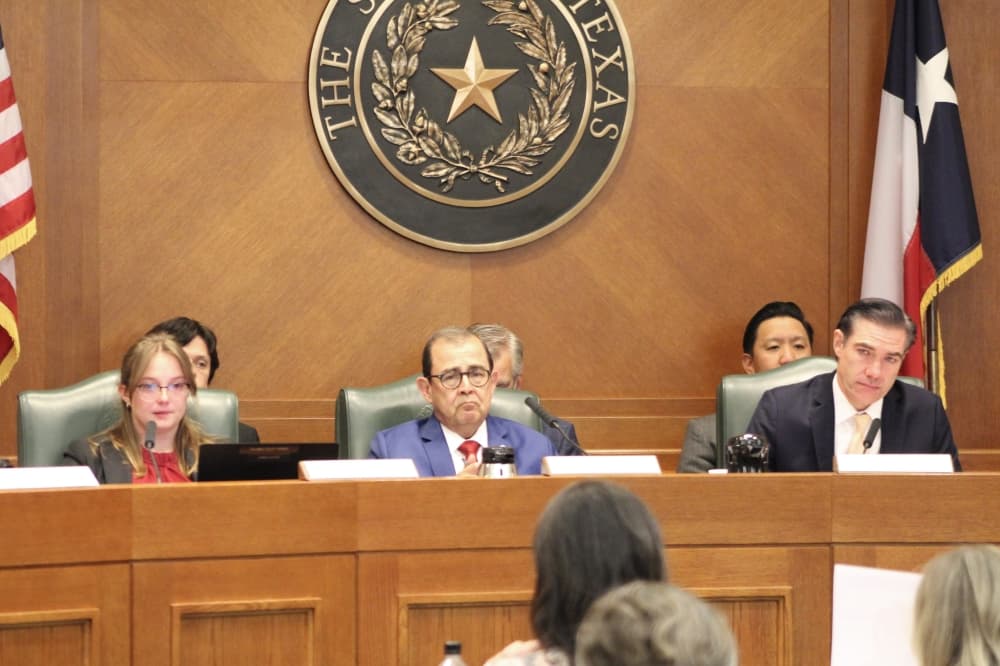
From left, committee clerk Haylee Plumley, Sen. Pete Flores, R-Pleasanton, and Rep. Morgan Meyer, R-University Park, hold back tears while listening to testimony from CiCi Steward, whose daughter, Cile, remains unaccounted for after the July 4 flood at Camp Mystic. (Hannah Norton/Community Impact)
Another state law requires that flood warning systems be installed in 30 flood-prone Central Texas counties with the help of $50 million in state grants. At least six sirens were installed along the Guadalupe River in Kerr County and they all went off during last week’s flooding, officials said, although Upper Guadalupe River Authority records show that those sirens are located upstream of the areas that were hardest-hit this July.
Comal, Guadalupe, Kendall, Travis and other Central Texas counties are also working on installing flood sirens with state grants, Community Impact previously reported.
In Kerrville on July 20, Abbott said local officials told him that “almost all rivers in this region hit record highs, [and] early warning systems saved lives.”
Abbott said “there's more to get done” to ensure that all Texas communities are better prepared for future disasters and have adequate warning systems. Ahead of Texas' 90th legislative session, which begins in January, state leaders and lawmakers will review lessons learned from both floods to determine if additional disaster-related legislation is needed, he said.
“The systems we put in place last year proved to be successful and helpful [in Kerr County],” he told reporters. “We want to make sure we are equally successful and helpful in every region across the state of Texas, and those are the kinds of issues that we will take up in the next session.”