Editor’s note: This story is part of a collection of local stories discussing the local effects and recovery of the July 4, 2025, flooding. Find more Travis County coverage here.
A year after deadly flooding tore through the Sandy Creek community, survivors are working together to create change and advocate for their community.
“What's happened to us is already done,” flood survivor Brandy Gerstner said. “We're trying to advocate for change for the long term, for the entirety of the state, as well as going beyond just county and state levels.”
The local impact
On July 5, the Round Mountain School hosted a memorial event for the nine Sandy Creek residents who died in the flooding. On July 13, the community held a cookout at the school to honor the deceased and celebrate the volunteers who supported the community.
“What's been beautiful, though, is the community that's been built,” Gerstner’s daughter and flood survivor Ashlee Willis said. “We did not [originally] move this far out in the country to get to know our neighbors.”
Prior to the floods, Linda Hambrick, president of the Friends of Round Mountain School, said few were showing up to meetings at the school, which has become a community center under the stewardship of the Friends.
The school, which was first constructed in the early 1870s, has a long history of transforming to serve the community. The one-room schoolhouse first underwent renovations in 1900 before a fire damaged the building in 1927. After reopening in 1929, the school was utilized for community events during the holidays and stopped hosting lessons in 1945. The property later underwent an ownership dispute in the 1970s before eventually returning to its status as a community center.
After the devastating July 4 flooding damaged more than 70 homes, the site quickly became a refuge offering survivors a place to rest, access resources and build community. As residents navigated the recovery process, they formed the Sandy Creek Alliance, which now often meets at the Round Mountain School, to advocate for the community.
Willis said the group has meetings of up to 120 attendees. Past meetings have included the attendance of Travis County leadership such as Judge Andy Brown and Travis County Commissioner Ann Howard, along with groups like the Central Texas Community Foundation, a public charity founded in 2004 to support local nonprofits and agencies.
Today, the Sandy Creek community has a Signal chat, a Facebook page and planning committees. Willis said informational materials are sent out in both English and Spanish.
“A lot of it is just like literally reaching out to your neighbors,” Willis said. “We're calling, we're texting. We just stay in constant communication. Sandy Creek is a really low-tech place. The best way to spread information here is by street sign.”
What’s next
Beyond organizing within the community, Willis and Gerstner are looking to expand resources for others who have been affected by natural disasters, working with Rebuild US, a national organization dedicated to distributing resources to communities as they recover from disasters.
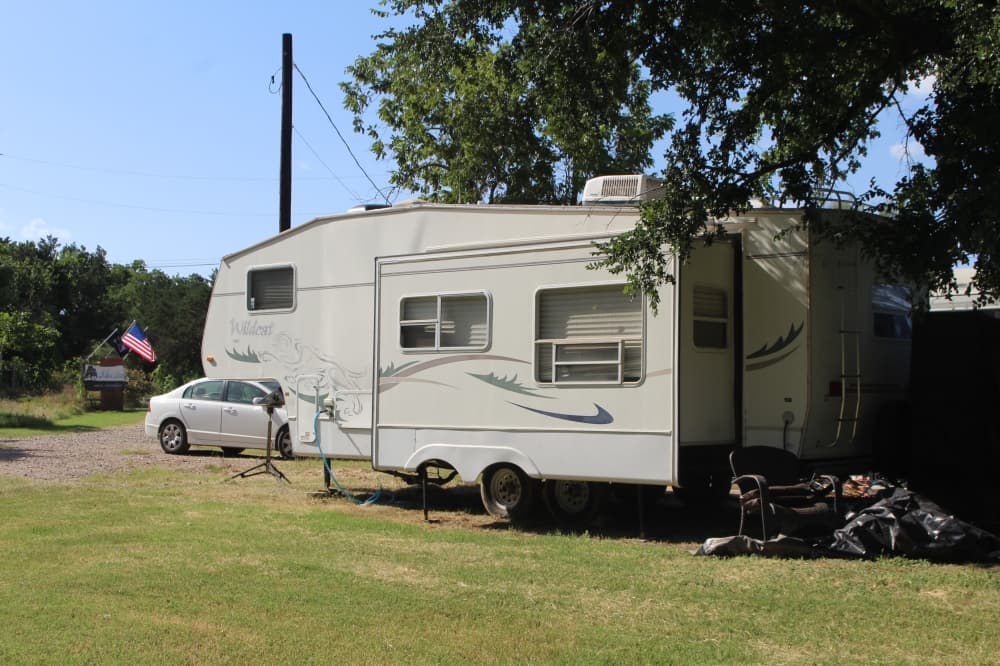
Both Willis and Gerstner still live in mobile homes over a year after the flooding due to the high costs of rebuilding. While Travis County has eliminated permitting application fees for residents, Willis said many are struggling with the “exacerbating” costs of rebuilding.
Additionally, Willis said the survivors of Sandy Creek are working with other natural disaster survivors across the nation to lobby for expanded protections at the state and federal level, including inclusion in discussions regarding recovery.
Gerstner has advocated for the Department of Housing and Urban Development to allocate Community Development Block Grant-Disaster Recovery funds to support long-term recovery for survivors of the Sandy Creek flooding.
“That's actually our only real last hope for Sandy Creek because if that block grant for disaster relief gets allocated by Congress, that's real dollars,” Gerstner said.
Funding from the Central Texas Community Foundation, which worked with Williamson and Travis counties, has provided support for affected residents. The foundation reported that about $7.9 million was distributed to 260 individuals or families in Travis and Williamson counties over two application cycles in the past year. The smallest amount of funding received amounted to $500 while the largest amount received was $100,000.
In terms of infrastructure, Travis County received $1 million from the Texas Water Development Board to install outdoor warning sirens, flood gauges and other equipment.
At the state level, Willis and Gerstner are advocating for the establishment of a permanent $500 million fund to support natural disaster recovery efforts, calling it the Texas Forever Fund. Willis said she personally handed Gov. Greg Abbott a letter about the program.
“There's such a need for a public option of assistance. ... Disasters don't discriminate; disaster recovery does,” Willis said. “A public option would help.”