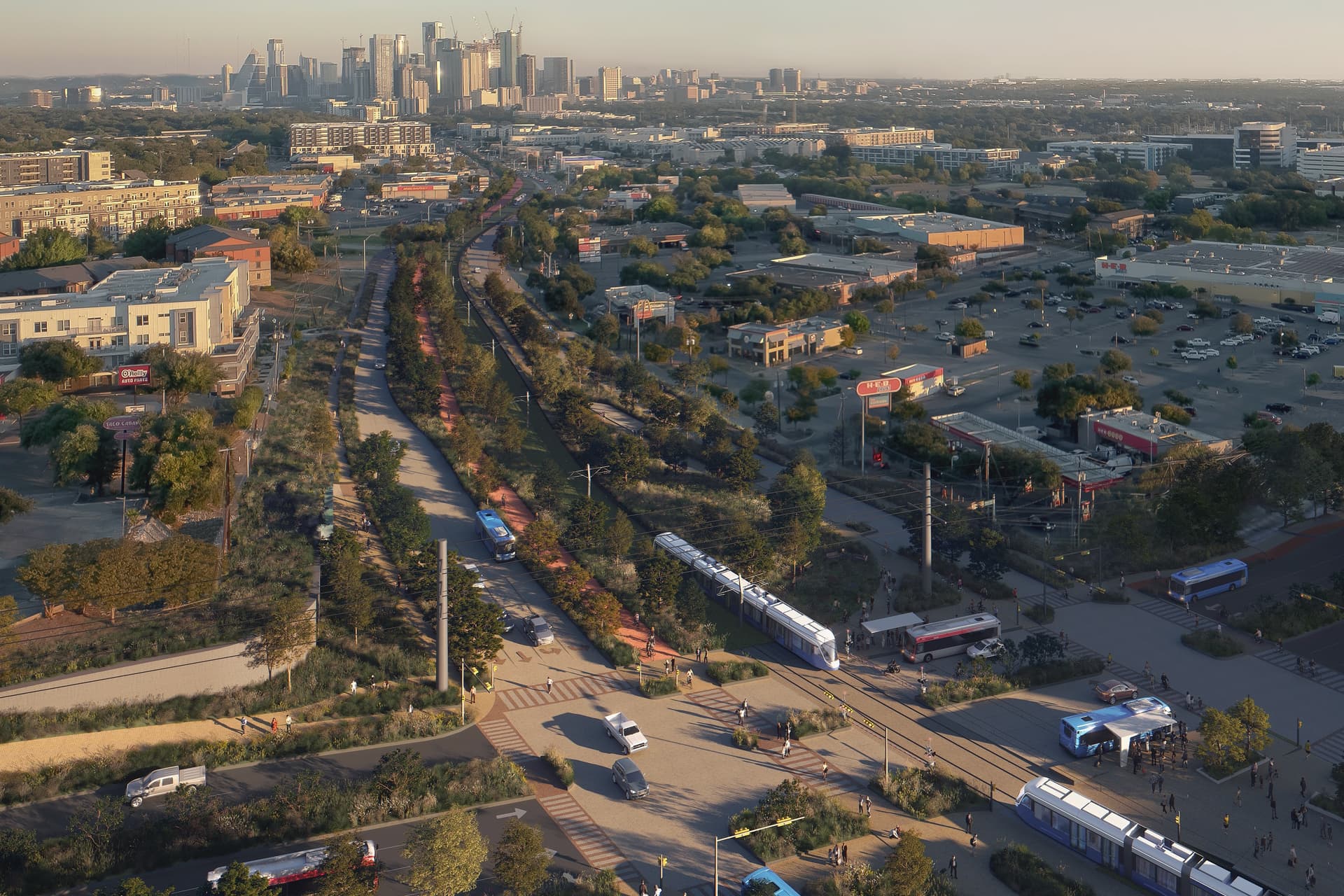
The Austin Transit Partnership is now planning to extend the initial Austin Light Rail line to Austin-Bergstrom International Airport. The extension had previously been considered a priority future addition for the rail system. (Artist conceptual visualization, Austin Transit Partnership)
The Austin Transit Partnership is kicking off planning for an extension of Austin Light Rail to Austin-Bergstrom International Airport.
The airport connection would represent a shift from current plans for the rail system, which label the extension as a future project, and the continuing Journey With AUS airport expansion program.
The big picture
Austin Light Rail is a signature piece of the multibillion-dollar Project Connect transit initiative approved by city voters with a permanent property tax increase in 2020. After cost increases resulted in scaled-down plans in 2023—including the removal of an anticipated airport connection—the rail network is now expected to connect Central, South and East Austin over 9.8 miles of track with 15 stations.
The first phase of Austin Light Rail will connect Central, South and East Austin.Courtesy Austin Transit Partnership
Through years of initial planning, the airport extension was viewed as a future addition on an undetermined timeline. But with rail system construction set to begin next year, ATP officials announced Nov. 10 that the transit entity is now considering service to ABIA.
Mayor Kirk Watson, who serves on the ATP board, said the update comes after Austin Light Rail cleared several notable progress markers and can complement Journey With AUS.
"A world-class airport needs a multimodal, world-class transportation system to connect to it. Sure, we need to improve roadway access. And we also should give people more choices about how they travel," Watson wrote in a Nov. 10 newsletter. "An airport rail connection has been part of Austin’s long-term transportation vision for years. With Journey with AUS, we have a chance to plan these projects strategically rather than trying to connect them after the fact."
The details
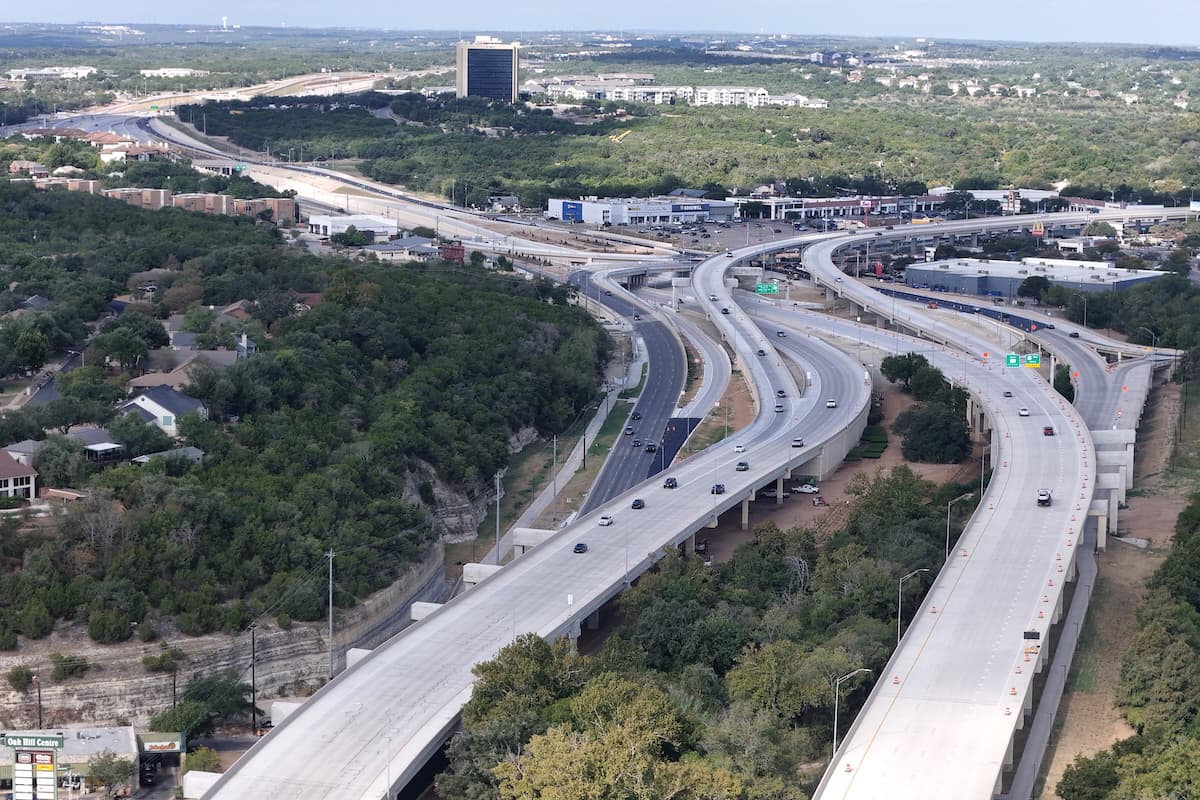
Austin Light Rail's first phase was expected to end in Montopolis, on East Riverside Drive at Yellow Jacket Lane near the system's planned maintenance yard. An airport connection along US 183 and Hwy. 71 has been classified as a "priority extension" only, despite widespread resident desires to have it in place from the jump.
"During the [National Environmental Policy Act, or NEPA] process for Austin Light Rail Phase 1, the number one comment we received from Austinites was to extend light rail to the airport—to increase mobility capacity and mobility choices, and to improve reliability in getting to the airport for both passengers and the airport workforce," ATP officials wrote in a Nov. 10 memo.
Now, planning for that extension is moving forward with the airport, Texas Department of Transportation and Federal Transit Administration, the agency responsible for key project approvals and billions of dollars in anticipated system funding.
The Nov. 10 announcement from ATP officials said the roughly 3-mile extension from the Yellow Jacket station will be a "mostly elevated structure" ending at a station at the expanded ABIA. According to ATP, the new round of planning will take up to a year and involve:
Coordinating with the airport to integrate the proposed rail line and station with the Journey With AUS expansion program, including a new arrivals and departures hall, for a "seamless and convenient" passenger experience
Starting a new NEPA process for the extension with the FTA, which has agreed to a streamlined review
Assessing the extension's costs and timing in relation to existing Austin Light Rail projects and revenue, and investigating other funding options including federal support
In a social media post, the airport confirmed it's working with ATP and maintaining space for the proposed rail facilities.
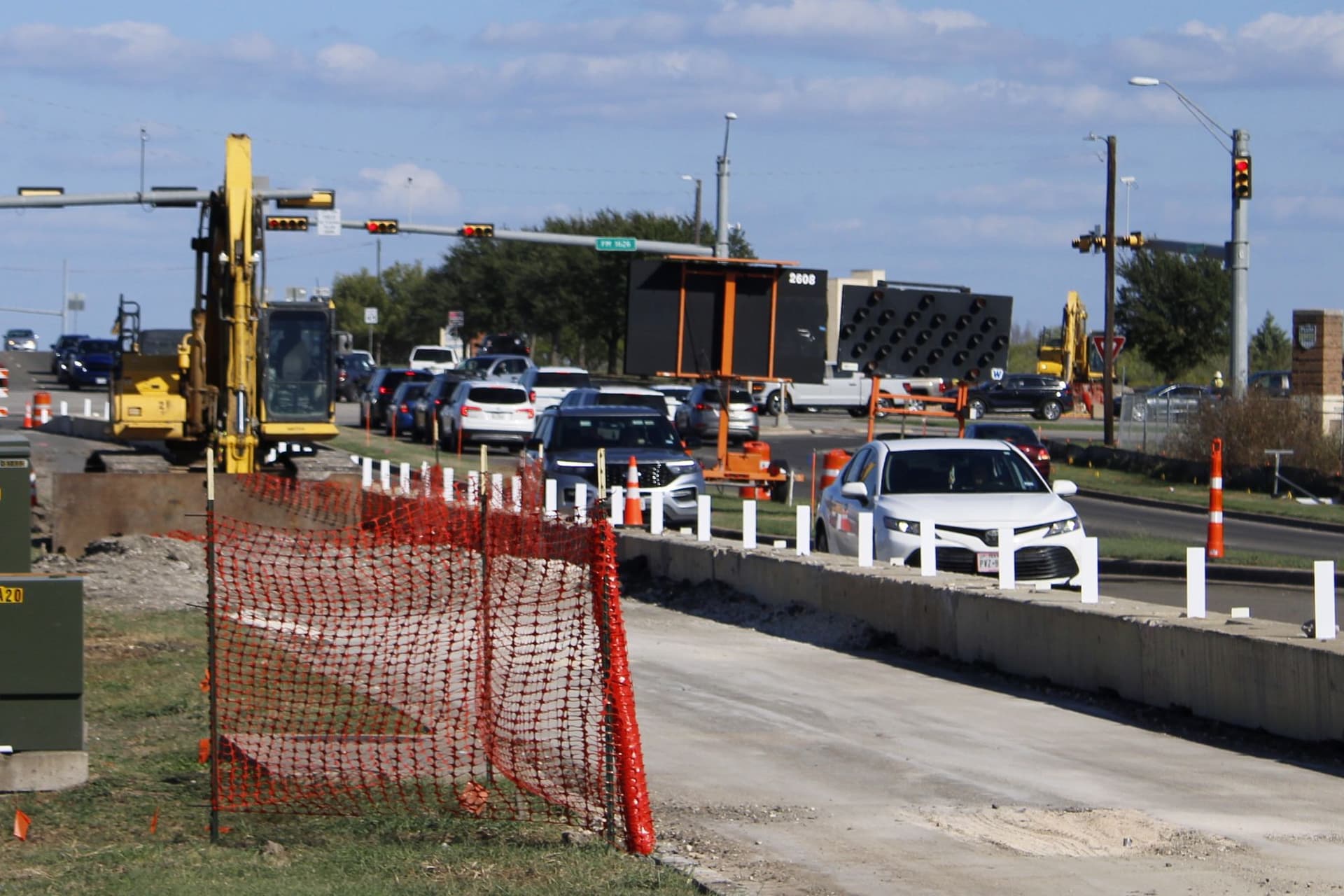
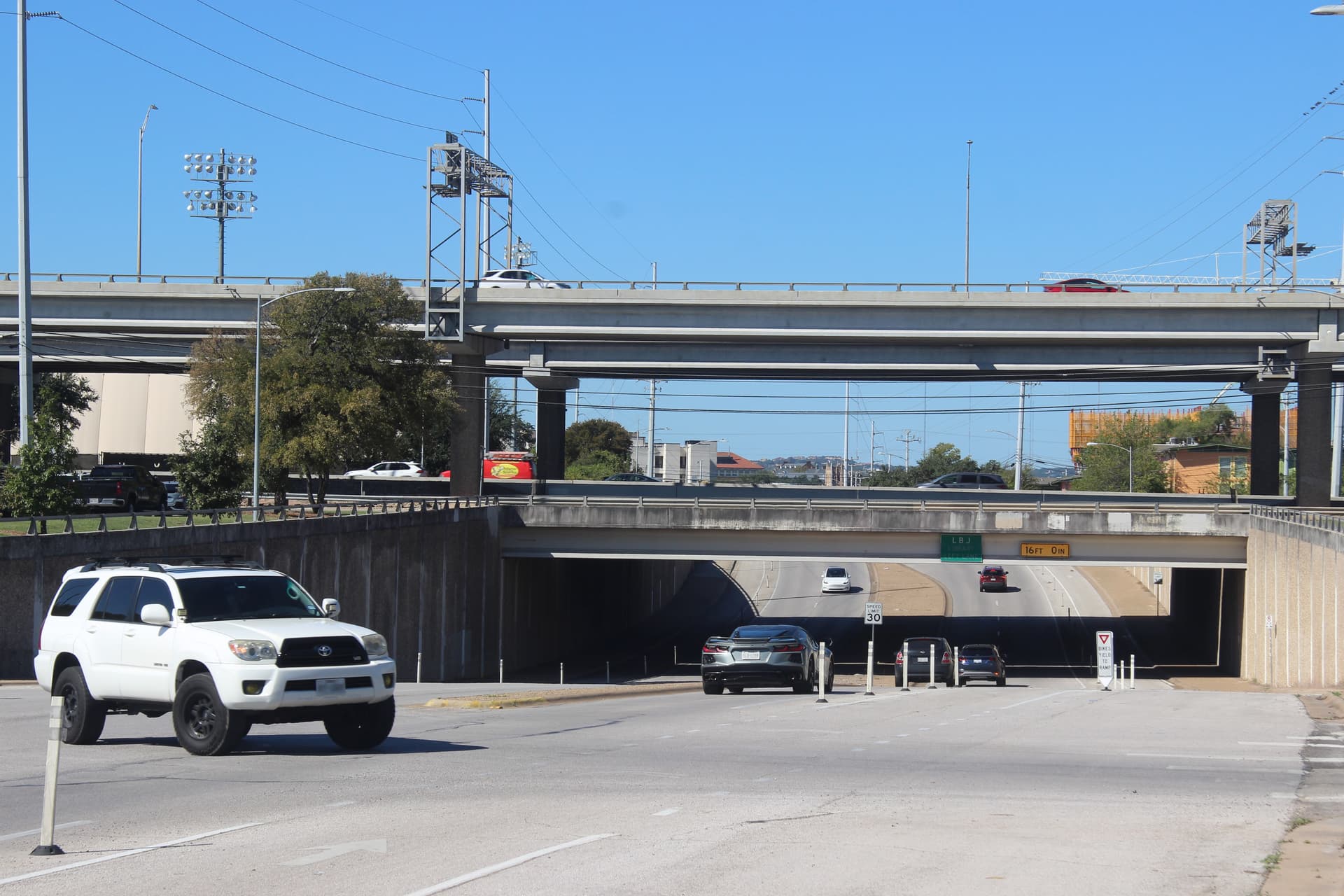
ATP officials noted the agency will need to work with TxDOT to ensure "coordinated and cost-effective" rail improvements along Hwy. 71. TxDOT spokesperson Brad Wheelis deferred questions to the city, but said the agency works with Austin anytime local projects overlap with state right-of-way. The FTA didn't respond to a request for comment as of press time.
While the extension's costs and development schedule are still to be determined, Watson said he hopes to see it added under the light rail project's existing budget without new taxpayer dollars required. He also said it's a critical project that'll support further economic opportunities along with the expanded airport.
"Our airport is an economic engine for Central Texas, serving travelers from 21 surrounding counties. It’s estimated that AUS will contribute more than $13 billion in economic activity in 2026 alone," he said. "We can see the benefit of having been ambitious back in the day and preparing for the future. We need to be equally ambitious about the transit system that can serve that airport. We should learn from and lean into our success."
The context
The fall announcement comes as ATP gears up to break ground on Austin's new light rail system in 2027 following several recent milestones, including:
Officials also recently voted to spend millions of dollars on downtown office space for ATP. Funding for leases and related improvements was reduced by tens of millions of dollars from a previous proposal that was shelved earlier this year, in part due to pushback from Watson over its cost.
The current iteration of Austin Light Rail's first phase was trimmed from the full Project Connect system outline presented in 2020. It ran roughly twice as long and included an airport connection, below-ground transit hubs, a downtown subway network, multiple crossings over Lady Bird Lake and a dedicated line with service to far East Austin.
Changes to those plans, as well as Project Connect's foundational tax-backed financing, have prompted legal and legislative challenges.
Lawsuits filed both by residents seeking to overturn the project, and the ATP seeking to validate its funding plan, remain in progress as of this year. And after facing largely Republican-led efforts to block Project Connect's financing structure in recent years, the outlook for any similar targeted legislation in 2027 under new Democratic state leadership is uncertain.