Democrats won all statewide seats in Texas during the Nov. 3 election, ending 24 years of Republican dominance in statewide positions. Democrats also won control of the Texas House, although the state Senate will remain majority-Republican. (Hannah Norton/Community Impact)
Democrats saw decisive wins up and down the ballot in Texas and across the nation in the Nov. 3 election, flipping the Lone Star State to Democratic control for the first time in a generation.
"We just took back Texas," Democrat James Talarico said as he declared victory over Republican Ken Paxton in the state's U.S. Senate race.
Their wins also mean Texas will have a divided state government for the first time in a generation, after Democrats won control of the state House but did not flip the state Senate.
Here's how we got here and what to expect in 2027.
What happened
As polls closed at 7 p.m. and election results began to roll in, Democrats almost immediately took the lead in statewide races. State Reporter Hannah Norton attended Talarico’s election night watch party at Austin's Long Center for the Performing Arts, while Editorial Intern Caleb Gottry was at Paxton’s event at the Westin Galleria hotel in Dallas.
At Talarico's watch party, thousands of supporters mingled on the center's patio, many of them glued to large screens that played cable news coverage of election results while others purchased refreshments from food trucks or chatted with vendors selling Talarico merch. Attendees cheered periodically as Democrats took congressional and gubernatorial races in other states, and the crowd erupted in celebration as Texas' races were called for the Democratic candidates, with some supporters chanting "U-S-A! U-S-A!" and waving signs with Talarico's campaign logo.
Nearly 200 miles north at Paxton’s event, doors opened a little after 6:20 p.m. to the general public.
Five Texas flags and five American flags lined the stage on one side of the hotel ballroom. A cannon sat on a smaller stage, with drink and food stations set up along the long sides of the room and Fox News’ election coverage projected on one wall.
Cheers erupted in the room as Florida's gubernatorial race went to the Republican candidate, though the roughly 150 attendees got notably quieter as Fox News announced that their estimates for Talarico’s victory had increased. Crowds began to thin out a little after 9 p.m., and the news stream was turned off after anchors announced Talarico's victory.
After the election was called, Pastor Richard Ellis led the group of Paxton supporters in prayer.
A group of Ken Paxton supporters huddle together to pray during the Republican U.S. Senate candidate's election night watch party at the Westin Galleria hotel in Dallas.Caleb Gottry/Community Impact
More details
By the end of the night Nov. 3, Democrats had won all of Texas' statewide races, including seats on state courts, in what politicians and experts are calling a massive blue wave.
Supporters take photos of state Rep. Gina Hinojosa, an Austin Democrat elected as Texas' next governor, at a Whataburger restaurant early Nov 4 in Austin.Hannah Norton/Community Impact
Democrats also took control of the Texas House for the first time in 24 years: By late morning Nov. 5, Democrats were projected to win 78 of the lower chamber's 150 seats, flipping 16 seats previously held by Republicans after entering election night with 62 seats, per election results from the Associated Press.
Republicans were projected to control 63 state House seats and nine races were too close to call as of press time with some ballots still being counted. Per state law, election officials have until Nov. 9 to receive mail-in ballots sent from overseas, and Nov. 13 is the deadline for officials to review provisional ballots, which are cast by voters who run into administrative or voter ID issues at the polls.
The Texas Democrats elected to hold statewide seats in 2027 are:
U.S. senator: James Talarico, an Austin state representative
Governor: Gina Hinojosa, an Austin state representative
Lieutenant governor: Vikki Goodwin, an Austin state representative
Attorney general: Nathan Johnson, a Dallas state senator
Comptroller: Sarah Eckhardt, an Austin state senator
General land commissioner: Benjamin Flores, a Bay City councilmember and rancher
Agriculture commissioner: Clayton Tucker, a Lampasas rancher
Railroad commissioner: Jon Rosenthal, a House state representative
Four seats on the nine-member Texas Supreme Court: Maggie Ellis (chief justice), Chari Kelly (Place 2), Kristen Hawkins (Place 7), Gisela Triana (Place 8)
Three seats on the nine-member Texas Court of Criminal Appeals: Okey Anyiam (Place 3), Audra Riley (Place 4), Holly Taylor (Place 9)
All three seats on Texas' 15th Court of Appeals: Jerry Zimmerer (chief justice), Tom Baker (Place 2), Marc Meyer (Place 3)
"Democrats didn't lose Texas overnight, and we're not going to win it overnight, either," said Texas Democratic Party Chair Kendall Scudder during a Nov. 4 call with reporters. "We have been working hard to make [last night] happen. In the last year and a half, we cleared our party's debt for the first time in decades, raising and investing a combined $40 million to execute the largest coordinated campaign in Texas Democratic history."
The impact
Texas has had a Republican governor, state Senate and state House since 2003, according to Ballotpedia, a nonpartisan political encyclopedia. In 2027, the state will be led by a Democratic governor, with a Democratic lieutenant governor presiding over the Senate and House lawmakers likely electing a Democrat to lead the chamber—however, the senators themselves are majority-Republican.
How much power Goodwin, the lieutenant governor-elect, will have over the Texas Senate is largely up to senators, who will approve the chamber's new rules when the legislature convenes in January.
The Senate's current rules give Republican Lt. Gov. Dan Patrick, whom Goodwin unseated, the power to form and appoint committees, dictate the route of legislation and recognize senators to speak during floor sessions, according to an analysis by Garrett Fulce, a Texas political consultant. Senators could choose to revoke those powers and give themselves more authority to make decisions.
"Texas stands as long as the Texas Senate Republican caucus holds the line," Sen. Charles Schwertner, R-Georgetown, wrote on X Nov. 3. "We will."
Sam Hooper, a legislative attorney and consultant, said he was "hopeful" that the Nov. 3 election results would lead to "a more collegial Senate" and cooperation among lawmakers of both political parties.
"Republicans are potentially very vulnerable in terms of what power they have left in the House, but also in a position to still make their weight felt in the Senate," Hooper told Community Impact in a Nov. 4 interview. "I think that some trading could happen back and forth—that maybe Republicans preserve some of their influence as they adjust to being a minority in the House at the expense of not completely defanging the lieutenant governor."
The majority-Republican Senate and majority-Democrat House will have to find a balance, as bills cannot become laws until they are approved by both chambers and sent to the governor. The legislature is also constitutionally required to pass a balanced two-year budget every session.
"If pragmatic heads prevail, I think there is an opportunity to knuckle down and really have a good session that is focused on issues like cost of living, like making the government just a lighter burden on everyone's lives—but it might not necessarily go like that," Hooper said. "A lot of people have campaigned on very specific issues [and] rolling back certain initiatives. School choice vouchers [were something] a lot of people wanted to expand, but in the coming session, that's probably dead in the water now."
When will Democrats take office?
While Talarico, Hinojosa and other Democrats declared victory in their races Nov. 3 and began planning their approaches to governing, they will not assume office immediately.
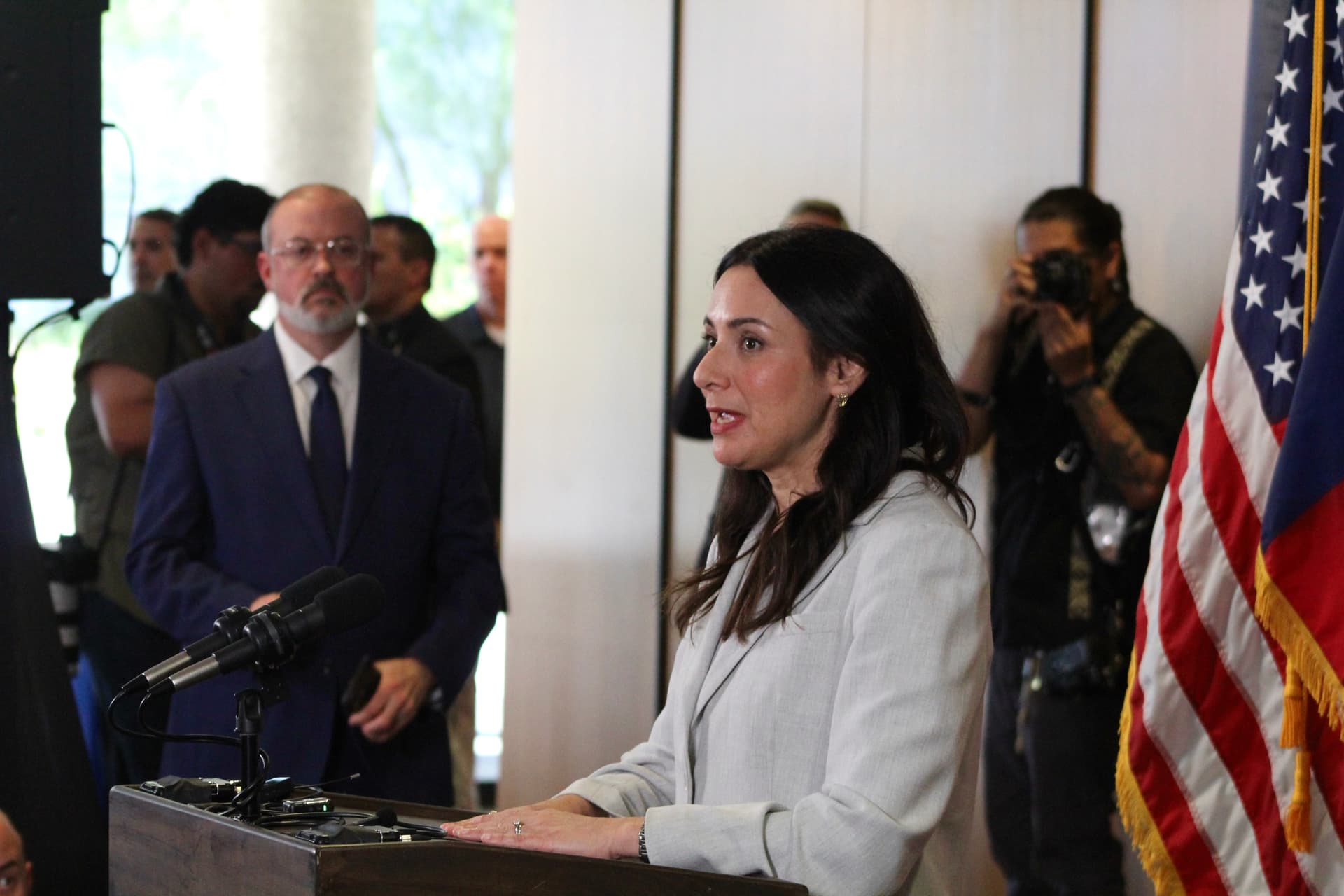
"This is not about being a Democratic administration," she said during a news conference at the University of Texas. "I'm not going to be the governor for just Democrats—I'm going to be the governor for all the people of Texas."
The official transition will not occur until January, and Republican incumbents will remain in office until then.
At the federal level, the 119th U.S. Congress is scheduled to conclude on Jan. 3, ushering in the 120th Congress, which Talarico will be a part of. New members of the U.S. House and Senate will be sworn in on the first day of the new Congress.
The 90th Texas Legislature is scheduled to convene on Jan. 12, and newly-elected lawmakers will take office that day. The Texas Constitution states that a new governor "shall be installed on the first Tuesday after the organization of the Legislature, or as soon thereafter as practicable."
This means Hinojosa will be sworn in on or after Jan. 19. In previous election cycles, the lieutenant governor was sworn in during a joint inauguration ceremony with the governor.
Other statewide elected officials are also expected to take office in January.