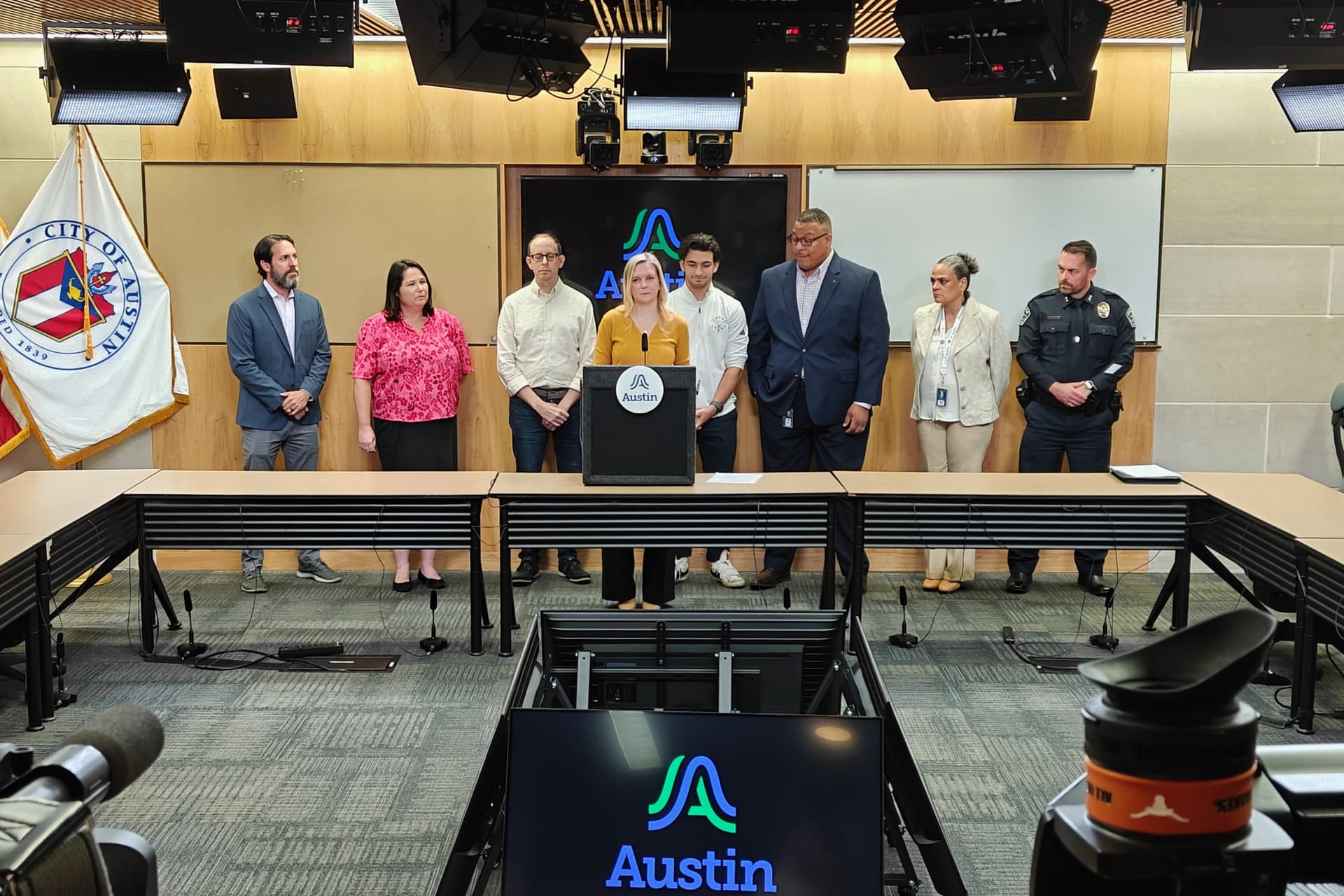
Austin leaders provided updates on a city education and enforcement campaign related to e-motos on Sept. 3. (Ben Thompson/Community Impact)
City leaders are continuing to increase messaging and enforcement surrounding electronic motorcycles and mini-bikes, or e-motos, which have drawn safety and regulatory concerns as they've grown in popularity.
The overview
E-motos are self-propelled vehicles that can reach top speeds well over 30 miles per hour. Devices falling under the e-moto umbrella can be illegal to operate on public streets, but difficult to distinguish from motorcycles, pocket bikes, mopeds and e-bikes—all of which have various definitions and regulations.
“These are powerful motor vehicles capable of exceeding 60 miles an hour, and they’re being ridden by kids who don’t have licenses, don't have helmets sometimes, and in many cases don’t know what the rules are. And there might be situations where their parents also aren’t aware of what the safety regulations might be," council member Paige Ellis said.
Austin residents, law enforcement and elected officials have all reported rising concerns related to e-motos, particularly with the higher-powered devices that aren't street legal. In response, City Council unanimously passed a resolution this spring calling for a review of local e-moto rules, and to boost public education about the vehicles and relevant laws.
Austin Police since produced a video about the devices and is now developing more materials as part of the informational campaign, which will also include a public-facing website. Officers are also receiving new training bulletins about e-motos with the broad aim of educating residents before any enforcement is needed. And the city is coordinating with other entities like Austin ISD to expand the reach of its campaign.
“This isn’t about discouraging new forms of mobility, it’s about ensuring that we integrate responsibly in our community," Assistant City Manager Mike Rogers said. "Austin has always embraced innovation, and with the right guardrails in place we can support a transportation ecosystem that is safe, connected and accessible to all."
Zooming in
Among the challenges identified during the city's continuing response is the difficulty identifying e-motos in action, and the way different devices are regulated. Police officials shared the latest on their approach at a Sept. 3 press conference and council Mobility Committee meeting.
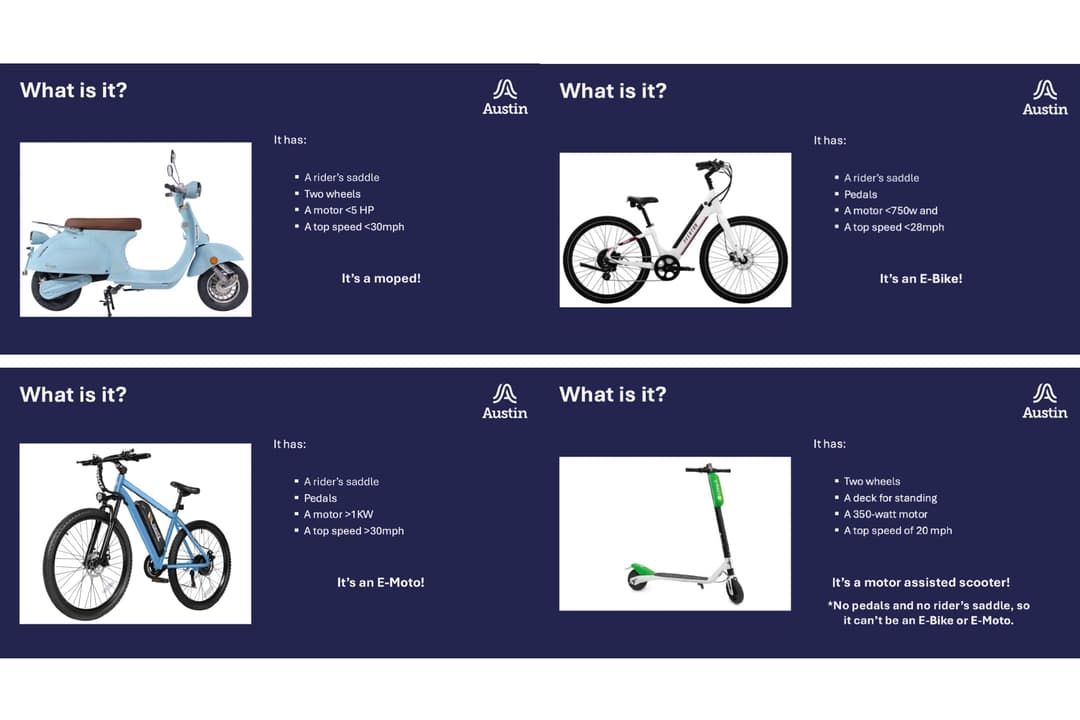
State transportation code defines e-bikes as bicycles with operable pedals, less powerful motors and top speeds of 28 miles per hour or less. Motorcycles are regulated like motor vehicles with licensing and insurance requirements, and mopeds are similar but with a capped top speed of 30 miles per hour.
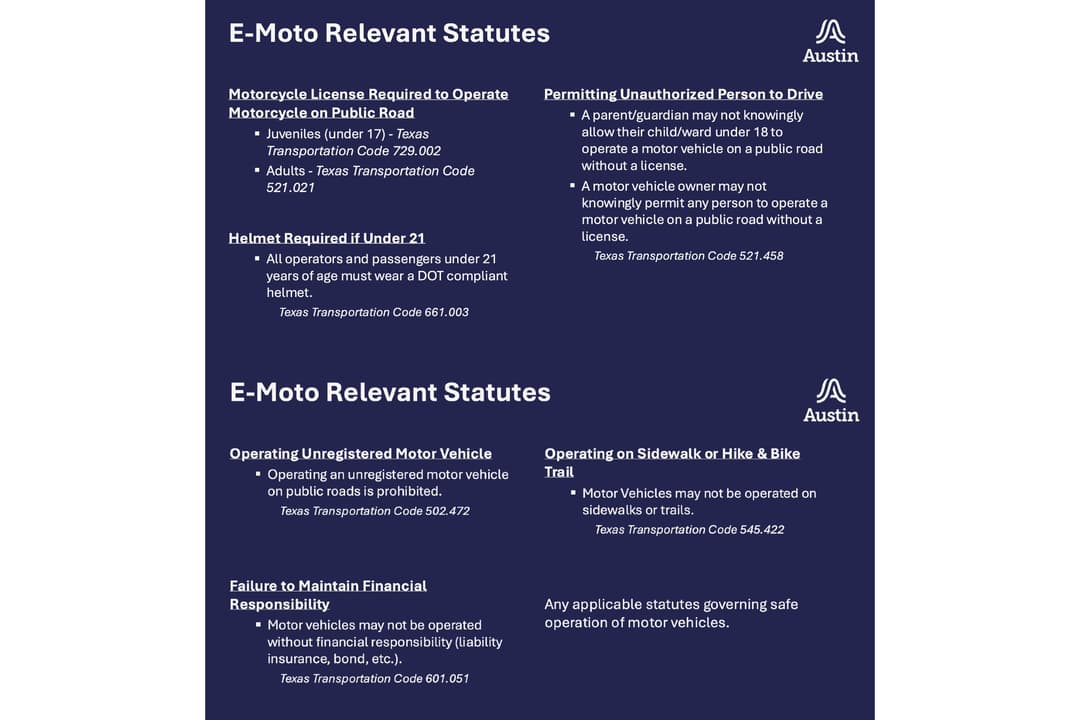
E-motos are other similar devices that don't fall under those definitions, don't have operable pedals, and have more powerful motors that can often reach highway speeds. E-motos that aren't classified as e-bikes qualify as vehicles similar to motorcycles, which would also require formal registration and insurance. Such devices can't be driven without a license or by children under 17.
However, many e-motos aren't street legal as they can't officially be registered or operated on public roadways.
“When we look at what we’re talking about with these little bitty pocket bikes and things like that, there’s no way physically for them to meet all the requirements that the state has on them," Assistant Chief Mike Chancellor said.
E-motos are similar to other electric mobility devices. (Courtesy city of Austin)
Given those conditions, Austin Police updated its training and has adopted an education-forward approach to dealing with illegal e-moto use. Outside more dangerous situations, officers are first warning e-moto users before issuing any citations or potentially impounding a device.
“The calls that we get to are the kids that are driving through the neighborhoods at 40-50 miles per hour on one of these e-motos and that vehicle is not registered, they obviously don’t have a driver’s license for it," Chancellor said. "We want to make sure we’re educating the parents and the users of these devices so that we can all enjoy our streets safely.”
Chancellor said he didn't have any data on e-moto citations since the city's campaign started this spring due to difficulty tracking and compiling that information. More information could be gathered by the police department, Austin Public Health and local hospitals in the future.
What they're saying
Ellis, who sponsored the e-moto resolution earlier this year, noted Austin has frequently served as a "guinea pig" for mobility advancements like electric scooters and autonomous vehicles. And as with AVs or other transportation options, the city may not be able to put its own rules into place given the state's dedicated authority over those topics.
"We are very familiar in Austin, Texas with new technology, and oftentimes the existing regulations or the existing authority that we have is not yet vetted," she said.
Higher-powered e-motos fall under similar motor vehicle regulations as motorcycles. (Courtesy city of Austin)
Council member Krista Laine said e-moto oversight and clear rules are important given the number of children now using micromobility devices to move around their neighborhoods or get to school.
“This has become a genuinely popular hobby, and riders deserve a place to enjoy it more freely as well as to build their skills for future safe use on roadways, should they so choose," she said. "Downtown Austin isn’t a safe place to pop a wheelie, and neither is the school pickup line.”
One more thing
As part of council's directive from earlier this year, the city is also exploring the creation of a dedicated e-moto recreation area where the devices could be legally driven. The police department has worked with Austin Parks and Recreation to identify potential sites, and Laine said other city property should be considered for that project as well. No potential e-moto park locations were identified as of this summer.