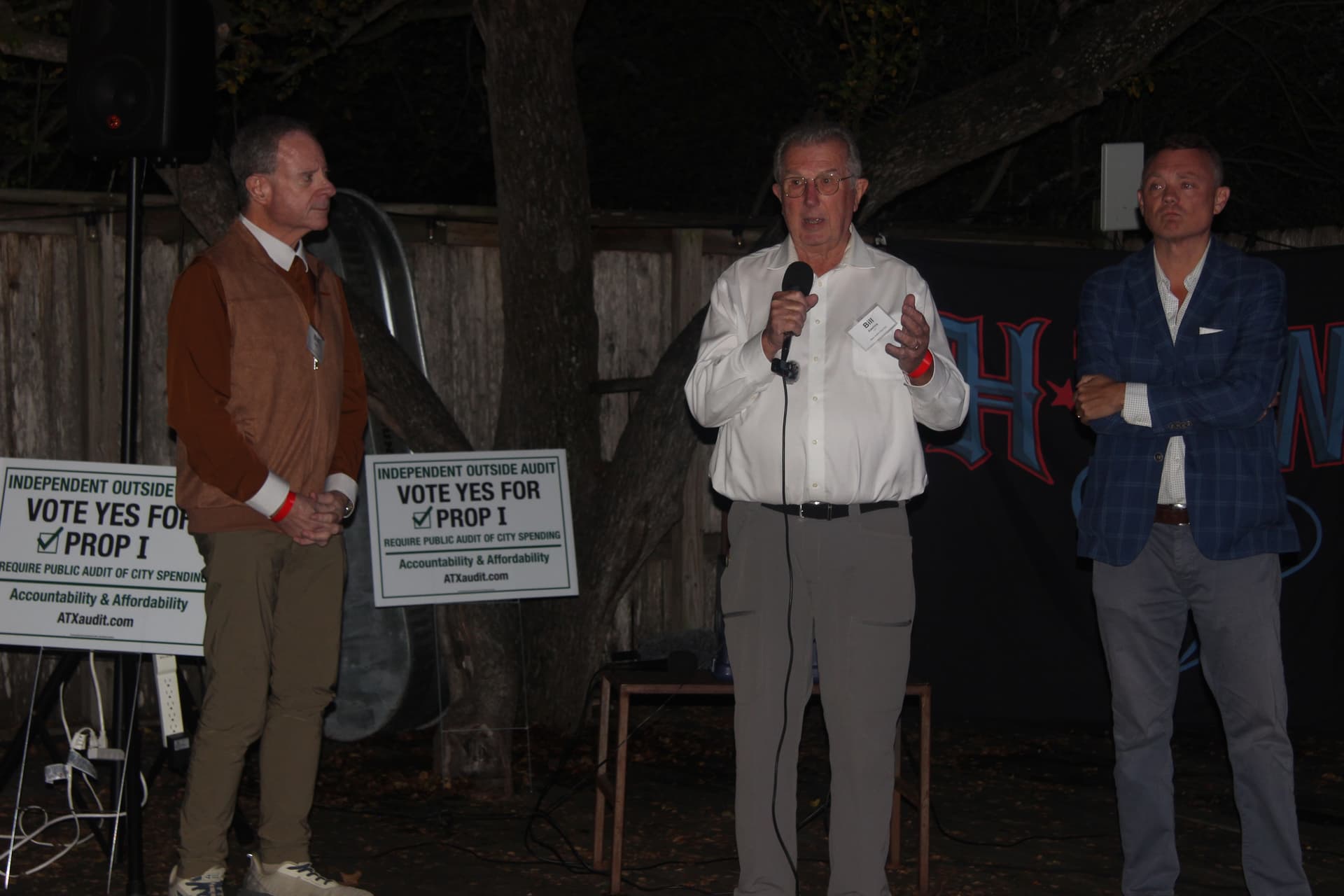
Proposition I author Bill Aleshire spoke about voters' rejection of the proposal for a citywide efficiency assessment at a Save Austin Now election night event Nov. 3. (Ben Thompson/Community Impact)
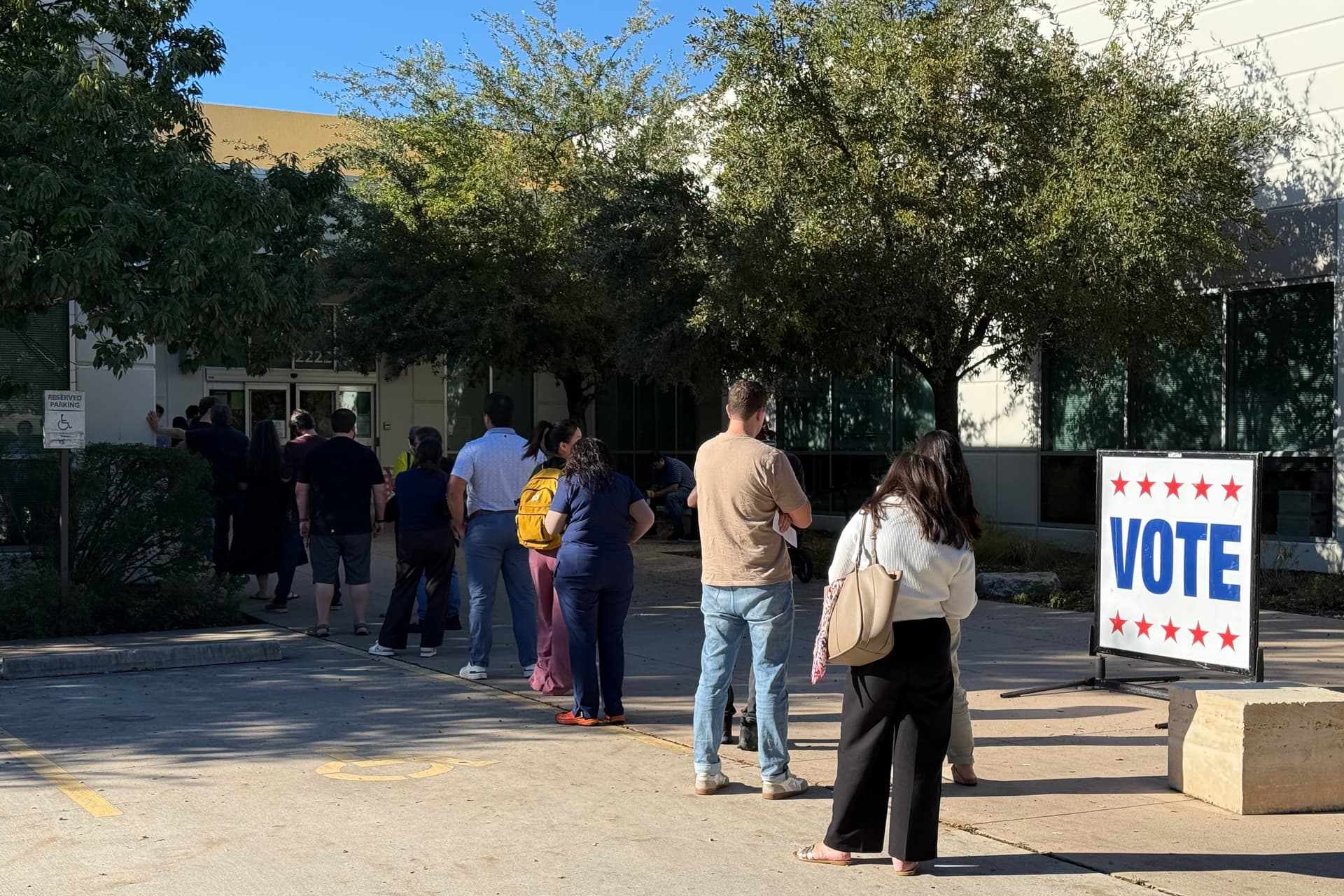
Austin voters rejected a proposed mandate for recurring independent assessments of city government operations, spending and performance by a 10-point margin, unofficial Nov. 3 election results show.
While the Save Austin Now-backed Proposition I failed, an existing multi-year comprehensive efficiency review authorized by City Council remains in progress with initial reporting expected early next year.
The big picture
City officials voted to establish recurring, wide-ranging assessments of Austin's government in February. The concept was suggested by Mayor Kirk Watson partially in response to the failure of last year's Proposition Q, a tax rate increase measure, and perceptions of voter discontent with City Hall's spending practices and transparency.
Watson called the assessment program a "back to basics" modernization of city government aimed at improving public trust. It requires a third-party contractor to:
Evaluate the efficiency of Austin's "operations, management structure, functions, programs, services and policies," including cost-benefit analysis
Report on city contracting practices, performance metrics, deliverables and accounting
Recommend cost savings and performance improvements across city departments, and assess how changes are implemented
Compare Austin's efficiency and financial standards to peer cities
The multi-year audit is taking place under a $5.23 million contract with Public Works LLC, with support and oversight from the Austin City Auditor's Office. The firm was selected this summer after it received the highest score in a public solicitation. Its project cost ranked in the middle of 24 total submissions that reportedly ranged from $1.1 million to more than $25 million.
Following the initial project that kicked off this year, the third-party citywide assessments will continue on a repeating schedule with at least three years between each review cycle.
The approach
Public Works anticipates taking three years to complete the process based on an assessment plan covering:
General fund departments providing public-facing services, including public safety, public health, homeless strategy, housing and planning, parks, library, animal services, and arts and culture departments, in Year 1
Enterprise and support services departments including aviation, transportation and public works, watershed protection, convention center and financial services departments, as well as City Council and city management, in Year 2
Utility departments including Austin Energy, Austin Water and Austin Resource Recovery in Year 3
A city spokesperson said Public Works has already made "significant progress" on its Year 1 assessments and is nearing an early progress marker. The firm's first public report could come at council's Audit and Finance Committee Jan. 20 meeting.
After initial reviews this fall, Public Works will move into benchmarking against peer cities, a preliminary analysis of finances and inefficiencies, and a look into Austin's staffing and overall organization. After another progress check, the firm will develop actionable improvements for the city to take on. It aims to complete the Year 1 process next summer.
The first year of Austin's new efficiency assessment process focuses on the city's general fund departments and is expected to wrap up in summer 2027.City of Austin
The council-approved program requires regular updates and recommendations to the audit committee, and posting relevant information publicly online. Direction from council, based on feedback from the AFSCME Local 1624 government employees' union, also ensures engagement with city workers on potential efficiency improvements.
The citywide audit program was adopted last year while Save Austin Now successfully petitioned a separate, similar initiative as an amendment to the city charter. That measure eventually landed on the ballot as Proposition I and failed in the November election.
The existing audit was approved through an ordinance that formally added it into city code. The program can only be changed or canceled by a City Council supermajority of at least nine votes—although that standard could depend on elected officials' willingness to contradict the policy.
"It is just a hurdle," Watson said in February. "You’d have to override the public’s desire and have a council that would go with six [votes, or a simple majority] in order to change that; that’s just the legal requirement. But as I was working on the draft of this, I wanted to put a marker out there that this was serious and that we meant it."
On the other hand, Proposition I's efficiency assessment program was drafted as a new element of Austin's charter. Charter amendments can only be adopted and revised through elections that are limited to every two years. Save Austin Now said that difference would prevent interference from the city, while opponents raised concerns about its inflexibility.
Proposition I included no cost estimate, but had a provision requiring the audit contractor to identify city budget savings totaling more than total project costs. Opponents said that requirement wouldn't result in an independent approach and could lead to unwanted budget cuts.
Ahead of the election, Austin estimated Proposition I's one-year assessment could cost more than $9 million. That figure was based on proposals submitted for the council-approved audit program that "most closely aligned" with the proposition's scope, the city spokesperson said.
A Proposition I project would've been funded in a mid-year budget amendment, with undetermined impacts based on the provision for offsetting costs. While the ballot measure failed, the city was in position to comply.
"The Austin City Auditor’s Office has been working with central procurement to be prepared if Prop I passes. City staff would begin working immediately on implementation and will follow the petition as written," the spokesperson said before the election.
Austin's existing efficiency assessment program and Proposition I had several key differences.Courtesy City of Austin
The existing efficiency assessment requires reporting at council sessions and the publication of all "information, results, recommendations, and implementation progress" online. Proposition I would have required all audit drafts and information compiled through that process to be provided, if requested.
Some information from the ongoing city review won't be publicly available, as state public records law allows "audit working paper" materials—such as internal communications and draft reporting—to be withheld. Although a program fact sheet from the city stated audit drafts would be public, the spokesperson said the working paper exception will apply while final results will be released.
"At tollgates, Public Works LLC will present dockets for each department itemizing areas for potential improvement. These dockets will be presented publicly, including which items were selected for further analysis and which did not move forward. Ultimately, reports for each department will be produced publicly. These reports will detail recommendations for improvements, including supporting detail," the spokesperson said.
What they're saying
Proposition I was opposed by the Don't DOGE Our Austin campaign, which received most of its funding from AFSCME's local and federal arms. AFSCME Local President Brydan Summers said the election results showed city voters recognized problems with the proposition and found it unnecessary given the existing auditing process.
"It’s not like an either/or on, ‘Do you care about efficiency as a city or not?’ It’s, ‘Did you think that this was the right way to go about that?’" he said in an interview. "Austin is a union town. Austin is a progressive town. The margin of the victory shows that the voters are not interested in seeing the kind of measures being brought forward by Save Austin Now, and we’re looking forward to the future.”
Watson said Proposition I's failure sent a message that voters care about good fiscal stewardship, and that the existing audit process will improve aspects of Austin's operations.
"The need for accountability and financial discipline doesn't depend on an election result. It's a fundamental responsibility of good government, and it makes a fundamental difference in how our residents experience our city," he said in a statement. "[T]he goal isn't simply to conduct an audit. The goal is to make government work better."
Council member Mike Siegel said voters recognized the current assessments taking place and the continuing work of the city auditor's office.
"Prop I was a burdensome, expensive and redundant measure. The defeat shows that Austin will not be swayed by a doomsaying message about the failure of their City government and local democracy. Instead, Austinites believe in our City's ability to manage resources for the greater good of our community," he said in a statement.
For Save Austin Now representatives, enthusiasm for local liberal candidates on the November ballot and misinformation by Proposition I opponents were stated factors that hurt their measure's chances.
“I feel sorry for the voters that got duped tonight by the boogeyman political strategy that took attention away from the merits of that charter amendment, and the audit they could’ve had, to turn it into a partisan issue," attorney Bill Aleshire, the proposition's author, said Nov. 3. "Austin has lost an opportunity to understand more about its city government."
Co-founder Matt Mackowiak said "massive" Democratic turnout and dishonest arguments against Proposition I led to its failure.
"We had hoped we would provide the information the taxpayers deserve. We had hoped that we would get an independent performance audit, be the first major American city to do that in the charter," he said on election night. "What’s disappointing tonight most is we did not lose on the facts, we did not lose on the merits. We lost because the other side very effectively lied about our proposal."