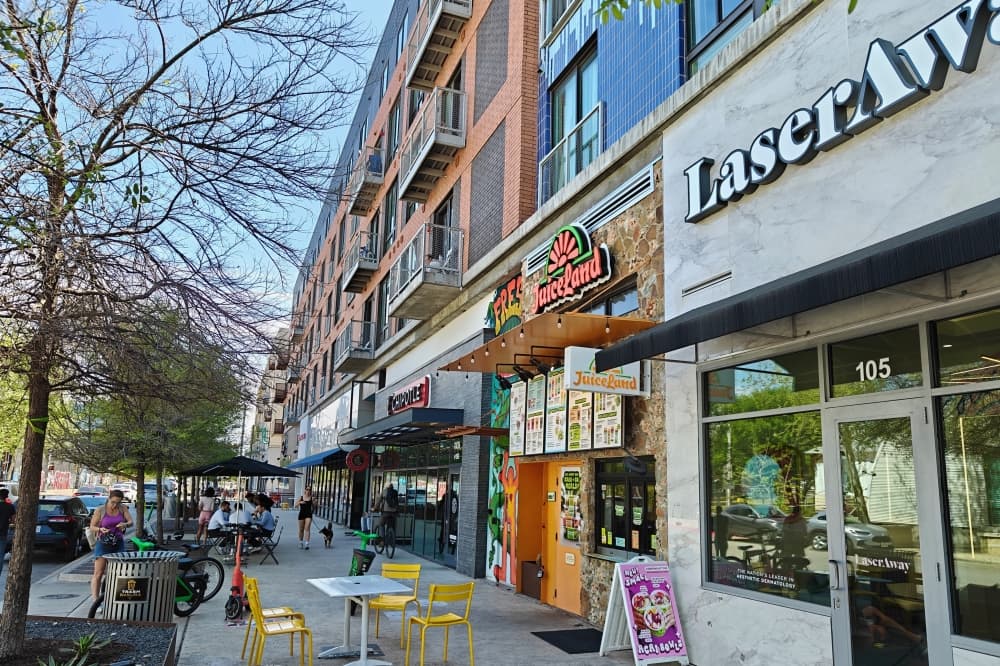
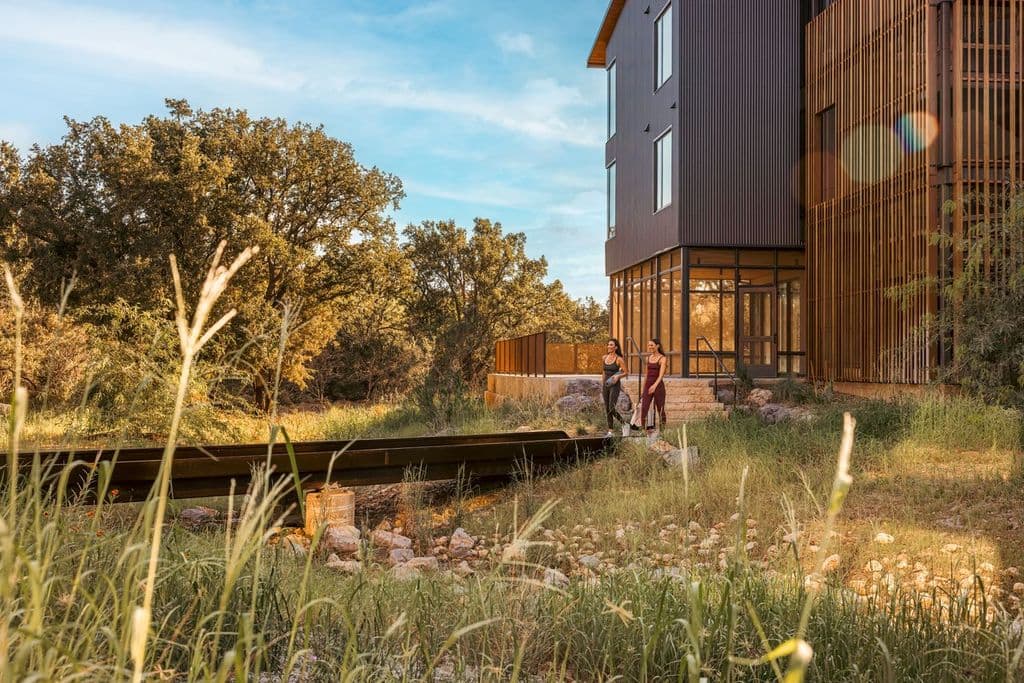
A new mixed-use building program with affordable housing requirements can now be used across much of the city. (Ben Thompson/Community Impact)
Affordable housing programs tied to mixed-use construction citywide and taller towers downtown are now in effect.
The big picture
City Council approved the new measures both in response to tensions over another mixed-use building program, and a 2025 state law that's impacted how Austin can incentivize affordable housing with new development.
Certain building entitlements that the city had previously traded for public benefits, like low-income housing, were automatically permitted under Senate Bill 840. That change prompted a local response to ensure continued affordable housing additions.
A citywide density bonus program called DBC is now in place, succeeding a similar previous program—density bonus 90, or DB90—that's been used in dozens of zoning cases since its creation more than two years ago. DB90 allowed buildings up to 90 feet tall, as long as a share of affordable housing was included. Hundreds of income-restricted housing units were created or planned under DB90, but it also drew frequent local opposition over the impacts of new construction and residential displacement.
Noting that pushback, officials called last year to revise DB90 with more varied options for building heights and affordable housing. DBC was established May 21 under that directive with tiered height levels to be used in different neighborhood contexts, and a lower affordability threshold than comparable past programs.
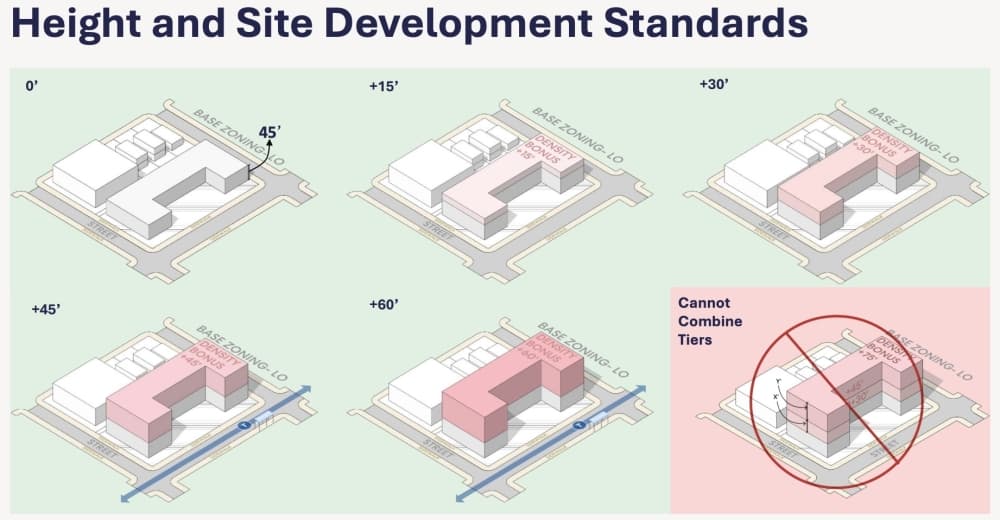
DBC can now be used in commercial areas across Austin; it doesn't apply in single-family or industrial zones. It includes five tiers ranging from 0 to 60 extra feet of building height on top of whatever is already allowed on a property using the bonus.
Austin's new DBC program allows taller buildings scaled for different parts of town. (Courtesy city of Austin)
The designation adjusts several development standards, including compatibility rules that limit larger projects near single-family homes. While DBC's compatibility was initially more relaxed, in line with the former DB90, an amendment from Mayor Kirk Watson established lower building heights close to existing homes.
“The compatibility in the DB90 program proved, in my opinion, to be out of alignment with the goal of integrating denser developments into residential areas with reasonable impact," he said in May.
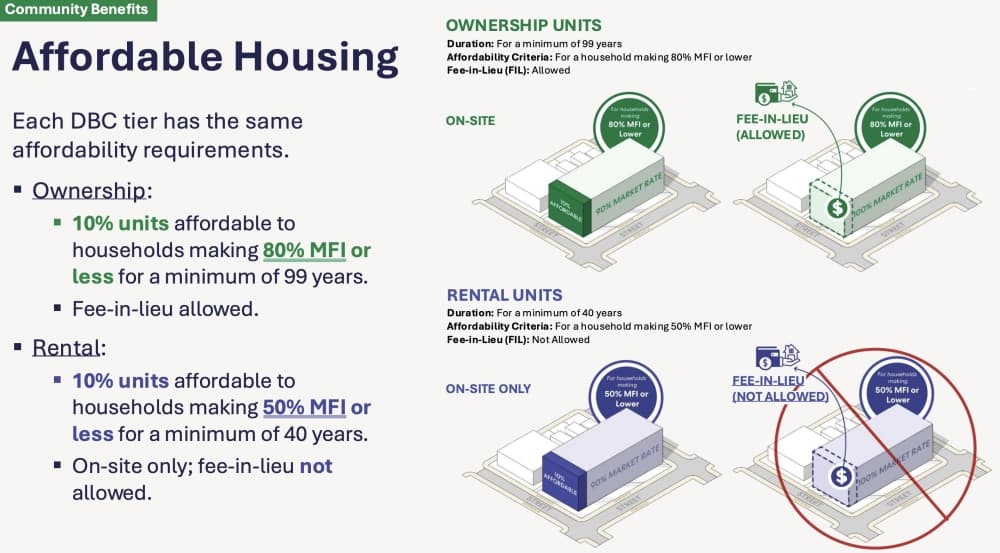
Developments using DBC must contribute affordable housing. For for-sale residential units, at least 10% must be reserved for owners earning up to 80% of the local median family income, or MFI. For rental projects, at least 10% of units must be set aside for tenants earning up to 50% MFI—a lower level than Austin's typical density bonuses, reflecting officials' desire to produce more housing for lower income levels.
Analysis by city planners suggested DBC would have a positive effect on housing affordability in Austin.
The DBC incentive program requires lower levels of affordability for some new housing. City Council also voted to allow fee payments in lieu of lower-income housing, which was not originally proposed by planning staff as shown. (Courtesy city of Austin)
Payments to the city's affordable housing fund can be made instead of providing new units under a council-approved amendment, and officials also called to further study the impacts of that strategy this summer. Some said the fee option will allow the city to support more lower-income housing in different locations. Council member Ryan Alter also directed staff to explore how Austin can prioritize affordable development at the deepest MFI levels.
“We have seen in the [Austin Strategic Housing Blueprint] that that is the area of biggest need of the city, but we’re not getting those units built," he said. "This is to change developer behavior; where you’ve got a development that might have had 10% of the units be at 30% [MFI] and another 30% at 50% [MFI], how do we make that 20% or 30% [of all units] at that 30% [MFI] level? What kind of requirements or incentives do we need to incentivize to make this happen?”
Alongside that work, the city will also review ways to preserve existing affordable housing and limit negative impacts on tenants if residences are torn down and replaced under DBC.
Another viewpoint
Officials passed DBC with general support in an 8-1-2 vote; only council member Marc Duchen was against. Duchen, a critic of DB90 and several recent city housing policy updates, called DBC absurd and said it lays out a "buffet of entitlements" for real estate developers at the expense of Austin residents.
“I get that this is here to address a policy issue due to SB 840," he said. "What concerns me is that we started with what I thought was a fairly sensible staff proposal that morphed into something that I can barely make sense of. What are we doing here, who are we serving? In what way does increasing the economic return and the base land value of commercial property serve the vast majority of constituents?"
The outlook
DBC's rollout appears different from DB90's two years ago, which came with a wave of initial interest after a separate building program was voided. Reflecting different real estate market conditions today, Austin Planning reported no applications to build under DBC were submitted since it went into effect June 1.
DBC is also meant to serve as a complete replacement for DB90 and Austin's vertical mixed-use, or VMU, programs. Austin is no longer accepting new zoning applications under those categories in favor of DBC going forward. Existing DB90 and VMU properties, or those with pending applications as of this spring, can either maintain their current standards or opt into DBC.
What else?
One week after DBC's passage, council members separately approved an update to Austin's Downtown Density Bonus Program. The longtime incentive has required affordable housing units or funds to be contributed as new high-rises were built downtown. SB 840's impacts led to temporary updates months ago, and the revised program with new height limits was enacted May 28.
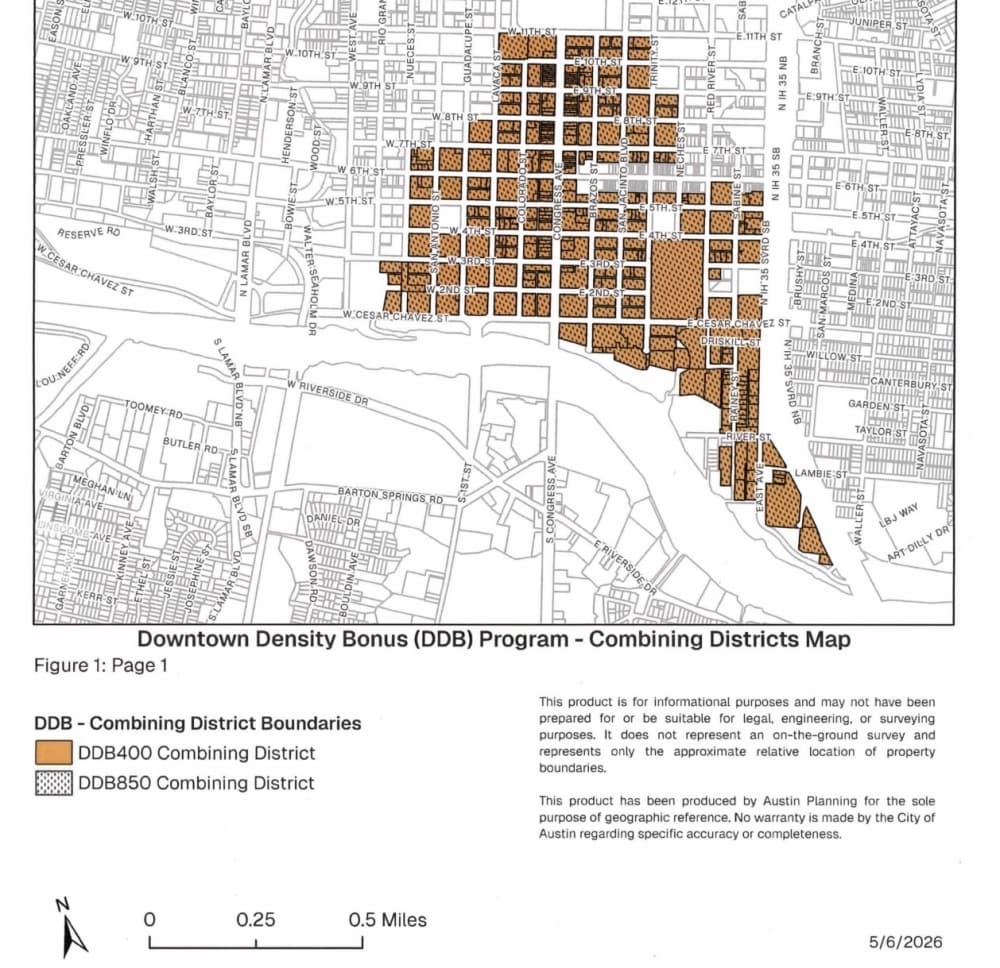
The update laid out a new designation of DDB400—granting 400 extra feet of height under the base Downtown Density Bonus Program—across much of downtown. It also created the voluntary DDB850 zoning label, which can see buildings to add up to 850 feet to their current allowed height. With those bonuses, maximum tower heights across much of downtown Austin are now set at 750 feet under DDB400 and 1,200 feet under DDB850.
The city revised building standards with affordable housing requirements for high-rise development in much of downtown, with planned expansion in the future. (Courtesy city of Austin)
Both programs also require affordable housing contributions by providing 5% of new residential rental units for tenants earning up to 50% MFI, or 5% of new ownership units for buyers earning up to 80% MFI. Fee payments based on the square footage of extra building area are also still allowed—historically, the most frequently used option under the downtown program. City planners reported DDB400 and DDB850 would have a neutral impact on housing affordability.
New construction under DDB400 was allowed as of June 8, while properties seeking to use DDB850 must go through a rezoning process subject to council approval. Austin Planning staff said it's too early to gauge interest in updated program.
Looking ahead, a future program phase will cover more of downtown and the South Central Waterfront south of Lady Bird Lake. Adjustments to include the Red River Cultural District area and implement historic preservation proposals are also in the works.