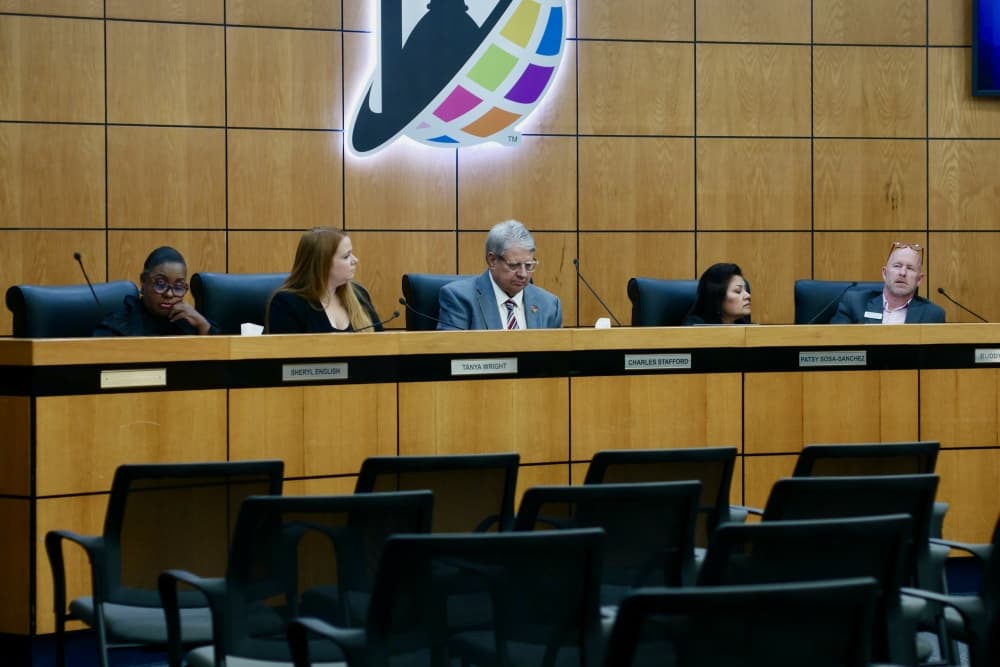
Denton ISD will end fiscal year 2025-26 with a roughly $22 million surplus, according to a report from Jennifer Stewart, DISD’s executive budget director, at an April 14 trustee meeting.
By the numbers
The district’s revenue exceeded expenditures by nearly $22 million for FY 2025-26, primarily due to Proposition A, a tax rate election voters approved in November 2025 that raised property taxes to $1.2069 per $100 of valuation. The tax rate added about $27 million to the district’s revenue, which the district used to compensate for the $15 million deficit and provide an additional payment to staff.
Texas House Bill 2 added state funding for teacher pay, special education and career and technical training. HB 2 increased revenue by about $19 million.
The district also received $7.4 million from one-time revenue sources such as land sales and tuition-based programs, and $8 million in one-time state funding sources, per Stewart’s report. The district’s revenue totaled roughly $388 million, about $62 million over the previously budgeted revenue of $326 million.
Expenditures totaled $366 million, about $20 million over initial projections of $345 million. Major campus repair projects, special education contract services, repairs necessitated by Winter Storm Fern and adjustments to employee compensation all added to the district’s expenditures for FY 2025-26.
Some background
District officials said the surplus will help to stabilize DISD’s fund balance, which sat at about $66 million at the end of FY 2024-25.
District policy dictates that DISD maintain a fund balance of three months' worth of expenses, or 25% of annual expenditures. The fund balance has declined from about $108 million and 35.35% of expenditures in FY 2020-21, down to $66 million and 19.06% of expenditures in FY 2024-25.
A February financial update showed that Proposition A and HB 2 would add just over $6 million to the fund balance after covering the $15 million deficit and additional staff payment.
The $15.4 million from state program changes and one-time revenue sources also added to the fund balance, Nick Petito, DISD chief communications and marketing officer, said. The added revenue puts the current fund balance at about $88 million and 24% of annual expenditures for FY 2025-26, according to district estimates.
“You can see that $21 million, almost $22 million, will help us stabilize. We still will not be back to three months' operating expenses with that, but we will be much closer than we were the last time we talked about our budget a year ago,” DISD Superintendent Susannah O'Bara said at the board meeting.
DISD officials use the fund balance to cover operating expenses over the summer, between the end of the fiscal year and receiving payments from the Texas Education Agency and taxes, O’Bara said.
She added that a low Tier 2 property tax rate, combined with a stagnant per-student allotment from the state, caused the district to operate in a deficit for several years.
“We have decreased our fund balance because of our maintaining that low Tier 2 [tax] rate [and] the lack of increase in state funding,” O’Bara said. “Because we've operated in a deficit for so many years, we had decreased our fund balance to be less than two months of available fund balance.”
In the past, district leaders chose not to pursue a tax rate increase because the district was growing and issuing bonds for new facilities to accommodate the growth. District leadership did not want to raise taxes and go out for bonds at the same time, board president Barbara Burns said.
Looking ahead
Preliminary budget projections for FY 2026-27 show the district will receive about $380 million in revenue. O’Bara said the actual revenue amount will likely be higher due to changes in the special education funding formula, though those changes are still being determined.
DISD officials also expect to incur about $370 million in expenditures, giving the district a surplus of about $10 million, according to Stewart’s report. District leaders are currently considering staff raises, which would cost the district about $9 million.
Editor's note: This story was updated to specify the per-student allotment as the state funding source and to add context to the district's Tier 2 tax rate history.