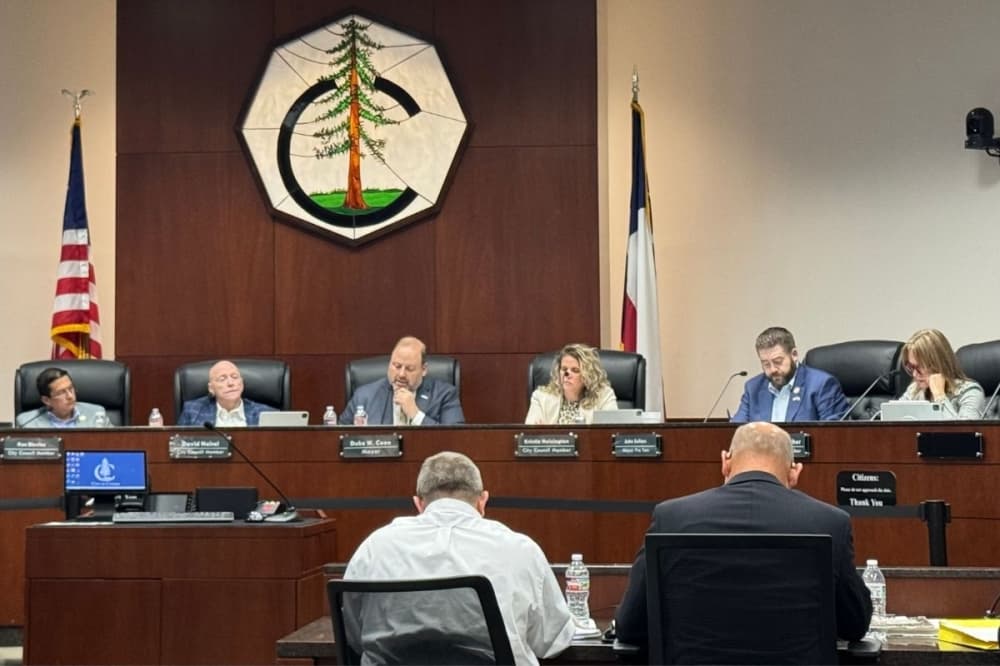
Two proposals tied to Conroe’s use of Flock Safety cameras were tabled indefinitely July 23 after City Council members voted unanimously to set both items aside.
One proposal would have created a temporary citizens advisory committee to study the city’s use of automated license plate recognition technology. The second would have asked the city attorney to determine whether residents could vote on Conroe’s participation in the Flock program.
The votes do not terminate, suspend or change the city’s Flock agreement. City Council also did not set a date for either proposal to return.
What happened
Council member Kristin Hoisington, who co-sponsored the advisory committee proposal with Mayor Pro Tem John Sellars, moved to postpone the item indefinitely. Sellars supported the motion.
The proposed nine-member committee would have included six citizen appointees, a Conroe Police Department representative, a technology or cybersecurity professional and a Montgomery County prosecutor, according to the agenda item.
Members would have reviewed the program’s costs, effectiveness, privacy implications, data-retention practices and the city’s options to continue, amend, renegotiate or terminate its agreement with Flock. Per the agenda, the committee’s findings would have been due by Dec. 31.
Council members Shana Arthur and David Hairel brought forward the second proposal, which would have directed the city attorney to research whether a public vote could be binding or advisory, as well as the process for placing the question on the November ballot and the estimated cost and timeline of an election.
Hairel ultimately asked to amend the motion to table the proposal indefinitely, and Arthur agreed. The council approved tabling both items without opposition.
What they are saying
Hoisington and Sellars said the advisory committee was originally intended to encourage a broader conversation about privacy, public safety and oversight. Both ultimately supported tabling the proposal after hearing concerns that residents who volunteered to serve could face hostility or intimidation.
“The questions that prompted this proposal still exist,” Sellars said. “Surveillance technology continues to evolve, and I believe that local governments will eventually need to have a broader conversation about transparency, oversight, public trust and safeguards.”
Council members Ken Blevins and Arthur said they support the cameras’ use as a public safety tool, while acknowledging that residents have raised legitimate questions about privacy, data access and potential misuse.
Blevins pointed to cases in which the technology helped police quickly identify suspects, while Arthur said the city must balance safety with residents’ constitutional rights.
“Safety and liberty are not opposing values, and we have a responsibility to protect both,” Arthur said.
Council member Hairel said the issue touches on crime prevention, government spending, constitutional rights and public trust. He said he supported giving residents a direct vote but agreed to table the proposal after hearing the positions of the other council members.
Mayor Duke Coon also voiced support for the program and praised council members for publicly explaining where they stood.
“I support this Flock program,” Coon said. “I’m going to support it until the moment [Conroe Police Chief Jon Buckholtz] tells me otherwise.”
What residents said
Several residents asked council members to reject both proposals and instead end the city’s agreement with Flock during public comment.
Conroe resident James Fletes said creating a committee or pursuing an election would delay a decision while the cameras continued operating.
“First, no to the Citizens Advisory Committee—all it is is a delay tactic dressed up as engagement, asking working people to volunteer their time for a job that your own staff should have already done,” Fletes said. “While it studies, the cameras keep running and the contract keeps ticking. Second, no to the referendum. A vote can get pushed out to a year or more, and every single month of another delay, the contract is costing this city hundreds of thousands of dollars no one in this city voted for.”
Fletes urged the council to use a nonappropriation provision in the agreement and “terminate the contract.”
Jon Bouché said residents should not be subjected to persistent government surveillance without their consent.
“We can’t have liberty without privacy, and I think it should make everyone a little bit uneasy to know that your daily comings and goings are being reduced to some data file on somebody’s computer somewhere,” Bouché said.
He asked the city to end its agreement and adopt an ordinance requiring voter approval before Conroe participates in similar automated surveillance programs.
How we got here
Conroe first implemented Flock Safety cameras in 2021, as previously reported.
The July 23 discussion followed a June 11 presentation from Conroe Police Chief Jon Buckholtz, who addressed residents’ privacy and public safety concerns surrounding the city’s Flock cameras.
Buckholtz said the automated license plate readers are used to identify vehicles connected to criminal investigations—not for traffic enforcement, speeding tickets or facial recognition. The cameras collect a vehicle’s license plate number, make, model and color, along with the date, time and location of a detection. They do not identify vehicle occupants or record audio or continuous video, he said during the June 11 meeting.
He said the Conroe Police Department’s Crime Reduction Unit made 202 arrests between its creation in August 2025 and the June presentation, with Flock cameras playing a role in 84 of those arrests. He said the technology has been used in investigations involving stolen vehicles, wanted suspects, missing people, burglaries, violent crimes and hit-and-runs.
During that meeting, Buckholtz also said camera data is encrypted, stored in a secure cloud system and automatically deleted after 30 days. CPD can share information with the Montgomery County Sheriff’s Office and nearby law enforcement agencies within a 50-mile radius, but the department does not allow access for immigration enforcement or reproductive care investigations and does not share its data with federal agencies, he said.
Buckholtz said all searches are recorded in an auditable log, and officers who misuse the system could lose their jobs and face an investigation. He also described the cameras as a “force multiplier” for a department with limited personnel.
As previously reported, the presentation showed Conroe’s cameras:
- Recorded 14.4 million reads during the previous 30 days, averaging 480,880 reads per day.
- CPD conducted 1,733 searches during that period.
- From Jan. 1-June 10, the system also generated alerts involving 553 warrants, 166 stolen vehicles and 38 missing people.
What’s next
The July 23 votes leave Conroe’s Flock program unchanged. Because both proposals were postponed indefinitely, neither the advisory committee nor the requested legal review of a possible election will move forward unless council members place the items on a future agenda.