Candidates representing Bryan and College Station addressed property taxes, public education, economic development, housing affordability, government transparency and public safety during part one of The BCS Chamber of Commerce’s candidates forum on Oct. 13.
The forum, hosted at the Brazos Center, featured the following candidates from contested races:
Texas House of Representatives, District 12
Texas House of Representatives, District 14
Brazos County Commissioner, Precinct 4
Bryan mayor
College Station mayor
Questions focused on local and state policy, with candidates offering differing views on how government should manage taxpayer dollars, support public services and prepare for continued growth in the Brazos Valley.
At the state level
Democratic nominee Andie Ho and Republican incumbent Trey Wharton, running for Texas House of Representatives, District 12, offered contrasting approaches to property taxes, school vouchers and healthcare.
Property taxes: Ho said local appraisal districts play a key role in determining property values and cautioned against shifting authority away from local communities. She advocated exploring alternative revenue sources, reducing tax breaks for large corporations and protecting public education funding from school voucher programs.
Wharton said he wants to move toward eliminating property taxes by attracting industry and generating additional revenue for the state. He also said the state should work with the Comptroller’s Office to address property tax increases that can offset the effects of homestead exemptions.
School vouchers: The candidates also disagreed over school vouchers. Wharton said voucher funding comes from the state’s general fund rather than public education funds and pointed to increased public school funding and teacher pay raises. Ho argued that voucher spending could divert resources from public schools and said she wanted to reduce or eliminate the programs.
Healthcare: Ho supported expanding Medicaid, saying Texas residents have been left without insurance because of the state’s coverage gap. Wharton expressed concerns about the strains of the federal program and said he had worked with hospitals, doctors and legislative committees to consider more affordable healthcare options.
Closer to home
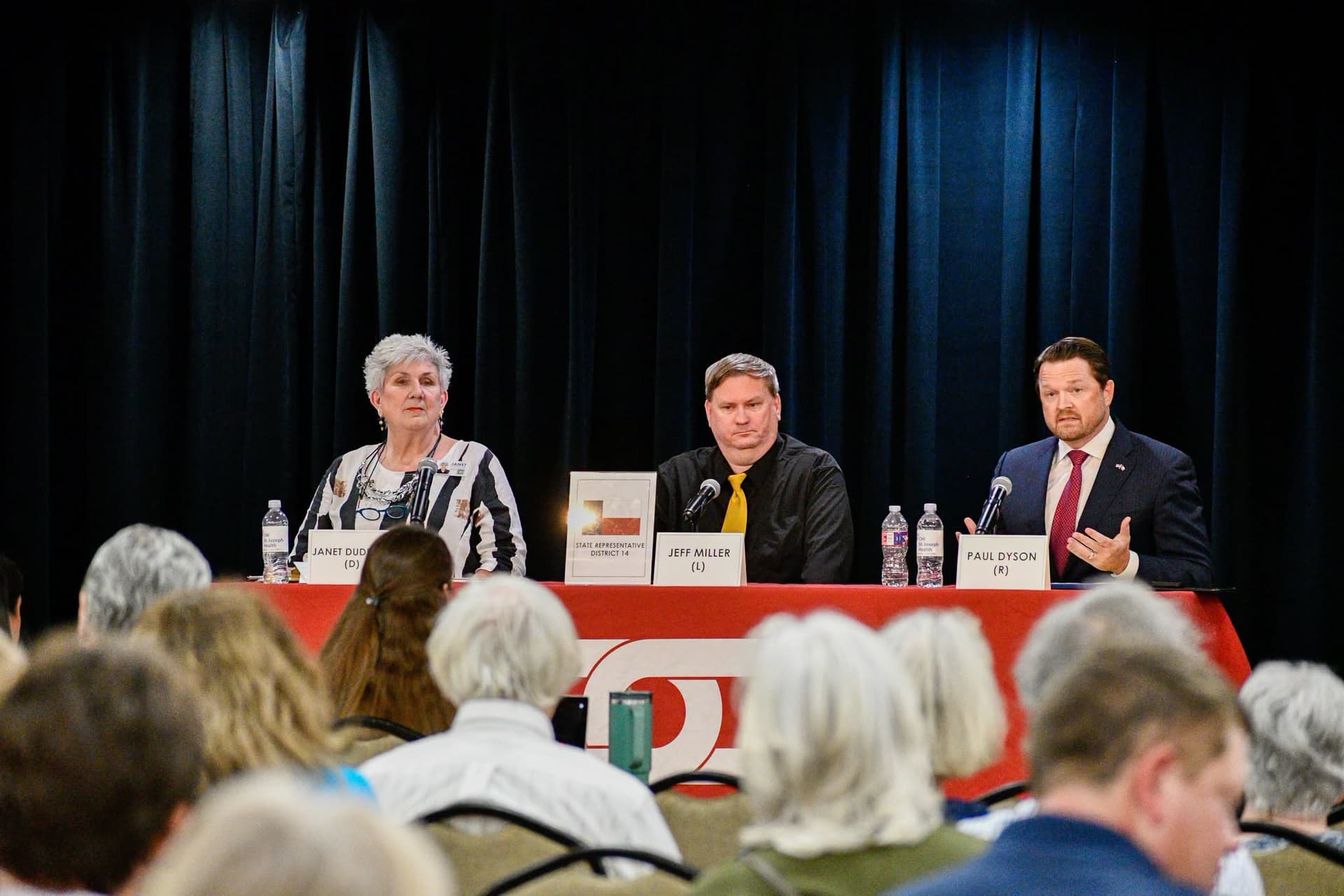
The three candidates for Texas House District 14–Republican incumbent Paul Dyson, Democrat Janet Dudding and Libertarian Jeff Miller–offered different approaches to property tax relief, government oversight, higher education and healthcare.
Tax relief: Dyson, an attorney who has represented the district for two years, emphasized continued tax relief and giving local governments more options. Dudding, a certified public accountant with a background in state and local government, focused on financial accountability and protecting public education. Miller, a longtime Bryan-College Station resident, advocated reducing government spending and limiting government involvement in people’s lives.
The candidates disagreed on how to provide lasting property tax relief for homeowners, renters and small businesses.
Miller said he supports eliminating property taxes entirely, arguing that doing so would require reducing government spending rather than replacing property taxes with a state income tax. He cited a proposal to cut the state budget in half over 10 years as a possible starting point and said reducing government responsibilities would help return decision-making power to local communities.
Dudding outlined several changes she would pursue, including eliminating a provision she described as allowing corporate property owners to select comparable properties in ways that reduce their tax bills. She also called for examining how school property taxes are distributed through the state’s school finance system–particularly payments to charter schools–and reducing the local share of school funding.
Dyson said about $50 billion in the state budget is dedicated to property tax relief and supports revisiting tax-rate compression. He also advocated giving local governments more flexibility to address their individual circumstances, including considering whether some communities could use an optional sales tax to offset property taxes. He said local governments should have more flexibility in setting homestead exemptions and other relief measures.
Dudding cautioned that sales taxes would also affect local residents, not just visitors, and argued that increasing them could add to the financial pressure households already face.
Infrastructure and property rights: Asked about the proposed I-14 corridor, the candidates emphasized different safeguards for major infrastructure projects.
Dyson said Texas must plan for growth while protecting property owners from unnecessary eminent domain. He said the government should demonstrate a genuine public necessity for a project and provide fair compensation to property owners.
Dudding called for stronger local control and sustained communication among government entities and residents as major infrastructure and industrial projects move from planning to implementation. She also supported fair, market-based compensation for affected property owners.
Miller said property owners should not be forced to give up their land simply because the state wants to build a road. He also suggested reducing the state’s share of gas taxes and lowering sales taxes as ways to ease the overall tax burden.
Local control and regulation: The candidates also discussed when state lawmakers should intervene in decisions involving issues such as zoning, broadband and short-term rentals.
Miller argued that decisions should remain local whenever possible, with state intervention limited primarily to situations in which local governments violate individual rights. He said too much power is concentrated in Austin.
Dyson said local decision-making is generally preferable because residents can hold city and county officials accountable at the ballot box. However, he said statewide action can be appropriate when local governments repeatedly violate individual or property rights and a broader policy is needed.
Dudding criticized what she described as state-level restrictions on local decision-making, including restrictions involving schools and community policy. She argued that local control should mean allowing locally elected leaders to lead, rather than using the phrase to justify additional government restrictions.
Higher education and academic freedom: On academic freedom and legislative oversight of higher education, Dudding said restrictions on what professors can teach, research, discuss or publish undermine the value of education. She argued that Texas A&M’s status as a major research institution depends on allowing scholars to explore important subjects, including climate change and race and ethnicity, through academic inquiry. She also raised concerns that state actions could put federal research funding at risk.
Dyson said the Legislature has a responsibility to ensure that taxpayer funds appropriated to public universities are used responsibly and transparently. He characterized some university course changes as questions of enrollment and return on investment, rather than a need for lawmakers to dictate exactly what professors teach. He also pointed to the research and economic opportunities generated by Texas A&M.
Miller said he supports academic freedom and opposes government dictating what can be taught. He went further than the other candidates, arguing for educational freedom beyond a system in which the state determines how people should learn.
Healthcare access and costs: The candidates took sharply different positions on Medicaid expansion and government’s role in healthcare.
Dudding supported Medicaid expansion, arguing that low-income Texans who work but lack employer-sponsored insurance can fall into a coverage gap. She said Texas is not drawing down available federal funding and argued that expanding coverage could improve access to care.
Dyson opposed expansion under the current federal approach, saying federal funding comes with conditions that can extend beyond healthcare. He said affordability remains a concern, particularly in rural communities and argued that federal assistance should give Texas more flexibility to address local needs.
Miller opposed expanding government healthcare programs and argued that government involvement contributes to high costs. He advocated alternatives such as direct primary care and allowing advanced practice nurses to provide more care without certain physician-delegation requirements.
In their closing statements:
Dyson asked voters to return him to the Legislature to continue representing Brazos County.
Miller emphasized offering voters a smaller-government alternative and urged organizers to allow candidates to speak at future forums regardless of whether an opponent attends.
Dudding called for greater accountability, ethics and integrity in state government.
County coverage
In the race for Brazos County Precinct 4 commissioner, incumbent Democratic nominee Wanda Watson and Republican challenger Peter Michelena debated county spending, road maintenance, procurement and economic development.
County spending: Michelena criticized the county’s budget process and questioned whether certain capital expenses could have been handled differently to avoid pressure on property taxes. He cited courthouse annex renovations and other county investments as examples of spending decisions that deserved closer scrutiny.
Watson defended the need for capital investments as Brazos County grows, saying decisions must account for future needs as well as current resources.
The candidates also differed on how county departments should manage limited resources. Watson said officials must evaluate departmental functions, staffing needs and operational priorities. Michelena advocated more detailed cost-benefit analyses and stronger oversight of major purchases, including a county building he said should be evaluated using its full long-term costs.
Roads and infrastructure: Watson said the county’s Road and Bridge Department has identified needed projects but faces funding and staffing constraints that contribute to deferred maintenance. Michelena called for more direct assessments of road conditions, better coordination with Bryan and stronger management of county resources.
Purchasing and contracts: Michelena said lengthy procurement timelines could delay projects and proposed faster approvals and a certified vendor list to help local businesses compete. Watson noted that commissioners are one part of a five-member court and that disagreements among members can also slow decisions.
Michelena said county leaders should take responsibility for delays and ensure problems are resolved.
Economic development: Michelena argued that growth should help pay for the infrastructure it requires, rather than shifting all costs to existing taxpayers. He called for coordination among the county, Bryan, College Station and Texas A&M, along with careful consideration of tax incentives.
In their closing statements:
Watson closed by emphasizing ethics, integrity, fairness and responsible stewardship of county resources.
Michelena said commissioners should be accessible to residents, work hard beyond standard business hours when needed and remain active in the community.
A new chapter
With College Station Mayor John Nichols not running for reelection, mayoral candidates Elizabeth Cunha and Bob Yancy discussed the city’s decision-making process, economic development, affordable housing, public safety and public trust.
Yancy, a current city council member, said he would prioritize neighborhoods, public safety, controlling taxes and fees, and restoring the city’s business-friendly reputation. Cunha, who also has served on the council in the past, emphasized careful spending, transparency, property rights and practical solutions informed by her experience working in local high schools and raising a family.
Economic development: The candidates offered different perspectives on the city’s purchase of the former Macy’s building.
Yancy called the property a reminder of a poor government decision and said the city should move toward disposing of it. One possibility, he said, would be demolishing the building and selling the land, which he suggested could be worth more in its raw form.
Cunha said the purchase was made in a different context, when residents were pressing the city to take action on the mall. She argued the investment helped stabilize the area and pointed to businesses that have since moved in or are expected to arrive. She said future development along Hwy. 30 could improve the property’s prospects.
The candidates also supported a role for the city in attracting investment and creating employment opportunities. Cunha said economic development can bring both jobs and additional tax revenue, while Yancy argued that College Station should use tools available under state law to pursue more development agreements and career opportunities for residents.
Cunha said she would like to see more jobs that pay a living wage, which she estimated at roughly $70,000 annually.
Affordable housing and Flock cameras: Both candidates said College Station could do more to address housing affordability, though they emphasized different approaches.
Cunha supported increasing the city’s homestead exemption, expanding its homebuyer assistance program and considering density bonuses to encourage entry-level housing. She said affordability could be improved even if it could not be completely resolved.
Yancy pointed to city fees and development requirements that he said add to the cost of new homes. He argued that municipalities bear some responsibility for making single-family homes increasingly expensive.
The candidates also discussed the city’s renewal of its contract with Flock Safety, a license-plate camera system used by law enforcement.
Yancy said he voted against renewing the contract, citing concerns about data sharing, privacy and the company’s platform. He said alternatives were available and argued that the system could face significant changes through future regulation.
Cunha said the city could adopt safeguards while courts and state lawmakers consider the issue. She proposed monthly audits involving the mayor or a council member, shorter data-retention periods, requirements for a case number and rules ensuring the cameras provide investigative leads rather than definitive conclusions.
In similar news
Incumbent Bryan Mayor Bobby Gutierrez and challenger Rafael D. Peña III debated economic development incentives, the city’s debt, a loan for a movie theater project, affordable housing and access to City Council.
Peña, a former Bryan City Council member who now serves on the Brazos Central Appraisal District board, said his campaign is focused on accountability, clear communication and protecting taxpayer dollars. Gutierrez, the incumbent, emphasized economic growth, infrastructure investment, public safety and the city’s efforts to attract businesses.
Development deals and the movie theater loan: Peña questioned past economic development decisions, including a deal involving land for the Traditions development. Gutierrez defended the city’s development strategy and said investments can take years to produce results. He also pointed to a recent payment from Traditions as evidence of a return on the city’s investment.
The candidates had a sharper disagreement over a $2 million taxpayer-funded loan connected to a movie theater project that has not opened as planned.
Peña said the payment had come due while the building remained vacant and argued that the agreement showed why contracts should include meaningful performance benchmarks and clawback provisions to protect public money.
Gutierrez said the city’s arrangement included an investment in additional facilities and infrastructure and that the city was working with interested parties to complete the project. He said the city expected its broader economic development efforts to deliver benefits to residents.
The candidates also discussed Chapter 380 agreements, which cities can use as economic development incentives. Gutierrez said agreements should produce a reasonable return through jobs, tax value and quality-of-life improvements. Peña said he supported properly structured tax incentives but opposed putting taxpayer dollars directly at risk without adequate protections.
City debt and infrastructure: The forum included a question about reported outstanding long-term debt of approximately $620 million for Bryan, compared with approximately $415 million for College Station.
Gutierrez attributed Bryan’s higher debt burden per resident in part to the city’s age and infrastructure needs. He said the city had maintained its property tax rate while continuing capital improvement projects.
Peña said infrastructure spending was necessary but argued that poorly structured economic development deals could divert money from other priorities. He pointed to the movie theater loan as an example of public funds that could otherwise have supported capital projects.
Affordable housing: Peña proposed revising a homebuilder incentive program to focus on smaller homes that would be more attainable for first-time buyers. He also advocated using vacant infill lots for affordable housing, including potential partnerships with Habitat for Humanity and shifting some community development funding toward down-payment assistance.
Gutierrez said he had supported earlier efforts to reduce red tape and encourage home construction. He argued that increasing the housing supply is difficult because of land costs and continued population growth, but said the city’s incentive programs had helped spur development.
Both candidates said attracting businesses and expanding the local tax base were important to Bryan’s future.
Council meetings and resident access: One of the clearest disagreements concerned the City Council meeting schedule and how residents can address elected officials.
Peña said, if elected, he would return to holding meetings on the second and fourth Tuesdays of each month and allow residents to sign up to speak until meetings begin. He criticized the current process, saying an earlier sign-up deadline and lengthy combined meetings can make participation more difficult for working families.
Gutierrez defended the current schedule–the second Tuesday of the month–as an efficient way to manage a growing workload for city staff. He said residents could contact him and other council members through multiple channels and emphasized the volume of development and infrastructure projects facing Bryan.
Peña argued that access to an individual council member is not a substitute for predictable public meetings and opportunities to address the full council. He also said he would hold town halls if elected.
Touching base on Flock: The candidates were also asked about Flock license-plate cameras. Peña said he would oppose renewing the system in its current form, arguing that it had lost public confidence. Gutierrez said the city would continue to listen to residents and law enforcement as it evaluated the technology.
The local impact
Across the races, candidates repeatedly returned to several issues affecting the Brazos Valley: Taxes and spending, economic development, housing affordability, public services and safety, transparency and public trust.
The forum gave voters an opportunity to hear candidates explain their priorities and challenge one another’s positions. The discussions also highlighted differences over how local and state governments should balance growth, affordability, public services and accountability to taxpayers.
The BCS Chamber of Commerce will meet again on Oct. 19 to hear from local city council candidates.