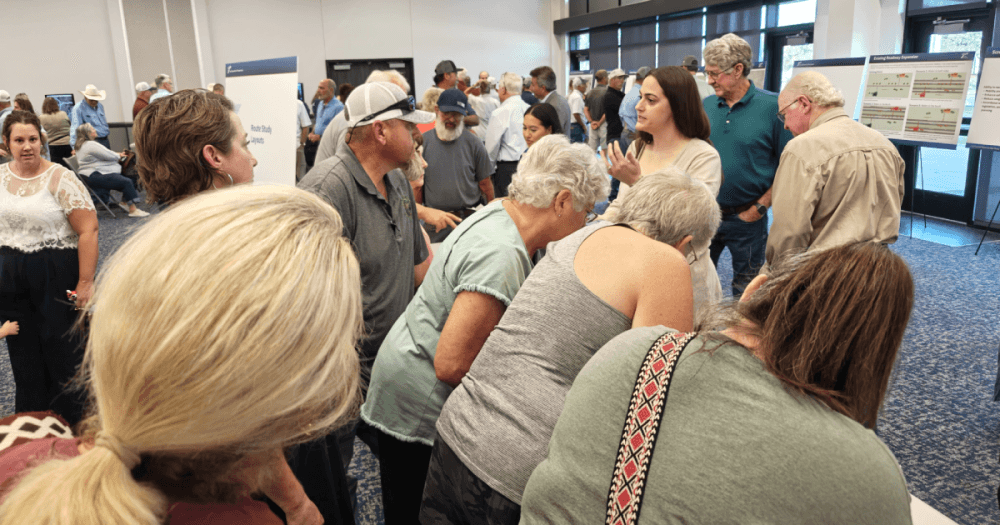
The Texas Department of Transportation welcomed feedback from residents about the potential routes for the cross-country Interstate 14 project in the area during an open house meeting in Bryan. (Rhett Brady/Community Impact)
Potential routes for the proposed Interstate 14 project through the Bryan-College Station area are taking shape as the Texas Department of Transportation enters the third step in phase one of its long-term study and begins narrowing down where the interstate could eventually go.
TxDOT presented the potential routes Aug. 18 at Legends Events Center in Bryan during one of several open house events about how the project could impact homes, farms, businesses and the environment.
What you need to know
Over the course of a decade, the state of Texas has conducted research on building an interstate highway stretching from West Texas to Georgia. Its first two phases included a feasibility study and an implementation plan. Step 3 starts with the study of potential routes.
According to the TxDOT website, the third step includes evaluating “up to three viable route alternatives and identifying a recommended preferred route, along with preparing preliminary cost estimates and a Schematic Implementation Plan for future project development.”
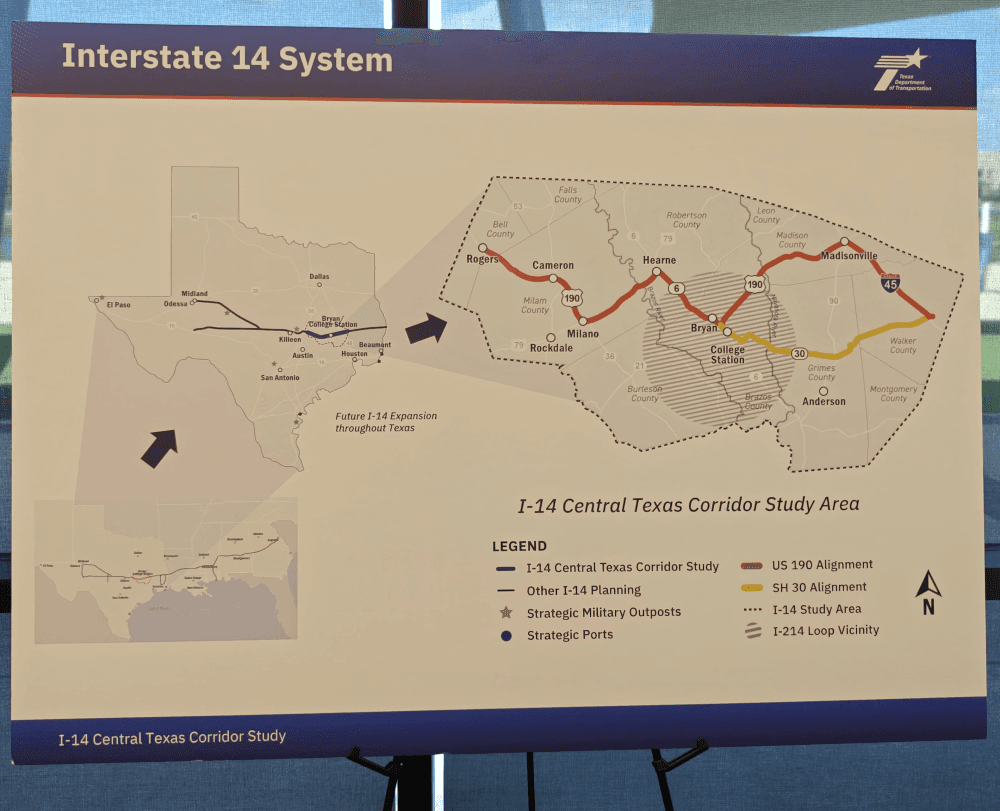
The proposed I-14 corridor throughout the state of Texas and Brazos County. (Rhett Brady/Community Impact)
Steve Fullhart, TxDOT - Bryan’s district public engagement specialist, said this third round of meetings is critical for gaining public feedback, especially since TxDOT will be in this current study for the next three years.
“We’ll take the input from these meetings, along with public officials and engineers, come back to the public and continue narrowing,” Fullhart said. “Ultimately, we want to land on a preferred route of I-14.”
Why it matters
Juan Quiroz, a planning engineer for TxDOT - Bryan, said the route concepts are an important milestone for the project because it’s the first time the public is able to see all of the research TxDOT has done.
“At this point in the study, it’s all about the routing,” Quiroz said. “The routes we are providing are intentionally wide because they’re going to give us flexibility over time to continue to do the study behind this public meeting.”
Quiroz said the refinement process is so important to the project’s effectiveness, and the public’s input is going to help shape all aspects of its direction.
“After we narrow down the potential routes, we will really be able to move around constraints and create viable routes that are about 1,000 feet wide,” Quiroz said. “The next meeting will be just as important as this one. We’re going to present the next level of refinement there.”
With the start of the construction of the I-14 project still far off, Quiroz said TxDOT wants to get everything right during the research process to be as efficient as possible. However, one current project will fit in with I-14 in an unexpected way.
“There’s still a lot more work to do and our funding would have to compete with other projects in our district,” Quiroz said. “The State Hwy. 6 project is ahead of the game because it is a funded project and it falls within the corridor study. We have to be forward-looking to make sure that project meets interstate standards.”
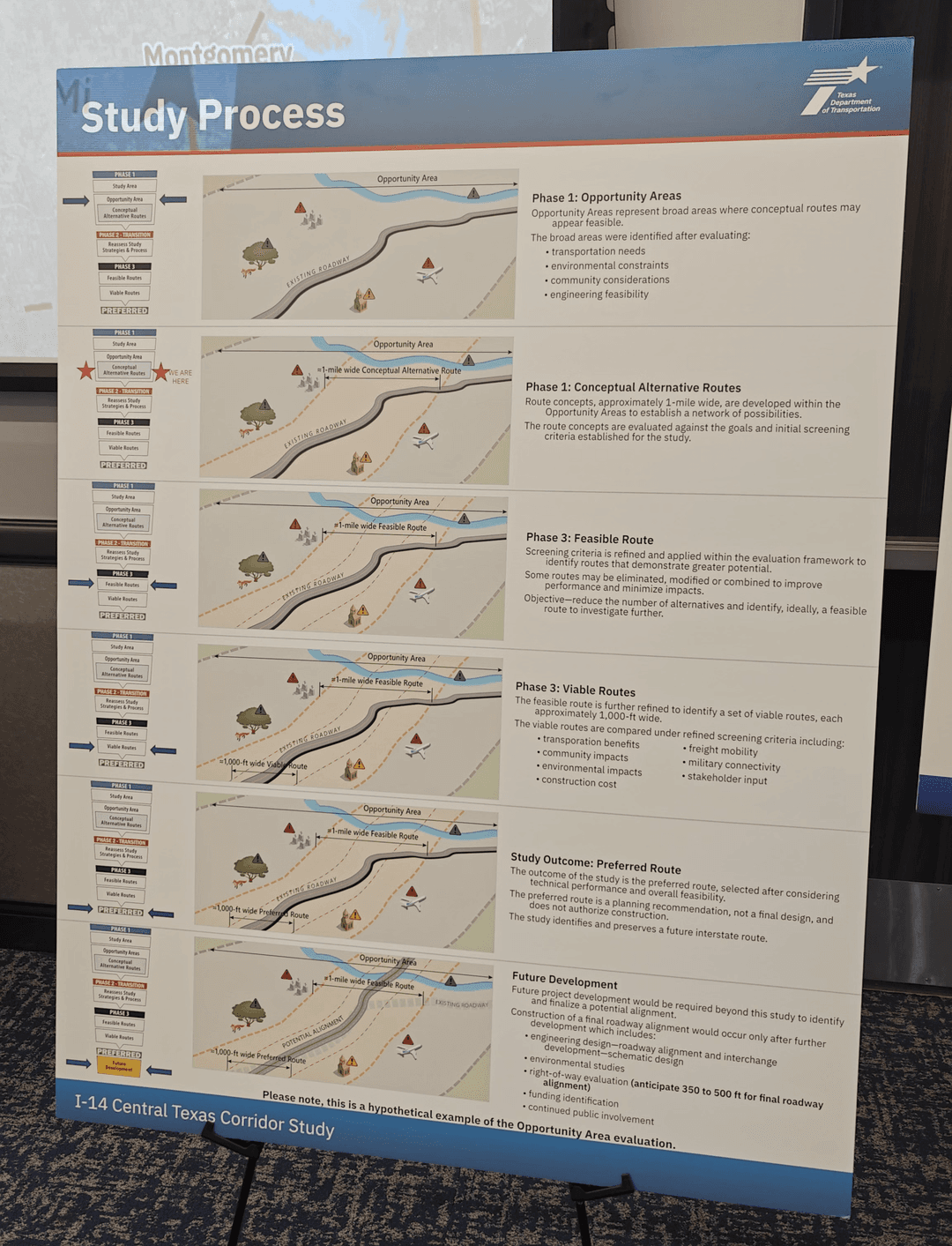
TxDOT's I-14 corridor study process and different phases. (Rhett Brady/Community Impact)
“Although I understand the need for improved transit in the region, it should not displace cash-rent farmers who are working hard to earn a living,” a commenter said.
Another commenter was concerned about displacing homeowners throughout the region, while also offering support.
“This route would displace many homes and new neighborhoods that are already in development,” the commenter said. “If property is to be displaced, fair prices and incentives for repurchase should be considered.”
Environmental concerns were also brought forth to TxDOT, with a commenter mentioning wetlands near Navasota.
“There will be a big hydraulic and wetland impacts crossing the Navasota, so a requirement should be to provide mitigation within the watershed,” the commenter said. “The habitat includes freshwater mussels, alligator snapping turtles and otters.”
Quiroz said overall feedback had been positive, with the project creating more transportation opportunities and helping with congestion, while also taking into consideration the impacts to the environment and residents.
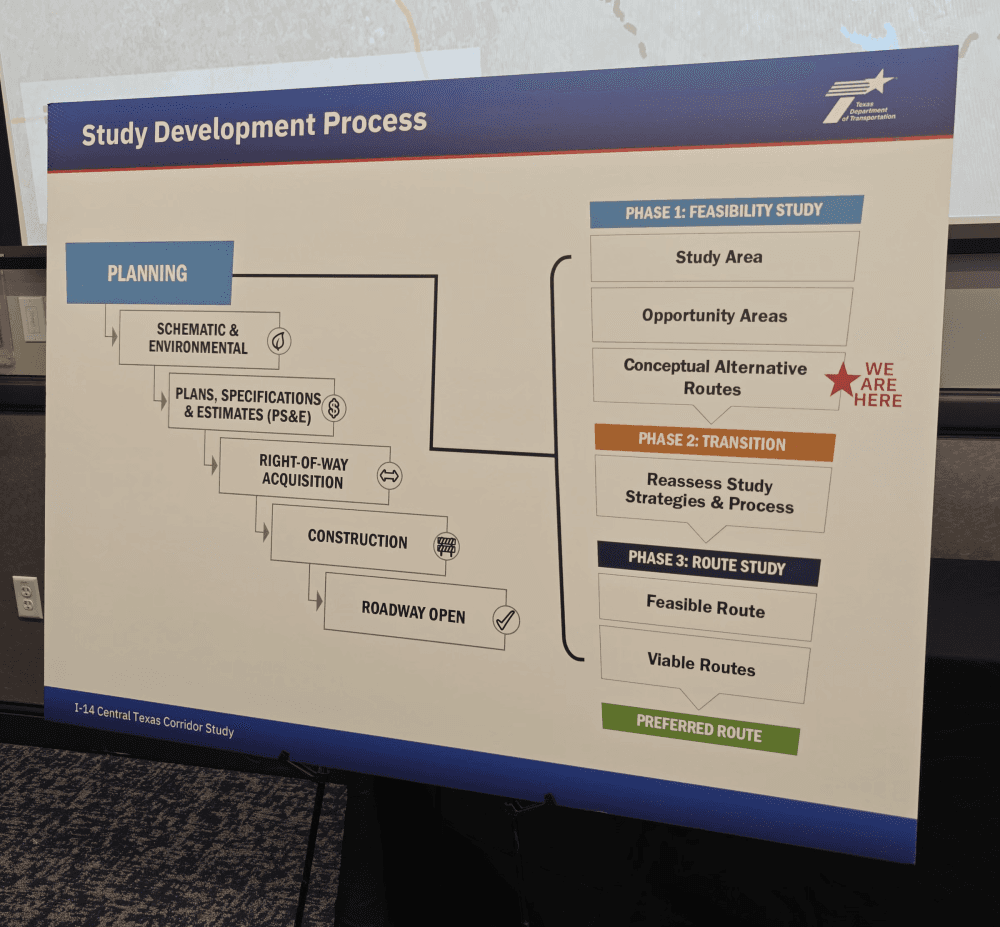
TxDOT's breakdown of different phases of the I-14 project. (Rhett Brady/Community Impact)
What’s next?
TxDOT will continue studying and refining potential routes over the next three years before identifying a preferred route for the I-14 corridor.
Construction could still be decades away, Fullhart said, but residents are invited to weigh in now.
“Ultimately, we’re talking about maybe 20 years before the interstate rolls through,” Fullhart said.
Public comments on the proposed routes will be accepted through the end of the month, with additional meetings expected next year in the Bryan-College Station area.
More Development news from Bryan - College Station