City planners are looking to increase allowances for mixed-use development in Austin, and expand options for building missing middle housing. (Ben Thompson/Community Impact)
Officials are preparing to allow a wider range of mixed-use development and encourage more varied housing types across Austin.
The zoning initiative is aimed at missing middle residential and mixed-use projects, and builds on a recent city study about those kinds of developments and proposals to expand their use. It follows other wide-ranging revisions made to Austin's complex land development code first adopted in the 1980s.
“A lot of our most charming, walkable neighborhoods in Austin predate 1984," said council member Paige Ellis, who's sponsoring the latest reforms. "I’m trying to do what we can as a council to fix some of the overcorrection that happened in 1984, and now we are missing an entire generation of missing middle housing because no one’s been able to build it.”
The setup
City planners said the "outdated" development code has led to sprawling growth patterns with less housing choice. Single- and multifamily projects have traditionally made up the bulk of Austin's housing stock, and are typically separated from retail, office and other commercial uses.
“By prioritizing single-use development over mixed-use development, the code has contributed to Austin growing in a way where many residents live far from where they work, play, and access goods and services," planners wrote in the January zoning study.
Austin used to see more varied housing construction with multiunit projects that can still be found in older parts of town, or places with separate building standards like the master-planned Mueller community. But overall, city data shows the vast majority of development since the code's 1984 adoption was funneled into either stand-alone homes or bigger apartments.
City planners and some officials point to missing middle housing types, defined in the three-to-16-unit range, as options that add choices for residents beyond buying a costlier home or living in a large rental complex. They're also commonly found in similar-sized cities like Seattle and Portland where more units can be built on residential lots.
The approach
Informed by findings from the January study, City Council will vote on a resolution from Ellis on March 26 calling to create two new zoning categories for use around the city including:
Missing middle residential zones for townhomes, cottage courts, single-stair buildings and other similar housing types. The January zoning study recommended allowing four to six units on lots of at least 5,750 square feet—Austin's pre-HOME minimum for residential construction—although specific unit caps and lot sizes aren't outlined in the council proposal.
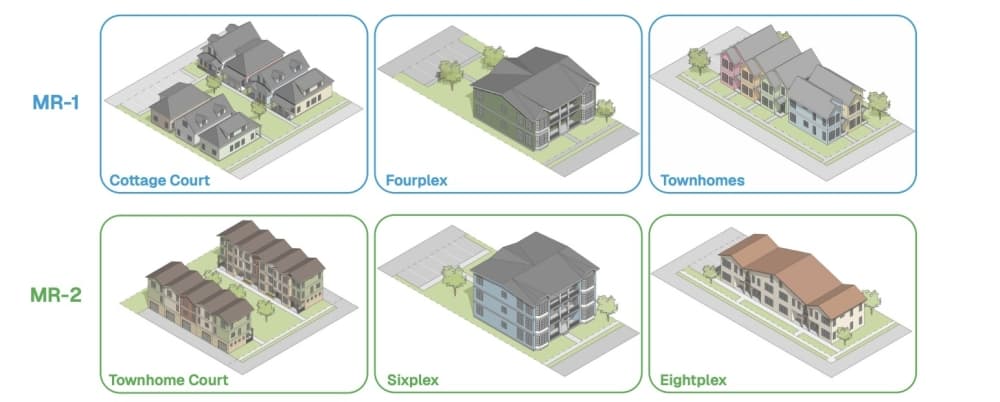
City Council is building on a recommendation from city planners to create Middle Residential, or MR, zoning to encourage missing middle housing development. (Courtesy city of Austin)
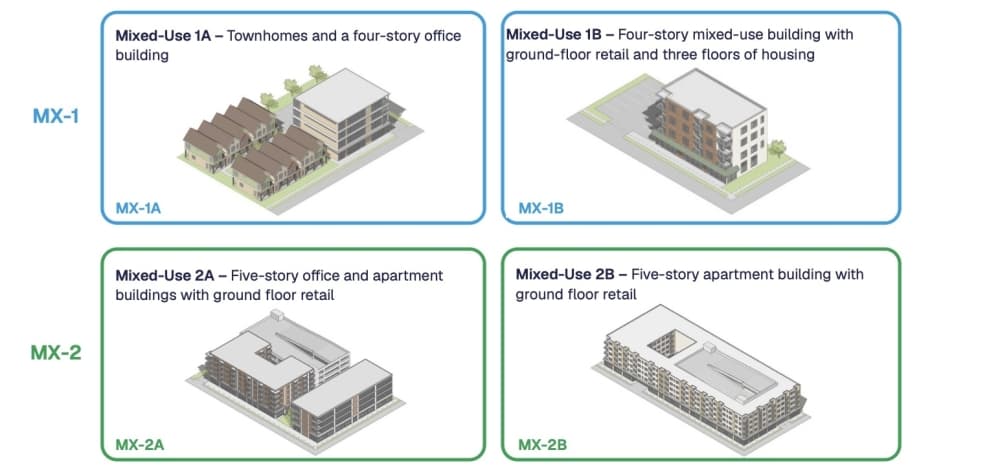
Mixed-use zones for transit-oriented and pedestrian-friendly development with both housing and commercial space, ranging from corner stores to larger apartments. The city study suggested splitting zoning into two tiers for smaller-scale missing middle and low-rise multifamily projects, and for taller projects with an active ground floor and wider range of uses. Vehicle-oriented uses like drive-thrus and gas stations could also be banned in mixed-use areas
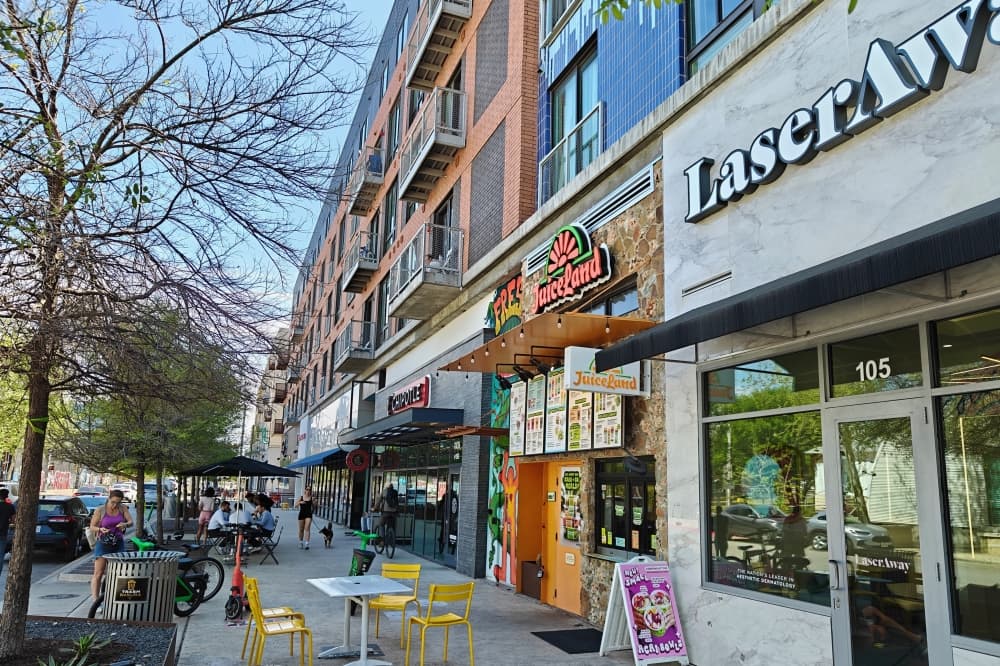
New zoning proposals could encourage various mixed-use development. (Courtesy city of Austin)
The measure represents the first step toward establishing the zoning concepts, a process that could be completed by next March. It also calls for neighborhood outreach, consultation with other cities that have taken similar steps, and reducing regulatory barriers that might hamper the new policies along the way.
Once finalized and approved in 2027, the zones also wouldn't immediately go into effect. Officials and city staff said further community discussions will be needed to determine where any new allowances would be most appropriate.
"Focusing on what the form and function does first, and not trying to overlay those over existing neighborhoods without knowing what they are and having people ask, is really, really important," Ellis said in an interview. "I certainly don’t want anyone feeling like something is changing underneath them without their blessing, because nobody likes that.”
Zooming in
The new approach to missing middle and mixed-use zoning follows years of lengthy housing policy debates at City Hall. Development code updates like the Home Ownership for Middle-income Empowerment, or HOME, initiative, proved to be controversial, and ended up passing with stated goals of bringing more housing to single-family areas and cutting the amount of land needed to build a house.
Still, planners said further changes are needed to meet city goals like adding more accessible housing and creating more walkable neighborhoods.
For example, HOME is producing hundreds of new houses but hasn't resulted in the variety of residential options that were intended. As of last fall, HOME regulations still mainly supported single-family construction, and most builders were opting to add two houses per lot rather than the maximum of three that are now allowed.
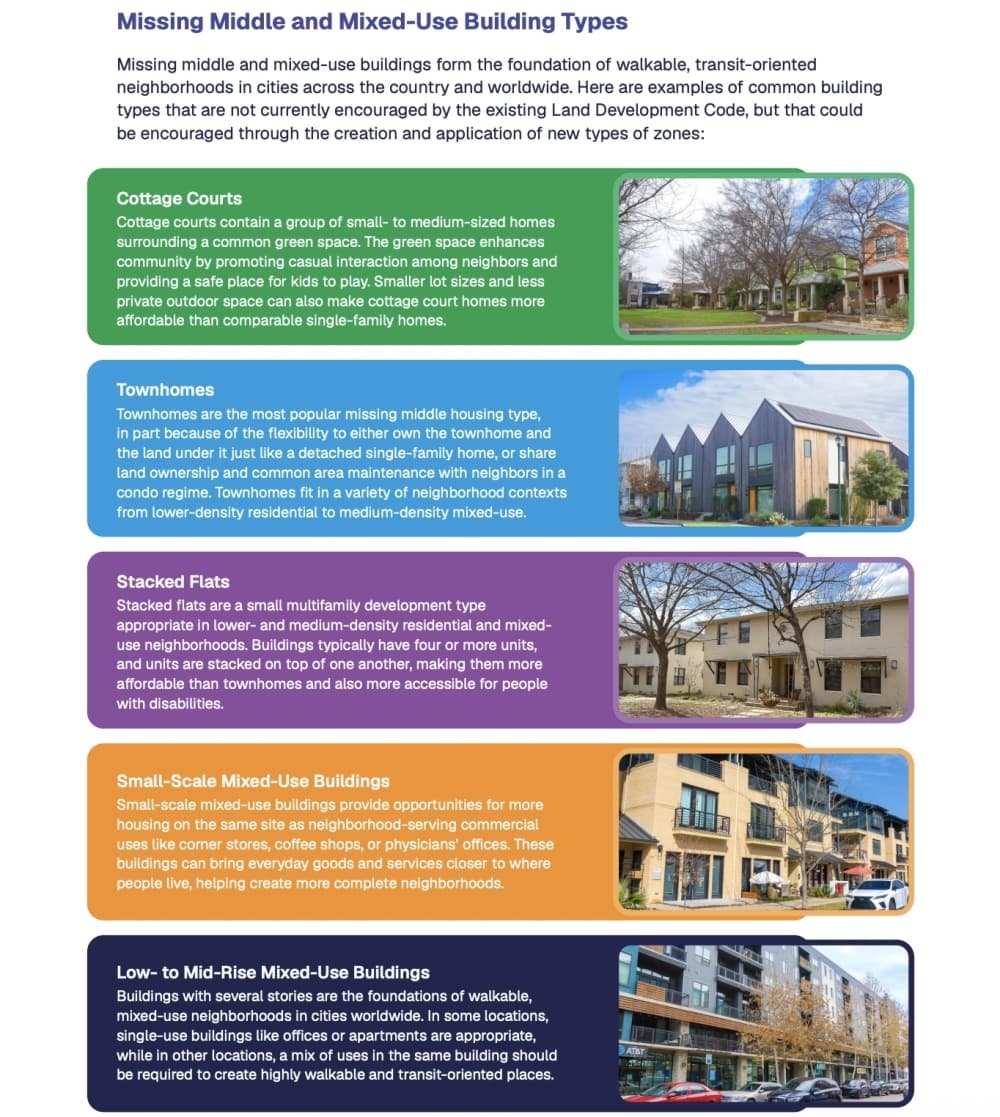
"This points to a need to permit and further incentivize missing middle types like cottage courts, townhomes, and stacked flats to provide additional housing that may be more affordable than the detached units that are mainly being built using HOME regulations," city planners said.
Various types of missing middle housing projects could become more common in the city under new zoning proposals. (Courtesy city of Austin)
Ellis also said she believes having more housing types in the market should help with affordability. She noted many of the city's "naturally affordable" units, or housing that's available below market rates without government subsidy, tend to be older options that are less commonly found.
"When you see 40 years ago the almost complete elimination of new missing middle housing coming onto the market, that’s 40 years where there’s not a 10-year-old unit, 20-year-old unit, 30-year-old unit that a lot of people may be able to afford easier," she said. "This is my way of trying to right the wrongs of 40 years ago, and make sure that as the decades move forward you get smaller footprints, you get tighter-knit communities, and neighborhoods that are more walkable and environmentally friendly as a result.”
What else?
Ellis' mixed-use proposal could increase the presence of retailers, offices, live-work spaces and other commercial spaces. It'll be considered alongside a separate resolution from council member Natasha Harper-Madison meant to bring some limited business operations to existing communities.
Harper-Madison's proposal, labeled the "Small Local Commerce Initiative," could open the door for neighborhood-scale storefronts. Her office said the change could bring coffee windows, garage art galleries or other "micro-scale" retail next door to residents after state lawmakers eased local regulations on home-based businesses, including small food producers, last year. The move follows another recent council vote to encourage more community-focused spaces like cafes in established neighborhoods.
“We’ve tackled the big stuff like minimum lot size, eliminating the parking mandates," Ellis said. "Now I think people are looking at, what can we copy out of some of our favorite neighborhoods? The neighborhoods people want to live in that are walkable, close to downtown, have good schools in them. How do more parts of town get access to that type of lifestyle?”