Fort Bend ISD administrators are undertaking a three-year boundary review plan aimed at addressing over and under capacity issues. (Community Impact staff)
Editor's note: This article was updated with a comment from Beth Martinez following press time. Additionally, the year Mandy Bui bought her house has been corrected and clarification on her position has been added.
Mandy Bui purchased her home in Harvest Green in 2017 with the expectation that her children would attend Neill Elementary School.
As Neill’s district coordination chair during the 2022-23 school year, she served on the school's Parent Teacher Organization and witnessed firsthand the challenges of overcrowding.
Neill had reached 101.1% capacity at the time, prompting Bui and other community members to support a $1.26 billion bond approved by voters in November 2023 that allocated $722.99 million for four new schools in high-growth areas in the northwest and southern portions of the district.
"I bought into the bond big time because I could see it firsthand—the classrooms getting strained, the teacher turnover, the burnout on their faces,” she said. “The teachers think that another school is coming, so they think there’s a light at the end of the tunnel.”
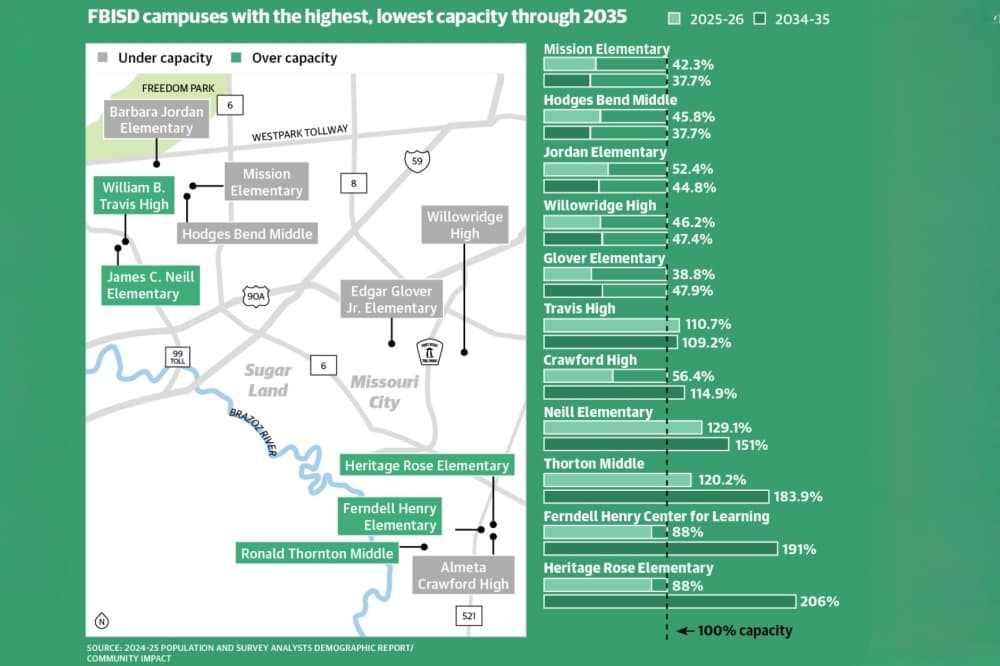
Now, district officials said they’re working to evaluate campus boundaries over the next three years to even out students across FBISD as 17 schools sit overcapacity for the 2025-26 school year. The changes could result in zoning changes and school consolidation.
The Harvest Green, Sienna and Trillium housing communities are expected to add the most students from home growth on northwest and southern portions of the district, according to the 2024-25 Population and Survey Analyst report. (Community Impact staff)
At a glance
Although some classrooms in the northwest and southeast areas of FBISD are experiencing overcrowding, district officials report that more than 20,000 seats remain available across the district—although not necessarily in areas where they’re needed.
Beth Martinez, deputy superintendent chief of staff, said at the March 24 board meeting that the boundary initiative will involve a thorough review of every feeder pattern, with the potential for school consolidations and closures being considered.
“In the most recent past, we have focused on growth in a few areas and we have not taken a district-wide approach,” Martinez said. “We have to look at our utilization across this district.”
While only one less campus will be overcapacity by 2034-35 school year, the number of undercapacity campuses will grow to 49, according to a 2024-25 Population and Survey Analysts demographic report.
Data shows there are still 3,887 additional housing units planned in Sienna, 1,203 additional in Trillium and 952 in Indigo as well as 440 single-family housing developments in Olympia Fields in Fresno projected for the next 10 years.
Aside from new housing developments, PASA President Stacy Tepara said at the Feb. 3 board meeting that most of the district’s growth will depend on charter school transfers—the majority of which involve students coming from areas outside of those new developments.
Land sales of closed campuses requires board approval and at least one year to begin receiving offers
A voter-approved bond would be immediate and would require that construction begin 18 months after the election
In an email, Martinez said if boundary planning alone cannot balance enrollment, new school construction may be proposed in future bond measures. She said the district will consider boundary changes, school consolidations and program relocations moving forward.
What they're saying
As of May 25, most schools with less than 600 students enrolled were located in the eastern portion of the district.
Stephanie Brown, founder of the Marshall Advocacy Focus Group, a partnership between the district and Marshall High School area volunteers, said school closures must consider past zoning decisions that routed Marshall schools to aging areas.
Brown said the feeder pattern has long been overlooked in bond funding, despite strong student outcomes, and urged the district to focus on improving existing school performance rather than building new ones.
“Why can’t we focus on how to improve school performance all over the district instead of always finding ways to build unnecessary schools,” she said. “The bottom line is that we are in the business of education, not construction.”
Moving ahead
District officials will review feeder patterns on a yearly basis, Martinez said. Some feeder patterns will be reviewed more than once to allow further needed changes. She said that
From May to September, Martinez said the district is conducting assessments to determine the conditions of campuses included in the first year of study after the board approved a $400,000 facilities index in June.
FBISD will host a special workshop in November to receive feedback on recommendations on these campuses, with board action to take place in February, Martinez said.
While variables such as demographic changes, increased enrollment in private or charter schools, and facility usage can affect the proposed timeline for long-range planning, Martinez said the district will move forward to provide capacity relief.
Throughout the three-year timeline, administrators will evaluate the campuses that correspond to the following feeder patterns:
2025-26: Austin, Bush, Crawford, Elkins, Kempner, Hightower, Ridge Point and Travis high schools
2026-27: Bush, Clements, Marshall and Willowridge high schools
2027-28: Crawford, Dulles, Elkins, Hightower and Ridgepoint high schools