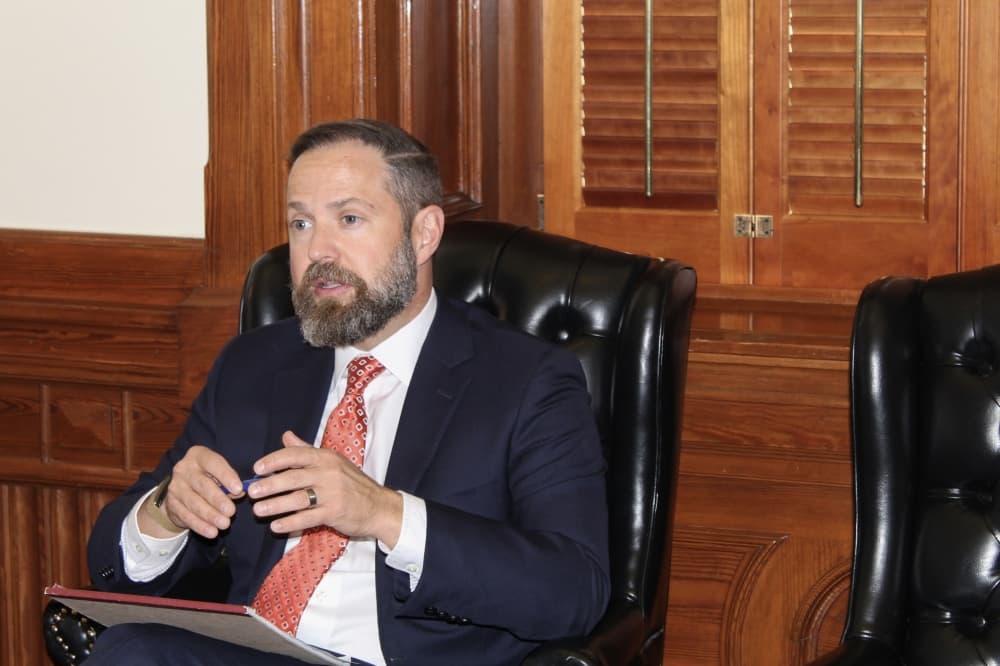
Texas House Speaker Dustin Burrows, R-Lubbock, sat down with Community Impact on April 3 to discuss the final stretch of Texas’ 140-day regular legislative session, which ends June 2.
From his office at the state capitol in Austin, Burrows said House members were on track to increase salaries for public school teachers; rein in school safety and discipline policies; and approve an education savings account program.
Burrows also discussed his working relationship with Lt. Gov. Dan Patrick and the two leaders’ shared goals of cutting property taxes, tightening bail restrictions, cracking down on THC retailers and helping communities prepare for natural disasters.
Burrows was first elected to the Texas House in 2014. He succeeded Rep. Dade Phelan, R-Beaumont, to lead the 150-member chamber this session. This interview has been edited for length and clarity.
The two legislative chambers are looking at separate teacher pay proposals: Senate Bill 26 would directly raise salaries for educators with at least three years of experience, while House Bill 2 seeks to boost pay through an increase in base per-student funding, among other things. How do you negotiate these differences?
At this point in time, we are trying to put the best product with the most involvement of House members forward to the House. [When] we actually get our bill over to the Senate, we'll figure out how to rectify those differences. But I do believe both chambers are committed to seeing an improvement in teacher compensation. ...
Our school finance bill is something that I'm very proud of Chairman [Brad] Buckley and the public education committee [for]. I think it's comprehensive; it does a lot of great things in addition to teacher pay.
[On] special education funding, it has extraordinary opportunities there. [We] saw a new bilingual education allotment that was in the bill [the committee] voted out today. I think it's just a really strong school finance bill.
Some Texans have expressed concerns that public schools could lose revenue if students leave for private schools under an education savings account plan, which would give parents public funds to spend on private education.
With about 80% of Texas school districts anticipating budget cuts next fiscal year, what would you say to public school leaders who are worried about this?
When we pass our school finance bill—which I believe will pass—there's not going to be any districts that lose any money.
In fact, every single district will actually gain an increase in the amount of funds available in the classroom for them. So I expect no less funding for our public schools next time. I really just don't think that's going to be the case.
To the extent that some [districts] have some concerns over students who may choose a private school over them, it's going to be a very small number. I don't think it's going to have a huge impact.
But we've also built in some things to make sure [districts] are held harmless and they're going to be okay. We can do both—we can fully fund public education and provide meaningful opportunities through school choice.
Similar to last session, the House and Senate are advancing competing property tax relief plans. Can you come to an agreement there?
We're having great conversations, and we're considering all sorts of things. We're certainly talking about [tax rate] compression; we're talking about [the homestead exemption]; we're talking about personal property tax exemptions for our small businesses.
Those are the three general tools that we are talking about utilizing for property tax relief. ... The amounts and the different mixtures are something that we're continuing to talk about, but ... I would describe it as a very good dialogue.
I was not speaker last session, but I was in some of those conversations. I would say [they have] a much better feel to them this time around. And I think we're gonna land the plane and find some compromise.
Texas is increasingly at risk for a variety of natural disasters, including wildfires and hurricanes. What is the House doing this session to help communities better prepare for these disasters and mitigate damages?
I’ll talk to you about the two bills that [the House passed April 2]. House Bill 13 is going to [create] the Interoperability Exchange Council. ... I was on the Panhandle wildfire investigatory committee; I was also on the Robb Elementary School shooting investigatory committee.
In both of those situations, we had a large number of law enforcement agencies ... that all showed up. A lot of the agencies were not able to communicate with one another, because they had different equipment that was on the same frequency. And you can imagine, whether you're trying to coordinate how to put out a fire, which is large and expansive, and trying to get to where you need to go, or you're trying to coordinate what happened in Uvalde, you need to have these agencies in a place where they can actually talk to one another to know what is going on.
HB 13 is aimed at getting a council to solve these communication barriers and then to fund local grants—especially to those law enforcement agencies that can't afford the upgrades of their equipment—and to get them all on the same page and message. So I think it’s a very much-needed thing, very supported by law enforcement, and something that is important [not only] for future wildfires, but natural disasters and other events that require first responders to come together.
[House Bill 143] is what we call dealing with no man's land. What I mean by that is, if you think about our electric lines, they’re basically strung across poles. And then you have wells, and they have to have power to them—the electric line that goes [from] the telephone poles to the well that's pumping oil and gas ... is sometimes on the ground, sometimes it's fraying, sometimes it's sparking.
There seemed to be an agency dispute between the Railroad Commission and the Public Utility Commission about who was responsible for that dangerous condition or line. They were somewhat pointing the finger at one another. After our investigatory committee [hearing]... they came up with a memorandum of understanding to figure out who was going to do those inspections, who was going to be responsible for replacement.
Not all, but most of the wildfires that we've encountered have stemmed from that type of situation, up in the Panhandle at least. So what that dealt with was codifying, putting into statute, those memorandums of understanding [and] best practices to try to have some regulatory scheme for that particular area of law.
Last session, after the 2022 school shooting in Uvalde, you authored House Bill 3, which expanded school safety requirements and directed districts to put armed security officers on all campuses. Tell me about the school safety legislation the House is considering this session, including House Bill 33, by former Uvalde mayor and freshman state Rep. Don McLaughlin.
There needs to be good coordination [and] there needs to be good planning. If you don't prepare for it, you are not prepared [when it happens]. It also requires some accreditation by the different law enforcement agencies, which I think is very important. ...
We are in a situation in Texas where you have every different local jurisdiction, whether it's a hospital district or independent school district, creating their own police force. I don't think that's a good situation. I think, in fact, it's a dangerous situation.
[With HB 33], we'll start to basically say, ‘Okay, you know what? If you're going to have your own agency, you have to have some minimal standards.’
Otherwise let's let the sheriffs do it. Let's let the major metropolitan police forces do it, because they're the ones with the experience, they're the ones with the training, they're the ones who've been doing this. We need to have them doing policing and not a stand-up-overnight law enforcement agency.
Patrick has told reporters he’s ready for a special session if a set of bail reform bills, some of which stalled in the House during previous sessions, do not pass. What are your thoughts on those proposals?
I have met with the families who are affected by this, and he's right. These are huge issues. I want to see this dealt with.
Chairman [John] Smithee is working on those bills. I check in all the time to see how it's going, and I get good feedback. So I feel very optimistic that we're going to be able to get some much-needed bail reform across the finish line this session. ...
This is a bipartisan issue. ... Sometimes people think this is a Republican versus Democrat issue—it's not. Everybody wants their streets and their houses and their communities to be safe. ... I believe it's going to happen, and the House is going to push for it. [The proposed constitutional amendments] do require 100 votes [to pass the House], so it's a higher threshold, but we’re working on it.
The Senate passed legislation that would ban all THC sales in Texas. On April 7, the House State Affairs Committee is scheduled to discuss the proposed Senate ban and a House bill that would tighten regulations on hemp retailers. Where is the House on these proposals?
Look, I'm a father of three. All of a sudden I drive down... from Lubbock to Dallas to Austin, and there are all of these stores that have popped up [overnight]. I'm all for small business, but I really don't know what's being sold... and I really don't know how safe this is. I have significant concerns.
That's why we're going to have these hearings. ... I think all members of the Texas House are interested in hearing from not only the public—and the business owners will have an opportunity to make their case—but experts in the field about the dangers that are associated with some of these chemical compounds.
What we're seeing sold out of here, people think is maybe just marijuana. I think a lot of it is synthetic. I think it may be, in fact, a lot more dangerous than what people are thinking about.
State data shows Texas public school teachers are leaving the classroom at rising rates, with over 12% of teachers leaving their jobs ahead of the 2023-24 school year. In 2022, nearly half of Texas teachers cited discipline issues as a top workplace challenge.
Tell me about the House’s plan to tighten discipline policies in public schools.
We have talked so much over the last few years about the importance of our teachers and paying them what they're worth, and we need to do that. ... But when you talk to our educators... about why they're leaving the profession, why they're not wanting their family to get into the profession, it's because they often have had an experience where they felt disrespected in the classroom and they couldn't do anything about it. ...
They get frustrated, rightfully so. They're trying to educate and do what they've been hired to do. Our House priority bill... is aimed at trying to give teachers a bill of rights, trying to give them the ability to restore that [order]. I know Chairman [Jeff] Leach is working hard to make sure teachers are protected, that they're supported, and they're going to have discipline in the classroom. ...
Somebody asked me yesterday, ‘What do you think the most important bill of session is?’ And I said, ‘There's a lot of them, but if I had to pick one that maybe isn't always in the headlines... this is it.’
This has to be it. We have to have our teachers being able to be respected in the classroom and being able to restore discipline in a learning environment. Because if we don't have that, none of this is going to work.