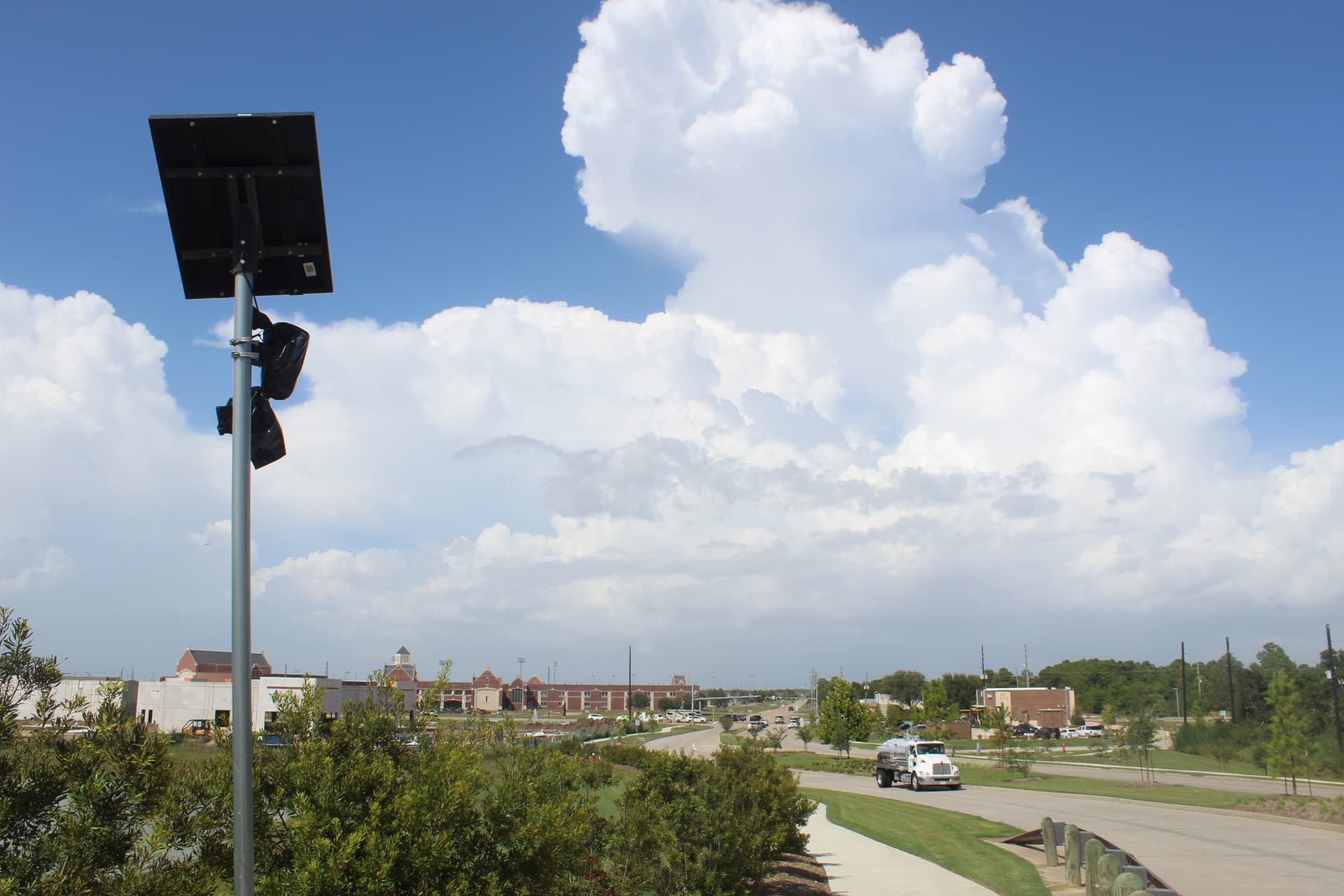
All 16 of Manvel’s Flock cameras were covered within 48 hours of City Council’s unanimous vote to cancel its four-year contract with Flock Safety on Sept. 8. (Haley Velasco/Community Impact)
In a unanimous vote made during its Sept. 8 meeting, Manvel City Council cut ties with Flock Safety and removed funding for the contract with Flock for the fiscal 2026-27 budget.
"These cameras are so much more, this company is so much more than just license plate readers, and they have no place in the city of Manvel," Mayor Dan Davis said. "It's time to deflock Manvel."
"This technology does not replace police officers, detectives, good police work or traditional investigative techniques,” Traylor said. “It's another tool, but it is a tool that provides investigators and officers with information at a time when minutes can matter."
However, Davis, council members and several residents voiced concerns over privacy and expressed distrust in private surveillance networks at the meeting.
"Supporting our police department and asking difficult questions are not mutually exclusive,” Davis said. “Public safety and personal privacy must go hand in hand."
What happened
Flock cameras are manufactured by Flock Safety and capture images of vehicle license plates. That data is then stored in a database for seven days, and can then be searched and shared between law enforcement agencies.
Manvel has used Flock cameras since 2024 through a four-year contract.
When City Council originally approved the contract in 2024, Davis said his understanding of the cameras was straightforward—they were license plate reader cameras that would alert officers when a vehicle associated with a stolen vehicle, wanted person or other law-enforcement hot list passed a camera.
“We [then] learned about extensive data sharing with outside agencies, broader search capabilities beyond simply reading license plates, AI-powered vehicle attribute searches, national network access and other tools and uses that were never part of my understanding when I voted for the system,” Davis said.
Shortly after the vote to cancel the contract with Flock, all 16 Flock cameras operating throughout the city were covered, and city staff provided a 30-day notice to Flock of the city’s cancellation.
Manvel’s Police Department also immediately shut off external agency access to Manvel’s camera feed.
How it works
According to Flock Safety's website, cameras are "designed to help authorized users find relevant evidence for investigations without compromising safety and compliance."
A larger trend
Neighboring cities also use Flock’s automated license plate reader system, with Pearland operating 112 cameras and Friendswood operating 36, data shows.
Friendswood’s 2024 annual police report credited Flock with helping recover 10 stolen vehicles worth about $320,000, while Pearland’s internal tracking system reports nearly $2.3 million in recovered stolen vehicles since 2022.
The cameras continuously capture images of passing vehicles. Flock’s artificial intelligence analyzes the images for information including a license plate, color and body style, said Lyndall Baker, a Pearland police crime analyst.
In Pearland, which contracted with Flock in 2022, analysts can search for vehicles by those characteristics and compare results with surveillance footage or witness descriptions.
“It doesn't do facial recognition,” Baker said. “The system cannot identify or search for people.”
Officers can also receive alerts when plates match law-enforcement hot lists, which flag vehicles reported stolen or linked to active investigations. Pearland maintains internal lists and can share selected lists with other law enforcement agencies.
Pearland disabled Flock’s nationwide data sharing in September after finding about 63% of searches over the previous year came from out-of-state agencies, Baker said.
The department requires a case number for each search and conducts monthly audits reviewing who searched, what was searched and why. Baker said no misuse has been found since audits began in 2023.
The debate
“We have many tools and this is just one that complements the other tools. We have to work this as any other lead. We don't know who's driving the car.”
Lyndall Baker, Pearland police crime analyst
"Flock cameras ... are ultimately tools of the surveillance state. These cameras ... can identify your vehicle by make, model, bumper sticker and track your entire journey."
Stephanie Baird, Manvel resident
What's next
City Council proposed several alternatives at its Sept. 8 meeting to replace Flock cameras.
Council member Harry Opliger suggested the city invest in a human police data analyst to evaluate local crime trends.
On the other hand, council member David Lands floated the idea of eventually building a city-owned and operated ALPR system, allowing the data to be controlled and monitored within the city.
As alternatives remain in the air, Davis said he doesn’t want to rush into another technology, and wants to clearly define investigative needs before determining the best tool to use going forward.
“I am particularly interested in solutions where the city maintains control of its data,” Davis said. “Whatever option comes forward should have clear policies, retention limits, audit requirements, cybersecurity standards and council oversight established before implementation—not afterward.”
Davis also believes the state legislature should have a hand in statewide guardrails for ALPR technology. He suggested placing limits on data retention, strong cybersecurity standards and clear rules governing how AI and other emerging technologies can be applied to data collected on public roadways, he said.
“Technology is advancing faster than many of our laws and policies,” he said. “Texans should not have to give up reasonable expectations of privacy simply because technology makes mass collection and analysis possible.”
More Government news from Pearland - Friendswood - Manvel