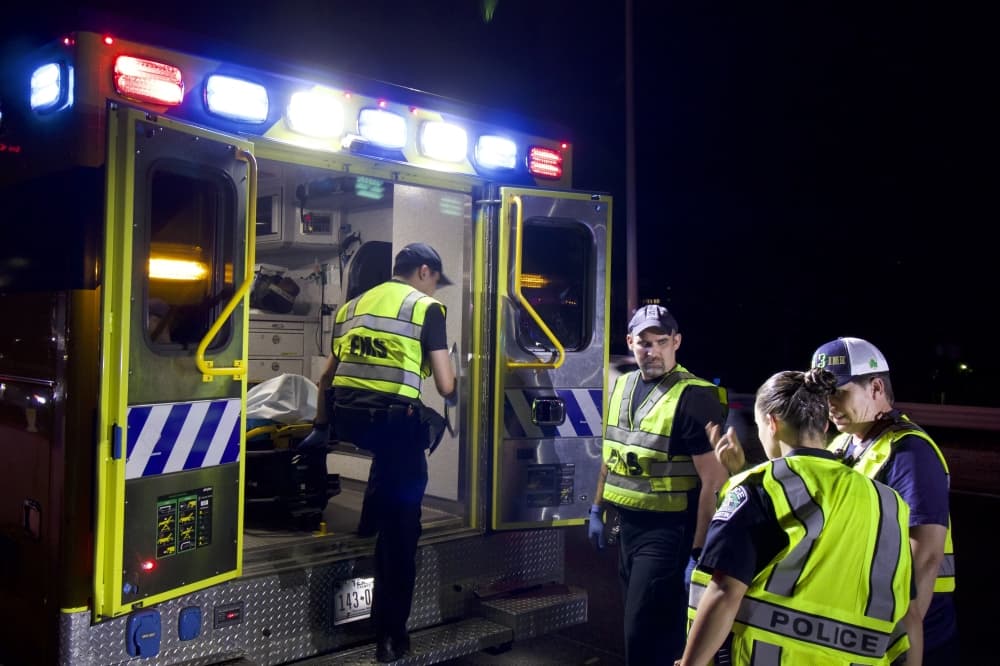
Austin-Travis County Emergency Medical Services provides emergency medical response to over 1.4 million Austin and Travis County residents, and as of May 27 was operating with 107 vacancies, according to Wesley Hopkins, ATCEMS chief of staff.
Staffing vacancies within the department lead to increased overtime for existing personnel, resulting in a consistent increase in ATCEMS’s overtime budget.
“Having the ability to staff ambulances on overtime is certainly an option, but, of course, it’s not sustainable,” Hopkins said.
Beyond overtime, vacancies also make it difficult for ATCEMS to request additional resources, said James Monks, president of the Austin EMS Association.
“It’s hard for us to say, ‘Hey, we need another ambulance over here,’ when we’re apparently struggling to staff the ones that we already have,” Monks said.
In an attempt to fill the vacancies, ATCEMS has increased academy sizes in the past year. It has also received a record number of applicants.
Zooming in
The academy is a paid training for those certified as an EMT-basic or higher who have accepted employment with ATCEMS.
Since January, ATCEMS has received 461 applications for the academy, breaking the previous record in September of over 350 applications.
In May, 33 participants graduated from the academy, nearly doubling the previous December graduating class of 17.
Now, nearly 50 participants are on track to join the next academy starting in July, Hopkins said.
“Having larger academies and filling those vacancies is our priority,” Hopkins said. “At least the recruiting pipeline is primed so we can get folks in the door.”
Hopkins expects almost half of the current vacancies to be filled after the July academy concludes.
Monks also believes that filling vacancies is one of the first steps in expanding resources for ATCEMS.
“Last year we had a lot of issues filling all the positions that we have, ... and the issue we run into then is we can’t really convince the city or anybody to invest in new positions and resources if we can’t fill them,” Monks said.
A closer look
The ATCEMS overtime budget has steadily grown over the past five years, as 2021 overtime accounted for 16.59% of the personnel budget. Now, 25.54% of the personnel budget is allocated to overtime.
ATCEMS also lost the opportunity for over $2.5 million in funding for ambulances and staff after Proposition Q was rejected by voters in November.
The proposition asked voters to approve a 20% increase in property taxes, or a rate of $0.574017 per $100 in property value.
As funding remains constrained, the department faces ongoing challenges in reducing overtime while maintaining service levels, yet Monks believes the increase in recruits will help expand services and resources.
“I understand the voters’ concerns for sure,” Monks said. “I’m hoping that with these recruiting classes, we can start filling more vacancies and start moving towards expanding our services the best we can.”
The details
Along with the increase in ATCEMS academy participants, Austin Community College has also seen an increase in the number of students completing Emergency Medical Services Professions programs.
ACC offers training for emergency medical technicians, advanced emergency medical technicians and paramedics.
ACC’s Emergency Medical Services Professions programs have seen a 94% increase in enrollment from fall 2021, with 85 students, to fall 2025, with 165 students, according to Sydney Pruitt, media relations coordinator for ACC.
“ACC’s EMT and even their paramedic programs ... definitely help us,” Hopkins said.
Beyond the Emergency Medical Services Professions programs, ACC partnered with Hays CISD, Pflugerville ISD and health care providers to launch the Central Texas Healthcare Academy in May.
This program connects high school students with health care careers by allowing them to enroll in dual credit classes with ACC and graduate with both a high school diploma and an industry-recognized health care credential.
“With ACC’s Paramedic pathway, students can earn their EMT-basic in high school and continue into the paramedic program seamlessly,” said Tina Carver, ACC manager of career programs.
Zooming out
West Travis County, specifically Bee Cave and Lakeway, have seen significant population growth in the past 10 years according to US Census data.
With this increase in population comes an increase in call volume for emergency services.
On top of added call volumes, some units in Western Travis County are stationed at apartment complexes, including ATCEMS Station 09 located at Paseo at Bee Cave by Cortland.
Historically, ATCEMS housed units at Travis County ESD fire departments, yet as the fire departments expanded, the ambulances were displaced, Hopkins said.
“It takes quite a long time to build anything,” Hopkins said. “And we needed something immediately.”
Working out of apartment complexes has benefits and downfalls, Hopkins said.
Apartment complexes often do not have backup generators, access out of the complex can be difficult, other residents can park in the wrong spots and they are not public safety facilities, Hopkins said.
“There are some advantages,” Hopkins said. “You can really get some decent creature comforts for the crews.”
As vacancies continue to fill, Monks says other challenges for EMS staff are still prevalent.
“It’s the workload. It’s the type of job we have,” Monks said. “Populations are increasing, but resources are not... We are just trying to figure out how to mitigate these issues as an industry."