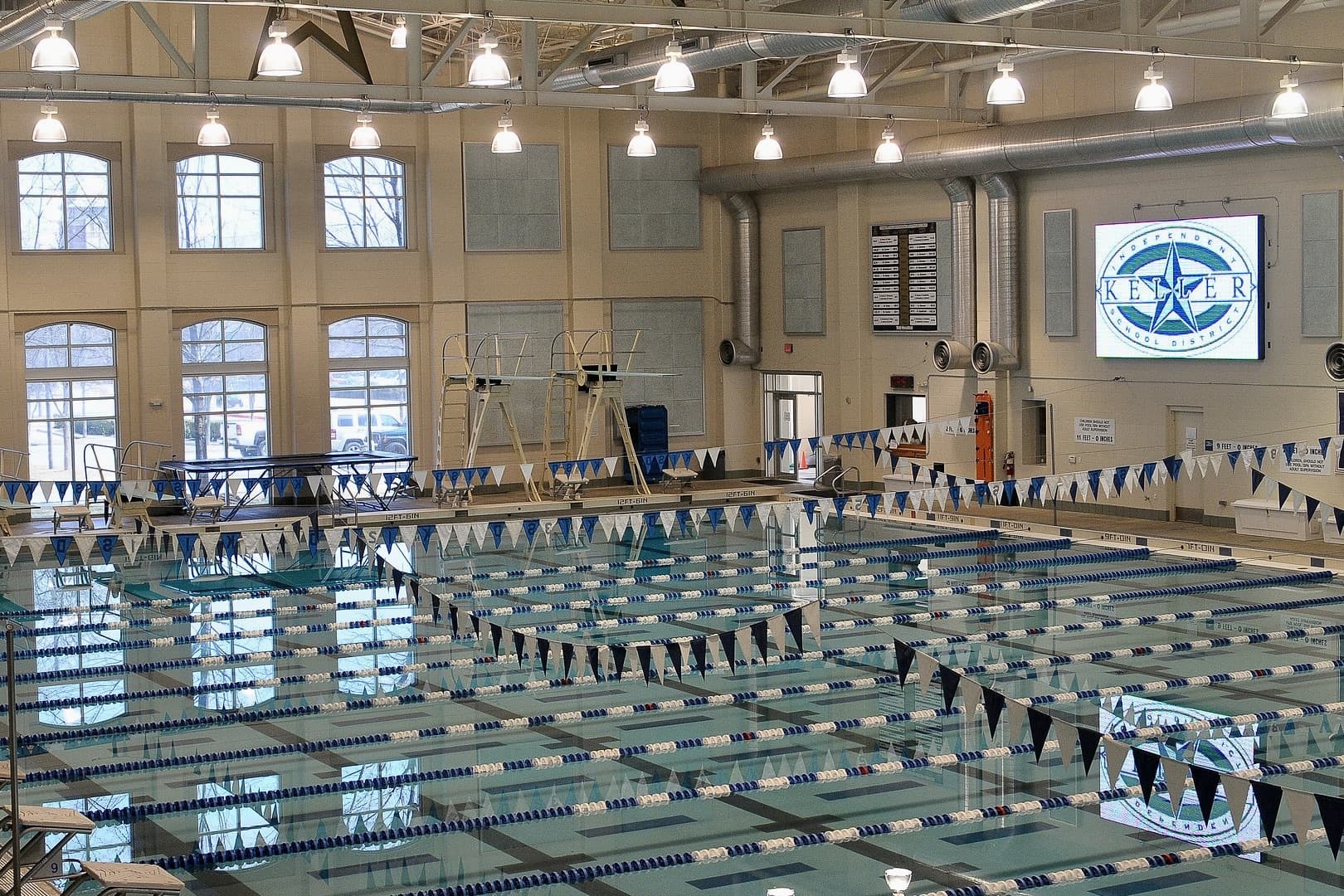
Keller ISD’s board of trustees voted 4-1 on purchasing the land where the school’s natatorium is located for $675,000 at its Aug. 27 meeting.
The details
The 2.4-acre parcel of land is currently owned by the city of Keller, which leases it to the district. The building and everything inside of the district is the responsibility of KISD, Superintendent Cory Wilson said. He added the district approached the city about purchasing the land and will clarify responsibilities for the natatorium.
“It adds long-term value to the school district [and] it ensures our investment in the facility benefits,” he said. “This does not affect our financial standing, nor will it affect any of the plans we have with our finances.”
Trustee Chris Coker was the dissenting vote, saying the district should wait to purchase the land after November to see if KISD’s $828 million bond is passed, which has a proposition dedicated to the natatorium. He said he's not against purchasing the land, but the timing isn't right.
“I don’t know if it’s wise to spend money we don’t have on a building that we’re going to keep using, anyway,” Coker said. “I’d rather see a multi-year lease ... to see whether or not this bond passes before we have this conversation.”
Deputy Superintendent John Allison said that by owning the land, the district has more control over the facility to make alterations without having to confer with the city.
During its Sept. 1 meeting, Keller City Council voted to approve the sale of the land. Council officials included the stipulation that if the building or property under this agreement is not used for an educational purpose in accordance to state law, it will be ceded back to the city of Keller.
"I think it's the right thing to do to clean up the the legal documents so Keller families can get back swimming at the natatorium we all love," Mayor Ross McMullin said.
Zooming in
Allison told the board about the progress on the repairs to the natatorium, which closed May 12 due to water filtration failures, according to previous reporting.
The repairs are in the first phase, which includes repairing the leaks and cutting two large holes in the pool deck to reach the leaks. Concrete was poured for the decking Aug. 28 and filter demolition is expected to start the first week of September. The new filtration system will then be installed with the goal of that being completed by the end of September, Allison said.
He added the district hopes to open the natatorium by the first week of October, though he said there is a possibility that the pumps sustained damage when sand got into the system when it failed.
The second phase includes bringing the facility up to current standards for long-term use and looking at the HVAC, pool pump and electrical systems to ensure it can operate soundly over the next 20 years.
What else?
Allison gave an update on some of the school buildings where HVAC systems have failed, resulting in high temperatures in classrooms.
“We have 20-year-old-plus equipment,” Allison said. “With triple-digit [temperatures,] it puts a strain on our cooling systems.”
Allison said the district has about 380 open work orders, which was 650 work orders around the time school started. He added that getting parts for the systems have been difficult and the temporary solution while the district waits for those work orders to be filled has been to put spot coolers in place.
“Spot coolers will reduce the temperature in the room,” he said. “They are not a replacement for HVAC.”
Allison said the district is using 180 spot coolers across the district, and each one costs about $550 a week to run, resulting in the district spending nearly $100,000 per week to keep classrooms and facilities cooler.
He said the district will get a discount once they hit the one-month mark using the spot coolers. The units will continue moving between campuses as needed until temperatures finally begin to fall.
The more than $756 million of the $828 million bond would go toward updating district infrastructure, like HVAC systems and roofing, according to previous reporting.
Editor's note: This story has been updated with information from Keller City Council's Sept. 1 meeting.