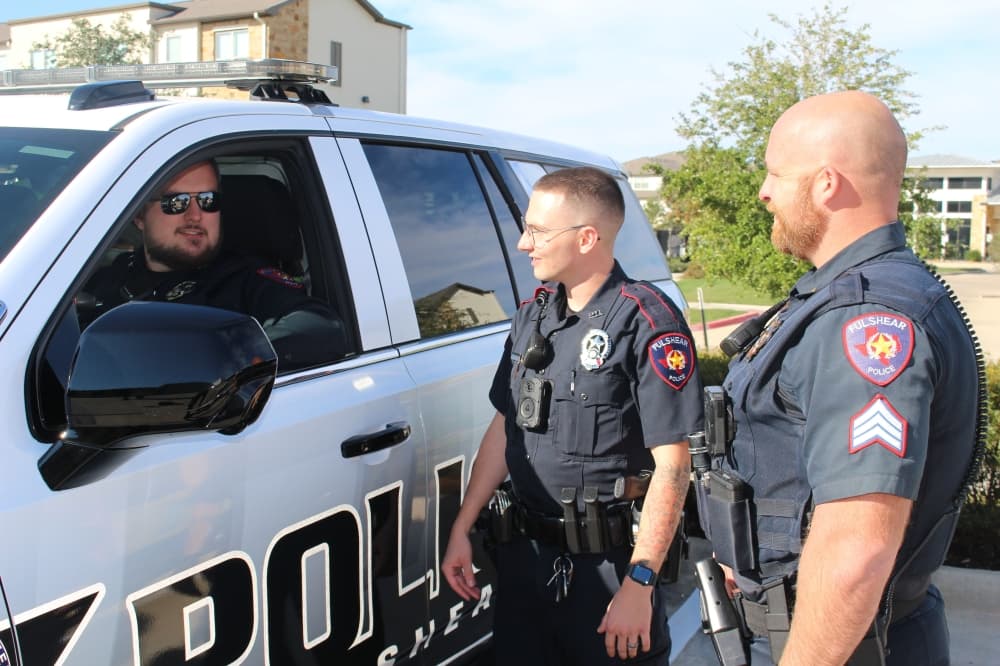
Fulshear residents could see a May or November ballot item to create a Crime Control and Prevention District, which would collect $0.25 of sales tax to fund law enforcement.
The move comes after Fulshear City Council created a committee Oct. 7 to discuss police department salaries, investigate pay compared to competitors and anticipate staffing needs, as well as to evaluate the future budget impact.
The committee was charged with creating a five-year police pay plan similar to Houston and Harris County—which both approved raises in 2025—so Fulshear can remain competitive, City Manager Zach Goodlander said.
The breakdown
The police salary committee compared Fulshear’s wages to surrounding departments, including Katy, Richmond and Stafford, finding the department currently sits around the 55th percentile in pay, with sergeants, lieutenants and corporals seeing the biggest gaps compared to other departments, said At-Large council member Jason Knape, who spoke on behalf of the committee.
The city also does not currently offer a cost-of-living adjustment—one of the most competitive benefits, Knape said.
But while the committee is aiming to hit the 75th percentile by fiscal year 2028-29, other factors, such as recruitment and retention of top officers, are also a priority, Knape said.
“We want to be based in data, but we don’t want to miss the heart and miss the feeling of what we’re feeling and what we’re perceiving, not only as a police department, but also as a city,” he said.
The committee proposed a 10th percentile increase each year, starting with a targeted 55th percentile in FY 2026-27, Knape said. The increase would cost about $4.3 million and see the department hit the 75th percentile for FY 2028-29. A dispatch would add $1.3 million to the FY 2029-30 budget.
“We can’t do it all in one step, that’s a huge undertaking, but what we can do is we can take incremental progress in order to get there and show a path of how we’re going to get there,” he said.
Funding the project
While Fulshear continues to grow in population and adds people to the tax roll—with an additional $299,347 expected from 571 new homes built this year—the city is “not just the police department,” and would have to find other ways to fund salary increases, Knape said.
To account for salaries and one-time costs, the maintenance and operations tax rate would increase from $0.1165 per $100 valuation to $0.1476. A one-cent increase in the tax rate is estimated to net $330,000, Knape said.
Additionally, the police committee suggested establishing a Crime Control and Prevention District, which would receive a $0.25 of sales tax. The money would either come fully from the Economic Development Corp.’s A-Board, reducing them to $0.25—the move recommended by the committee—or split between the A- and B-Boards, reducing each to $0.375, Knape said.
Knape said the A-Board is currently expected to receive $2.3 million—a number projected to increase annually by 10%.
In order to establish the CCPD, the council would have to call an election—something Knape suggested they could do for the May or November general elections.
Why it matters
Houston Police Department officer salaries will increase by 36.5% by 2030 after an $832 million police union contract was approved May 21, Community Impact reported. Meanwhile, Harris County increased constable salaries to $260,000 on Sept. 9 with an extra focus on law enforcement pay parity in the FY 2025-26 budget.
Fulshear prides itself on being one of the safest cities in Texas, due to a low area of responsibility per officer and fast response times, Knape said. Safewise—a website that ranks and reviews home security technology—ranked the city as the third safest in Texas in March 2025.
However, due to a selective hiring process causing longer times to fill open positions and rapid population and development growth, the city will soon see increased needs, including its own dispatch by FY 2029-30, Knape said. The city currently relies on Fort Bend County for dispatch.
What’s next
City Council will meet for a special meeting Feb. 3 and could call an election for the creation of the CCPD, per Knape’s recommendation.
Knape also suggested the committee continue meeting biannually in the future.