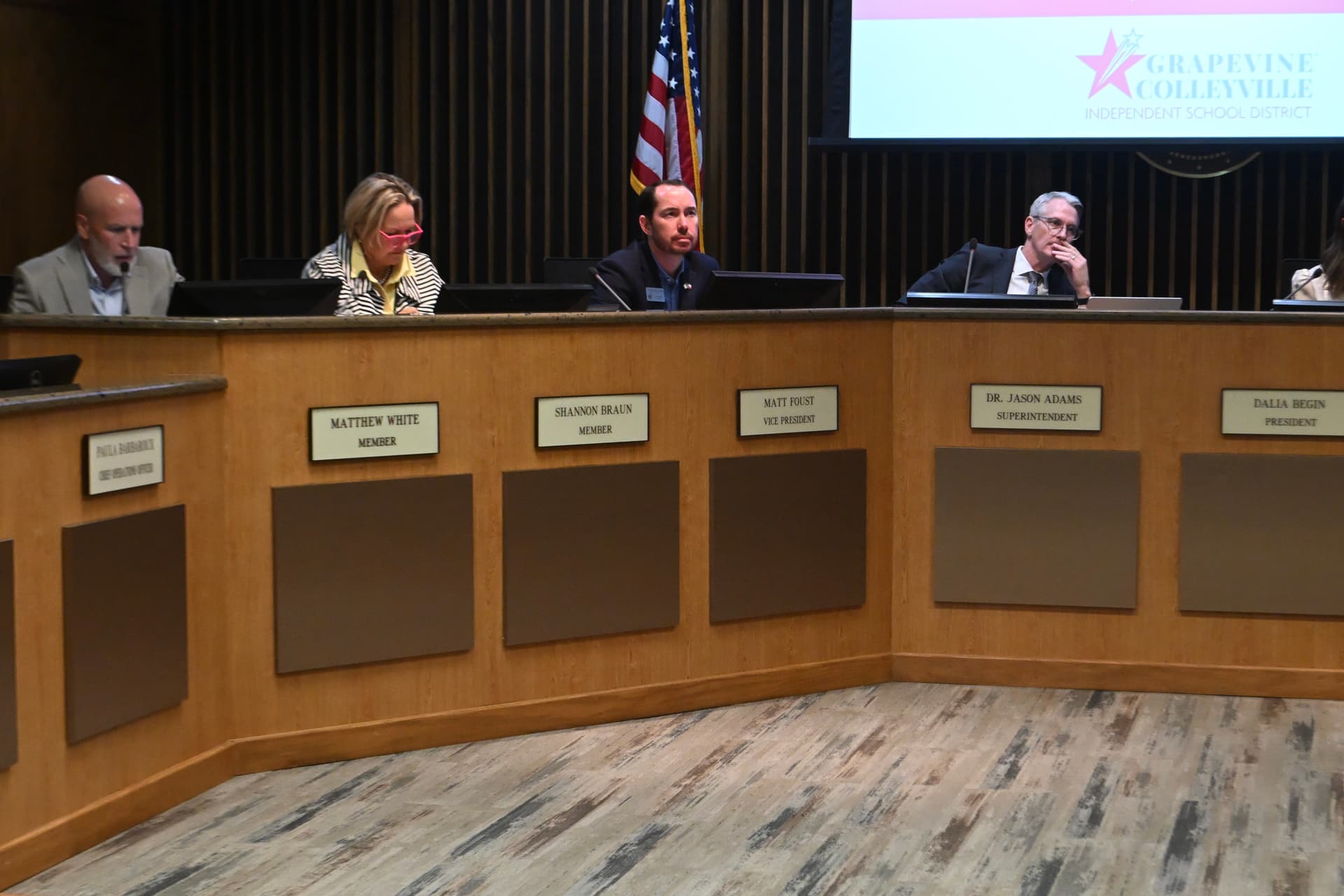
Grapevine-Colleyville ISD named Jason Adams as its new superintendent this summer.
Adams was named superintendent in June after the district’s board of trustees approved his contract June 15. Adams replaced interim superintendent Rick DeMasters, who stepped into the role in December 2025.
Adams has worked in education for over 28 years as an elementary school teacher, assistant principal, principal, district administrator and deputy superintendent. He most recently worked as the deputy superintendent of Garland ISD.
Community Impact sat down with Adams to discuss his goals for the district. Responses have been edited for length, clarity and style.
What is your vision as superintendent for Grapevine-Colleyville ISD?
Ultimately, our job is to prepare kids when they leave our system, and I think not so many years ago, that for some people that meant graduating kids and getting them to walk across that stage. Now, it means so much more than that. It means that yes we do have kids graduate [and] walk across that stage, but walk across that stage straight into a college classroom confident and well prepared to be successful and persist through college. Or, that means going straight into the workforce and having a pathway to a viable living wage. As a superintendent in the school system, you set the vision and the conditions to make that happen for all kids, and so I feel strongly that our system should be set up to give kids choice; that when they graduate from our schools, there's real choice. Not all kids want to go to college or need to go to college, but I think all kids should have that opportunity if they choose to do so.
What are the district’s biggest financial challenges that lie ahead?
Similar to a lot of districts in Texas, you have districts facing declining enrollment. That impacts district finances quite a bit, and you have districts trying to prioritize programs and functions to make sure that we're maximizing our resources as a district. The challenges are always, when you have budget constraints like that, how are we maximizing the resources that we have? That's part of it. I think the other part of it is how are we maintaining competitiveness with staff salary, and so we're in a unique situation that we're a recapture district, and so we consider all those variables: decline in enrollment, trying to maximize the resources that we have and also trying to remain competitive with surrounding districts. That's going to be the challenge. How do we stay competitive with teacher salary and knowing that we have to be able to compensate our teachers and keep our teachers? That's a big part of it.
How are you and your leadership team addressing those financial challenges that you see ahead?
Part of it is that you seek to understand first, and I think a big part of the next couple of months is just to understand the landscape. You want to make sure that you're seeing what you think that you're seeing, and you fully understand the issue before you start making decisions. I know this district has had some tough decisions they've had to make over the last couple of years, and so I think understanding the current financial situation and trying to plan not just for next year but years down the road.
You're a recapture district. Can you explain what that means?
Part of recapture is certain districts are property wealthy districts in the state, and just the way the state funding formula works, some of that money for those districts is recaptured at the state level. This district sends close to $30 million a year back to the state to help fund schools beyond our own community, and that's just part of the state funding mechanism for public schools in Texas.
How do you define success beyond just test scores?
In the state of Texas, we have to start how schools and a community’s schools are evaluated, and that's through our public accountability system. In some ways, you can evaluate success of a school and a school district by the overall accountability rating, which I'm excited to report this year for GCISD, it's an A rating. They jumped up five points, which is substantial to go from an 86 to a 91. It just shows so much work that took place last year to get to that point. But I also understand that students and schools are more than an academic rating. I think that our community is an A community. We are an A-rated district now, and so I'm excited about that. I also think that all kids should have access to an A campus, and so our goal is to be not only just an A-rated school district, [but one] where every kid goes to an A-rated campus, and I think we're on that direction already. We have remarkable principals and teachers that have been doing so much work to get kids there. But it also comes back to what I said earlier. It's part of our job is to prepare kids to walk across that stage, and so an A rating represents a couple of things. It represents we've received an A rating for accountability, but it also represents that students are prepared, students are on grade level, students meet graduation requirements, CCMR requirements, [and] they're prepared when they leave us. I think our job ultimately is: all students should have access to an A-rated campus, but they ultimately should be prepared when they leave us, whether that going straight into a college classroom or into the workforce.
What are your top safety and security priorities when it comes to school campuses?
Safety and security is always going to be a priority in our district. First, we have a great partnership with our cities where we have SROs at every campus. That's not common across the state of Texas, and that just shows the commitment that our community has to student safety. Having SROs on campuses is significant, but that just goes to show you this community invests so much in keeping our schools safe.
How do you, as the superintendent, preserve what families value about GCISD?
One of the things I've come to appreciate on just a deep, deep level is the partnership and commitment from people in this community. It's not uncommon for me to talk to people, and hear their story, and it usually starts out something like this. I chose to come to GCISD because I wanted to live in this community, and I wanted to send my kids to GCISD schools. The strength of this district is a long legacy of that. You have people that go through this system, their parents moved here to send their kids through our schools. They move away for college and career, and ultimately, they come back to the community because it's such a remarkable community, and they want to send their kids to these schools. That says a lot about the fabric of GCISD as a whole and what we do for kids in our schools.
What do you hear from students, and then how does that shape your leadership?
I think student voice is paramount. We got to be able to talk to those that are going through our schools every day. Throughout my career, I've always tried to move closer to the classroom, and a big part of that is understanding the student experience. One of my priorities coming into this district will be meeting with kids, hearing from them directly. I've only been here for a few months. We've been in school for [a few] days now, but we will meet with our kids and just understand their experience. We'll have a superintendent student group where they'll have direct access to give feedback and voice to the district. And I think it's important. You can never lose sight of that. I think it's also important just to try to move or shrink the distance from [the] superintendency and central office directly back to classrooms as much as we can, because that experience and that voice, that's important.
Is there anything else our readers should know about the new superintendent of GCISD?
This is my 29th year in education, and one of the things I promised myself I would never lose sight of is you're always going to be a teacher at heart. You always got to remember what it's like to be in the classroom. I'm a strong advocate for public schools, I understand the significance in our school systems and I'm just excited to be part of such a remarkable community. This community has a long legacy of excellence. They’ve been a model in so many ways for academic excellence, fine arts excellence, excellence in athletics, and so really every part of this school organization has a long history of that. I think part of the next chapter is going to continue to build upon that excellence, and so we continue to write that story.