Georgetown Emergency Medical Services responded to almost 30,000 calls in 2025, a number that has continued to increase year over year. To meet demand, the Georgetown fire and EMS departments are planning new facilities and implementing upgraded technology.
What’s happening
The department responded to 1,129 more EMS calls in 2025 than in 2024, which averaged out to about 80 per day last year. Total annual responses have risen from 22,883 in 2021 to 29,398 in 2025, according to a department update from January.
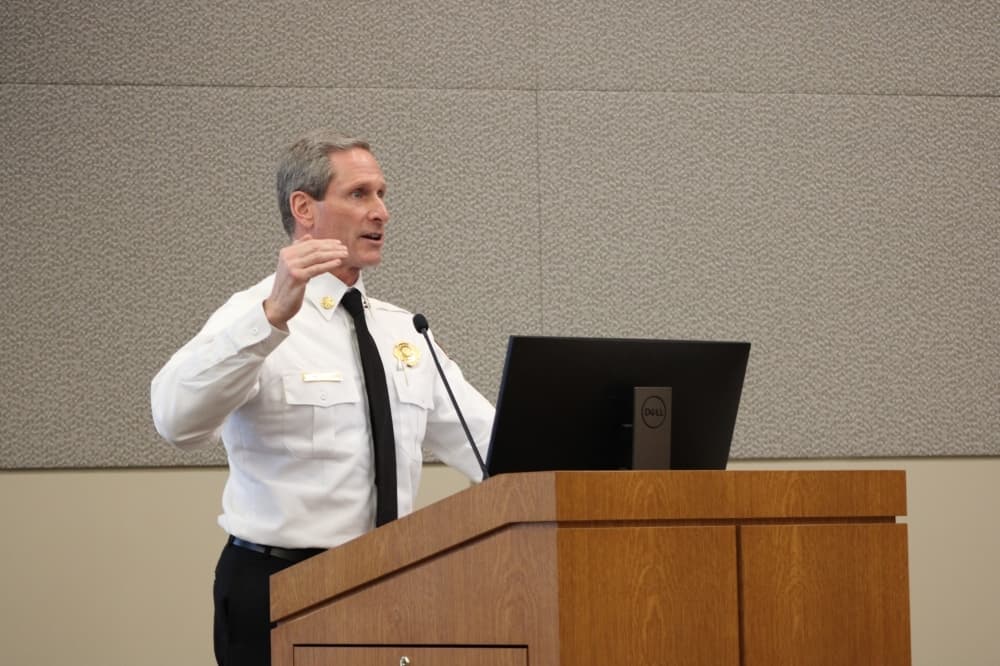
Increased call demand has led to slower response times, which Fire Chief John Sullivan said the department is actively trying to address through upgraded equipment, increased staffing and new facilities.
The city has plans to open three new fire stations in the next 10 years as well as an EMS substation, which will house ambulances to send out when they’re most needed, Sullivan said.
The first of the three planned fire stations is Station No. 8, which will be located at Westinghouse Road and FM 1460. Design work is currently underway, with construction starting next year ahead of an expected 2028 opening. In the meantime, the department is utilizing predictive software to track call habits and strategically move ambulances around the city to anticipate where emergencies will happen.
Check it out
The department is beginning to use tools, such as robotic CPR assistants, video laryngoscopes to help insert breathing tubes, and preprogrammed IV pumps that measure precise medication doses, in order to reduce human error and efficiently respond to emergencies.
The department is also rolling out a ventilator program on EMS captain vehicles to mechanically assist breathing, freeing up responder hands for other critical care tasks.
“Now you can have an attendant running the van, focusing on suction, continuing on with patient care,” EMS Captain Nicholas Kopp said.
The department has also integrated privacy-compliant artificial intelligence tools into its electronic patient care reports, which allow the responding paramedics to verbally dictate patient assessments, cutting down on documentation time and getting ambulances back into service faster, Kopp said.
Another AI tool allows responders to take a photo of a patient's medication or handwritten notes to populate the information into their chart with accurate drug names and dosages.
The cause
While general population increases drive some of the 911 call volume, shifting demographics in an older population are a primary factor behind the increase in medical emergencies, Sullivan said.
As residents age, the department is seeing a high need for medical care related to chronic conditions, strokes and traumas. Falls are currently the biggest driver of trauma calls, and the department has also seen an increase in cases of sepsis.
“We try to normalize and socialize the fact that 911 is there for a reason, and we want to be there and provide early intervention rather than late intervention,” Sullivan said.
What else?
Residents can sign up for Smart 911, which provides emergency dispatchers who opt into the program with the exact location of the caller as well as shares the patient's profile, including their medical history.
Paramedics are trained to look for medical documents attached to the refrigerator when responding to an in-home emergency, Sullivan said. Residents should place physical medical history documents in a sleeve on their fridge for efficient emergency response.