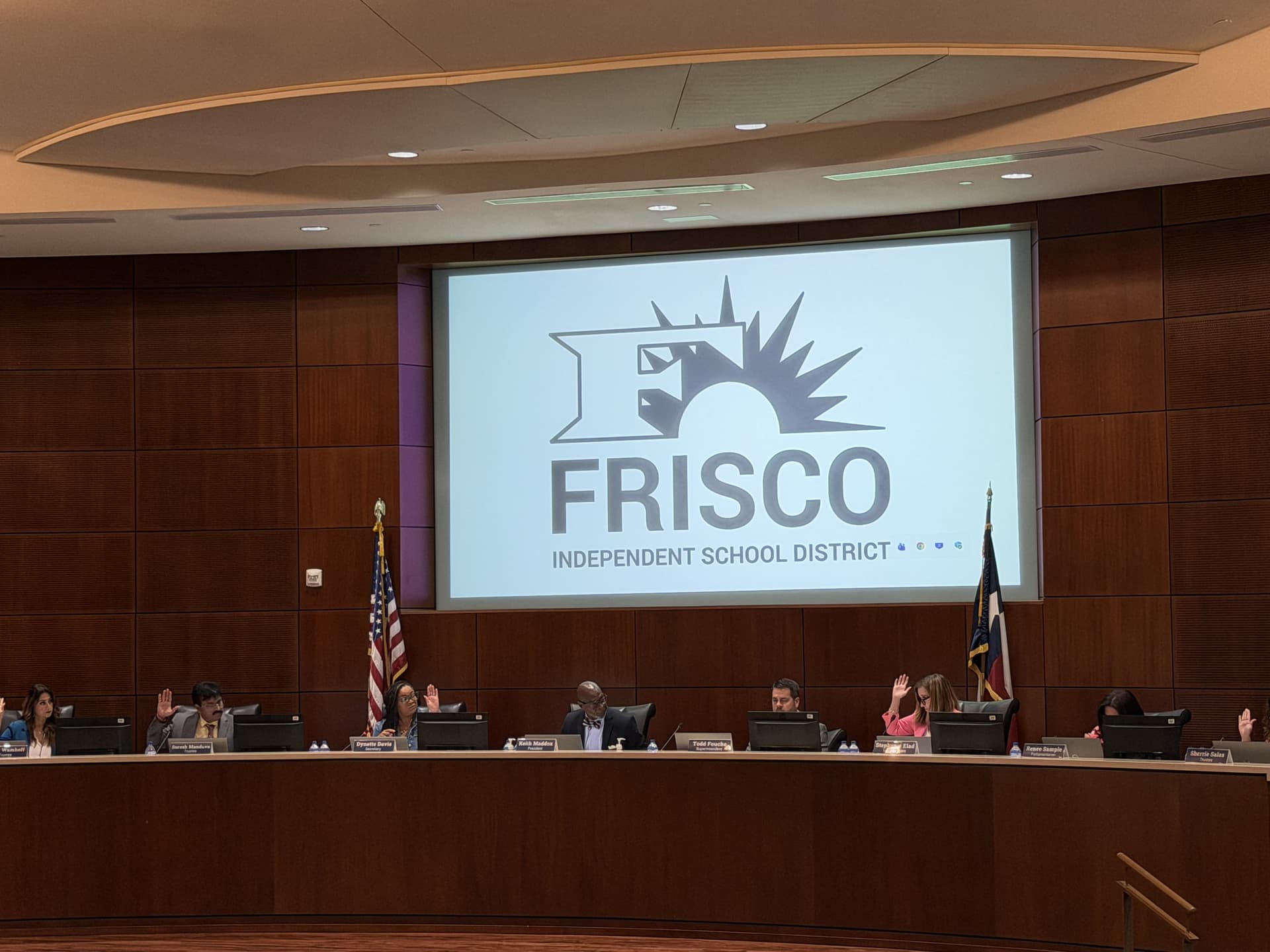
A year after voters turned down Frisco ISD’s tax ratification election, or TRE, to increase the property tax rate by 13 cents per $100 of valuation, the district still faces funding shortfalls going into the 2017-18 fiscal year.
On the surface, it appears that FISD would be in good shape for the 2017-18 school year because final property appraisal values released at the end of July showed the district netted $19.69 million more than what was originally projected in June.
However, because of the state’s funding formula, FISD will not benefit from the increased property tax revenue, because as the district’s property values rise, the amount of funding from the state decreases.
“The school finance system in Texas is complicated, and it is not as straightforward as people think,” FISD board President John Classe said.
Rising property values
The way the district builds its budget is based on certified estimated property values provided in April by the Collin and Denton central appraisal districts. Based on those estimated values, the district will then build its budget and make projections for upcoming fiscal years.
FISD’s fiscal year runs from July 1-June 30. Therefore, the district needs to approve its budget for the upcoming school year by June.
“The majority of our revenue is taxes and state aid, so we have to know what our taxable values are going to be to project revenue and then state aid comes from that,” FISD Chief Financial Officer Kimberly Pickens said.
However, because these property values are estimated, they can change by the time the values are certified at the end of July. According to both Collin and Denton counties, property values increased by 10-14 percent this year compared with last year.
“When we give the estimates in April, we’re still doing the work, and we don’t know how many new exemptions there’s going to be and we don’t know what the level of protests will be,” Collin County chief appraiser Bo Daffin said.
Based on the state’s funding formula, if a district’s property values go up the amount of state aid is decreased.
“State shares have dropped dramatically,” said Josh Sanderson, deputy director of the Equity Center, an Austin-based school finance research and advocacy organization.
Sanderson said state shares were, on average, about 50 percent of a school district’s revenue in 2006, but that number has dropped to about 38 percent.
“That’s problematic because all of the strain from funding for new [state] programs, staff raises or inflation is placed on a district and the local property taxpayers,” Sanderson said.
FISD is known for being one of the fastest-growing school districts in Texas. Though the district did experience a slowdown in enrollment last year, the district is still expected to grow by more than 4,000 students by 2019.
Sanderson said even though property values are going up, the district’s expenses are going up because there are more students. FISD has to accommodate these students with less funding from the state, he said.
“People need to have a better understanding of how the funding mechanism in Texas works for public schools,” Classe said. “Everybody assumes because their property tax bills are going up every year because valuations increase, then Frisco ISD should be fine, but the reality of funding from an operational standpoint is that we don’t get to keep that money.”
 A funding problem
One of the reasons FISD called for the TRE was because of the loss of a special state aid fund known as the Additional State Aid for Tax Reduction—or ASATR—that expired Sept. 1. This fund replaced some lost property tax revenue when school districts were required to compress tax rates by one-third beginning in 2006.
With this tax rate compression, the district became what is known as fractionally funded, meaning FISD received only a percentage—88 percent—of the total state funding available per student under the state’s funding formula. In 2011 the state began significantly reducing the funding for ASATR, and lawmakers decided to end funding altogether by Sept. 1, 2017.
In 2016, FISD took advantage of a formula adjustment made available to districts in the 2015 legislature, which helped FISD phase out of ASATR more quickly. Districts like FISD that were fractionally funded were allowed to choose whether to adjust their formula or continue ASATR, depending on which scenario was more beneficial.
Under the adjusted formula, FISD receives 98 percent of the total funding available per student rather than the previous 88 percent. Therefore, FISD found that taking the formula adjustment meant receiving more money per student.
The formula also allowed FISD to pay less in recapture, which is where wealthier school districts share local tax revenue with other school districts. FISD is expected to not pay recapture until the 2019-20 school year. FISD’s property wealth—determined by property values and the weighted average daily attendance—would need to be above a certain level for the district to begin paying recapture. According to FISD’s projections, FISD is expected to pay up to $26 million in recapture in 2019-20 because of rising property values.
In the end the district found it was more beneficial to take the adjustment in both the 2015-16 and 2016-17 fiscal years even though the adjustment meant the district no longer received ASATR funds, Pickens said.
However, the additional funding FISD received from the adjusted formula was not enough to make up for the overall funding shortfall.
“We didn’t fall off an ASATR cliff; [the adjusted formula] just held us constant,” Pickens said. “The key piece of information is [that the adjusted formula] didn’t address the true basis of the funding problem. It basically broke us even with where we were to begin with, which was in a deficit situation because of the cuts to state funding.”
 Cost-saving measures
After the TRE failed last August, FISD went into cost-cutting mode to prepare for the loss of state funding for the upcoming school year as well as in future years.
The district made a decision to delay the opening of four new schools, which saved the district more than $15 million. The district also began a priorities-based budget process to identify cost-saving measures.
As a result of the process, the 2017-18 budget includes 59 strategies to reduce costs and generate additional revenue. The strategies brought in a net savings of about $5.8 million. All of the strategies have been implemented, Pickens said.
Moving forward
FISD will continue its priorities-based budget process this year as the district continues to plan for the future.
“This fall, the focus is going to be on high school capacities, buildings and the small-schools model,” Pickens said. “We need to make sure that whatever our plans are going forward with facilities that it still meets the community needs, wants and expectations.”
A bill was passed in the 85th Texas Legislature that would award hardship grants to districts that would be strongly affected by the loss of ASATR. However, Pickens said FISD does not meet the criteria for the grants and does not expect the district to receive extra funding in the coming years from the state.
Before ever calling another TRE, Pickens said the district will continue to evaluate its needs, enrollment and property values.
“I think that long-term, the way that the current finance formula works in Texas, what we’re working on now is not sustainable,” she said. “There are a lot of things that have to be looked at as a whole picture in order to decide when to call another TRE and for how much.”