Richardson ISD officials proposed district-wide raises based on role and experience for 2026-27 at the May 7 board of trustees meeting.
The board came to a consensus on a proposed raise that would cost the district roughly $8.3 million. The board is set to officially approve the new 2026-27 budget and the proposed raise in June.
Breaking it down
Despite RISD’s budget shortfall and $25.7 million in cuts proposed in April, district officials have maintained that pay raises are a priority throughout the development process for the 2026-27 budget.
“We know that we have to continue to make significant reductions in our expenditure lines,” Superintendent Tabitha Branum said. “We also know that we want to continue to build on the momentum that this board has made to address compensation, to address lowering our turnover rate.”
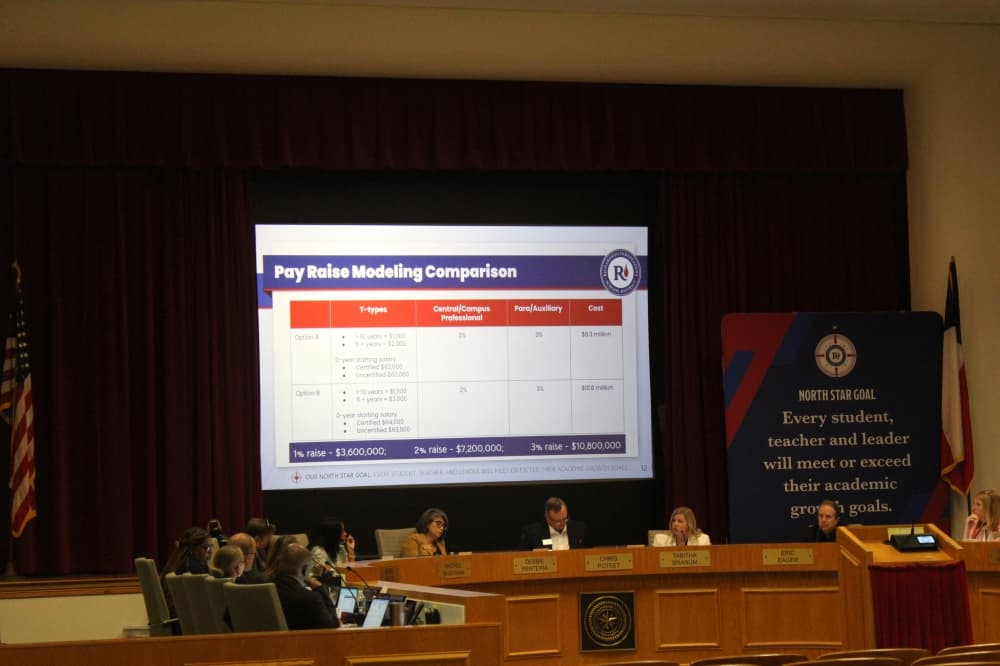
The proposed pay raise includes a percentage raise for central and campus professionals and paraprofessional and auxiliary staff, as well as a flat increase for “teacher-types,” who are teachers, librarians, counselors and nurses.
Teacher-types with one to 10 years of experience would receive a $1,000 raise, while those with 11 or more years of experience would receive a $2,000 raise. Central and campus professionals would receive a 2% raise, while paraprofessional and auxiliary staff would receive a 3% raise.
The starting salary for certified teachers would be $63,500, and uncertified teachers would start at $63,000.
The proposal keeps RISD competitive with entry-level salaries while also preserving the district’s substantially higher salaries for experienced teachers compared to neighboring peer districts, said Chris Goodson, assistant superintendent of human resources.
“For 15, 20 and 25 years [of experience], we would still be paying our experienced teachers more than our surrounding districts,” Goodson said.
A closer look
This compensation model is set to cost the district roughly $8.3 million. The board considered a second compensation option that would increase teacher salaries by $1,500-$3,000 based on experience and would cost the district $10.8 million.
“[The] $2.5 million [difference] doesn’t sound like a lot, but we can do a lot [with it],” trustee Vanessa Pacheco said. “There’s a lot of priorities, and as much as I’d love to give and do all the things for our educators, for our staff and everybody else, we’re in a tight spot.”
Goodson also noted that health insurance rates continue to increase. RISD’s employee health insurance contribution is not as high as some neighboring districts, but Branum said that the district does invest in additional benefits, like the staff health clinic, that are available to all district staff.
“Those investments are also a form of payment,” Pacheco said. “It’s not an actual cash dollar, but it is an investment we’re making on our Richardson community to support them and to make sure that they’re taken care of here.”
The big picture
RISD is facing flattening revenue and declining enrollment at the same time that district budgets are becoming increasingly determined by student numbers, said David Pate, assistant superintendent of finance and support services, at a past meeting.
“We’re having to make some pretty significant cuts. We know we’re going to have to make more cuts,” trustee Megan Timme said. “We [also] want to have the best teachers in the classroom [and] we want to be able to recruit the best.”
The district has consistently invested in compensation increases and benefits over the last several years, and has seen increased teacher retention, particularly among experienced teachers, Goodson said.
“We are doing everything we can, but that is the reality we have been forced into,” trustee Eric Eager said. “We’re fighting two battles right now, where the amount of money that goes to the state goes up, but we’re trying to help our teachers simply pay for insurance.”
Even with the efficiencies that the district found through the budget cuts, Pate said RISD is still facing a more than $21 million shortfall in next year’s budget, which is expected to grow significantly over the next several years.
“We cannot continue to operate in deficit spending,” Eager said. “Going into next year, we’re really going to have to have some tough decisions.”