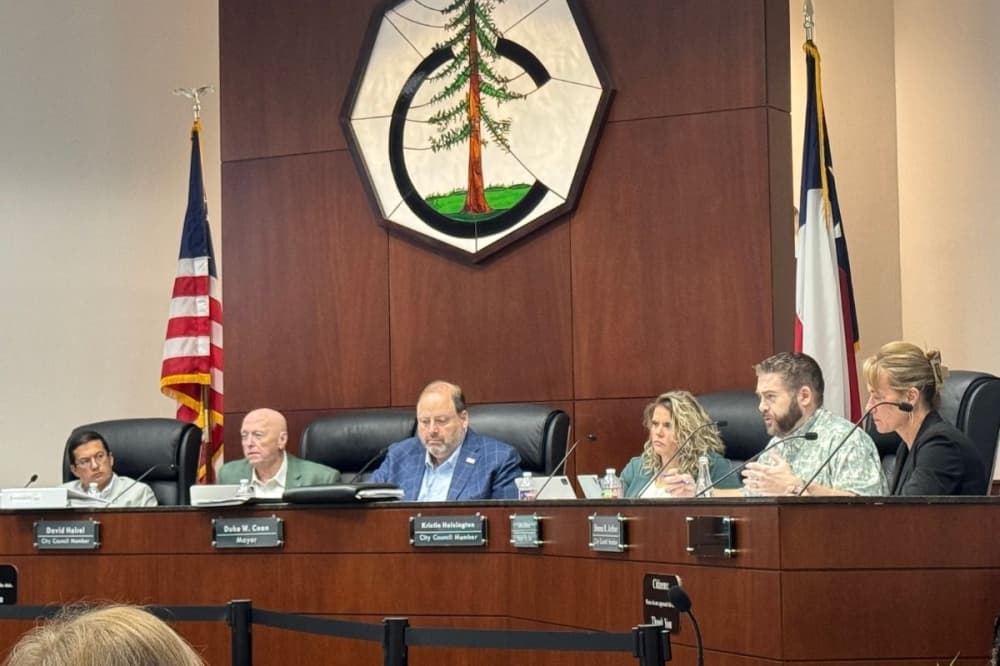
Conroe officials are continuing to look at how to pay for the city’s growing drainage needs, but City Council stopped short of moving forward with a proposed stormwater utility fee Sept. 10.
During the meeting, council reviewed available grant funding, upcoming drainage work and roughly $210 million in identified drainage projects. Officials did not suggest the city would fund all of those projects at once.
What happened
Mayor Pro Tem John Sellars asked what grant opportunities were available to help cover drainage costs.
Staff said the city is continuing to look for grants, but home elevations and property buyouts are currently the only active grant-funded drainage efforts.
Officials said roughly $5 million in drainage work is included for fiscal year 2026-27, accounting for less than 10% of the approximately $210 million in identified projects discussed Sept. 10.
“Drainage is one of those things you don’t see the effects [of] until it hits,” Public Works Director Jason Miller said during the discussion.
Staff also clarified that the proposed stormwater utility fee would be a city program and is unrelated to municipal utility districts.
The discussion
Sellars questioned what moving forward with the proposal could ultimately cost residents and businesses.
Sellars said he wanted additional cost information before the council moved any further with the proposal.
The council did not vote on the stormwater utility fee Sept. 10, and the proposed $4 residential charge was not adopted. Staff was given general direction to continue evaluating the issue and provide additional cost information.
How we got here
The proposal previously presented to council called for residential customers to pay a flat $4 per month. Nonresidential properties would pay $4 per equivalent residential unit, with one unit representing 3,200 square feet of impervious surface, such as rooftops and pavement.
Consultants estimated the fee could generate about $4.43 million annually. The original study identified nearly $11.9 million in capital needs, along with roughly $276,000 in supporting labor costs. Projects included work along Alligator Creek, Live Oak Creek, Canterbury, Oxford and Hunnington Drive.
Council held off on taking action Aug. 27 and instead asked staff to return with a broader look at the city’s drainage system, including existing problem areas and projects already planned.
Also of note
Council also declined to advance a proposed 4% increase to residential and nonresidential water and sewer rates after a motion on the ordinance died for lack of a second.
The proposed rates would have taken effect Oct. 1 and were recommended following the city’s 2026 water and sewer rate study. Customers enrolled in the city's single-family Lifeline program for residents over age 65 or with disabilities would not have received an increase.
City documents state the adjustment was proposed to help cover rising operating and maintenance costs along with improvements to the city’s water and sewer infrastructure.
During the discussion, officials said the need for additional utility revenue was being driven largely by the city’s capital improvement program and they also pointed to future impact fees as another potential source of infrastructure funding.
Because the ordinance did not advance, the proposed 4% water and sewer rate increase was not adopted Sept. 10.