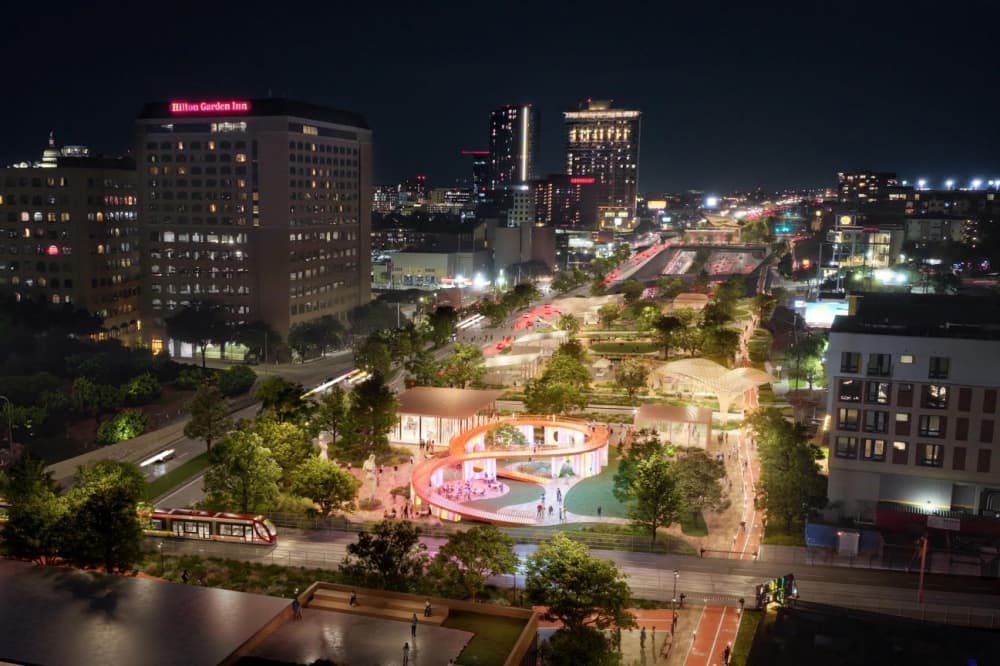
The city is planning to build a series of amenity decks over I-35 downtown but has yet to secure funding for the multiacre structures. (Courtesy city of Austin)
Austin will commit more than $100 million to support future public amenity decks covering portions of I-35, after a scaled-down alternate proposal was tabled this spring.
Current situation
I-35 is being widened and lowered below street level through the Texas Department of Transportation's more than $4 billion Capital Express Central initiative. Construction is now underway and expected to last into the 2030s.
Austin has planned for years to bridge some of the new-look I-35 through a local "cap and stitch" program. The city would develop larger caps and smaller stitches to cover the interstate, connecting downtown and East Austin with public decks that could house parks, plazas and small buildings or venues.
The city's finalized plan includes three downtown caps covering nearly 11 acres between Cesar Chavez and 12th streets, plus two northern stitches covering more than 3 acres at 41st Street and the Capital Metro Red Line.
Building all caps and stitches is now estimated to cost about $400 million, added amenities across all decks could cost nearly $260 million, and maintaining the structures will cost about $9 million annually once they're in place.
Austin has yet to secure any of that funding, and it remains to be seen when decks would be built. However, the city has reserved an initial $104 million for the future caps' foundations.
The action taken
Last year, City Council approved the plan for TxDOT to build the initial cap and stitch roadway elements into the Capital Express Central project. That work is being funded with a $63 million state infrastructure loan and $41 million in local debt. A deadline to formally commit that $104 million to TxDOT is approaching this year.
The outlook for the overall cap and stitch plan isn't yet settled, especially after a federal grant to support the largest structure from Cesar Chavez-Fourth Street was canceled. The city's limited financial flexibility for the eventual caps led to a recent suggestion from Mayor Kirk Watson to reduce their scope. His outline included a smaller version of the Cesar Chavez-Fourth Street cap, and future-proofing for a separate future cap from 11th-12th streets only. Watson said the proposal would lower costs and construction timeline, getting more immediate results for taxpayers footing the project bill.
Despite some support on the council dais, Watson's alternate plan didn't win over enough members to replace the more expansive, and expensive, version as decided last year. His scaled-down cap measure was withdrawn from council's May 28 agenda, and Austin will proceed with the $104 million infrastructure commitment this year while more than $600 million in future deck financing is still to be identified.
The city must now finalize its agreement with TxDOT for the deck support elements before the summer. Tucker Ferguson, TxDOT Austin district engineer, said the city commitment is "critical" given the complexity of designing and building the multiphase I-35 expansion. Project letting for the infrastructure foundations could begin in fall 2028, followed by construction soon after.
The cost
The overall price tag and uncertain financing have led some officials to push back on the cap and stitch plan, especially given the likely development timeline. While the supporting infrastructure will be added as part of Capital Express Central, the full decks may not be if local funding isn't secured during the process. If they're not built by the time the I-35 expansion is complete, TxDOT won't allow new projects for a decade—pushing any deck additions to at least the 2040s.
“This will be difficult construction with or without any caps or stitches," Ferguson told council on May 26. "I-35 construction is going to be disruptive. We don’t want to finish that up, get the benefit of the new highway system and how it’s operating, and then go right back into construction.”
Austin will agree to fund more than $100 million in foundational infrastructure for future decks over I-35 this year. (Courtesy city of Austin)
Some future cap funding could come from the city budget or voter-approved bonds. Austin is also looking for external partners like private businesses or philanthropists, a strategy used by many other cities that completed comparable highway deck projects.
"At this time, the City is seeking external partners to develop cap decks and negotiate air rights agreements either through change orders, which can occur between 2030-2032, or release separate letting for cap construction after the completion of the CapEx project (2043 or later)," Brad Cesak, Austin Transportation and Public Works spokesperson, said in an email.
That process will be supported by the Downtown Austin Alliance, the downtown advocacy organization that's been involved in local cap and stitch efforts since 2018. In a statement, the DAA said the highway decks represent a "once-in-a-lifetime opportunity" to reconnect downtown and the east side with new public spaces and mobility options.
"We are excited and thankful that the Austin City Council is moving forward with financing the 'future proofing' of all downtown cap locations, enabling us to begin focusing on the Cesar Chavez-4th Street location," the DAA said. "This is cap location is our priority focus and we’ve begun discussions with the City of Austin on next steps related to governance structure, financing strategy, and philanthropic outreach. We are confident that in this next phase of planning, new funding sources and opportunities will become available."
According to council
Mayor Pro Tem Chito Vela, a supporter of Austin's full cap strategy, said the smaller version floated this spring by Watson wouldn't have offered as much of a public benefit as the original plan the city is now proceeding with.
“I understand the desire to spend less money. ... But I think we get to a situation where you don’t want to be pennywise and pound foolish, where we’re going to do something to say we did something that actually does not bring any value to the area, that does not bring any additional mobility value, that does not have any economic value," he said.
On the other hand, council member Krista Laine has questioned the value of the full cap plan and said Watson's alternative would've resulted in a nearer-term amenity.
“This really comes down to, are we going to deliver something that we ourselves can enjoy? Or are we going to build structural elements with no delivery, potentially, until long after those of us here have all retired?” she said.
Council member Zo Qadri, who represents much of the downtown area along I-35, favored the broader approach and said it lays a foundation for something future residents will enjoy.
"Yeah, we might not see it in the next four to five years or we might not see it in eight years. But I want to make sure that we have something in place that when people look back at this council, they don’t say ‘Wow, they really had an opportunity and they blew it just because it’s not something that we’re going to see during their time in office,'" he said.
Referencing city constraints, council member Marc Duchen said the caps would represent "hyperinvestment" in Central Austin alongside other major projects downtown that should be reconsidered.
“My sense is the last thing that we need is another project where we see the actual returns potentially decades later, if they happen at all," he said. "We need some wins, and if we deliver on projects I’d love for them to be in a timely way where we’re able to enjoy them in the next five or 10 years rather than have an albatross or a money pit."