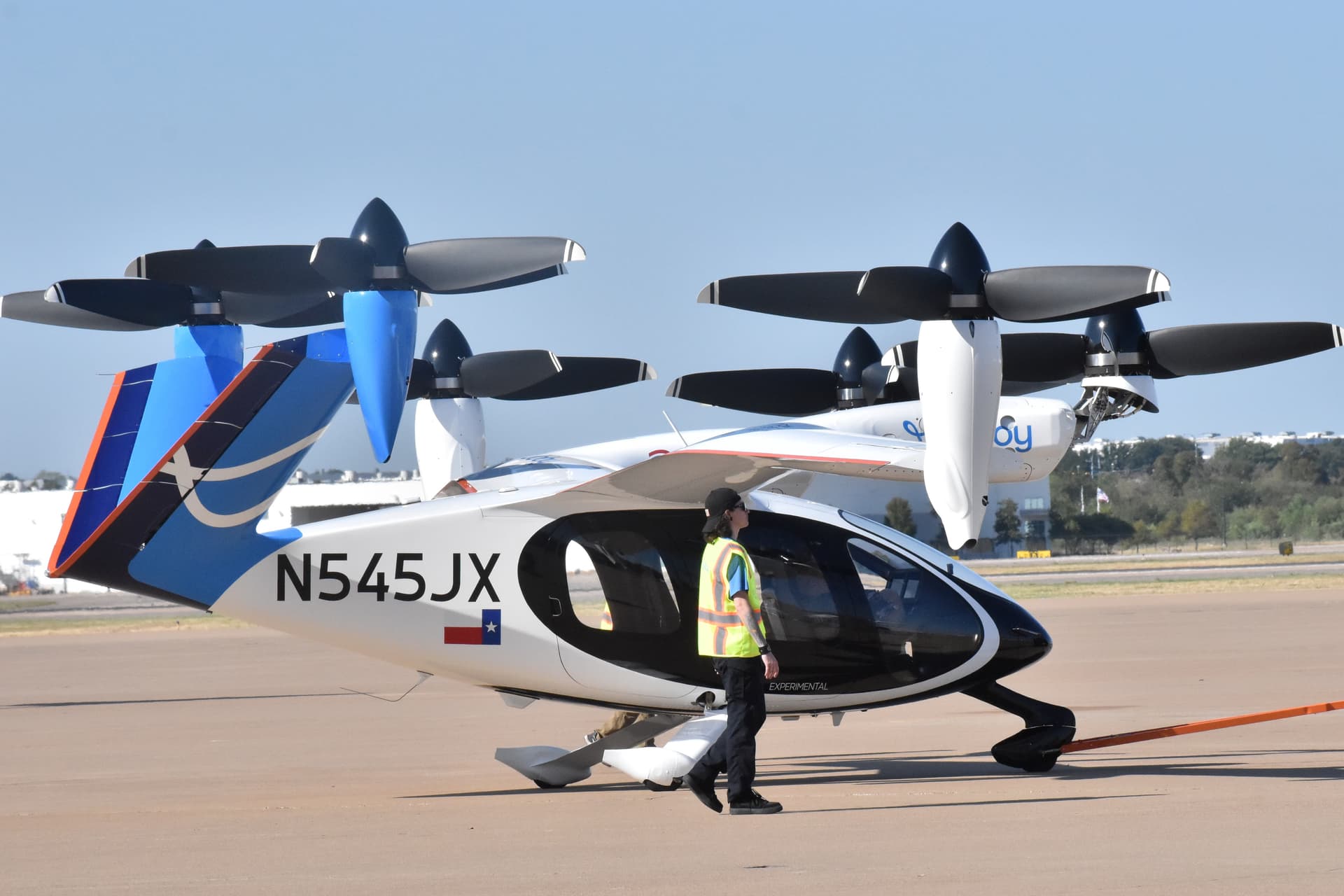
Austin leaders are preparing for the arrival of electric vertical takeoff and landing, or eVTOL, vehicles like air taxis in city skies. (Cody Thorn/Community Impact)
Editor's note: This story was updated to correct references to LIFT Aircraft.
Austin leaders are continuing to prepare for the arrival of new types of aircraft like air taxis that are being deployed in skies across the country.
“We’re going to need to get ahead of this," Assistant City Manager Mike Rogers said. "This isn’t something that is coming, this is something that is here. I hate to say this, but we’re a bit behind."
The big picture
Under a federal push for advanced aircraft, new mobility options like electric vertical take-off and landing, or eVTOL, vehicles are now being evaluated for uses from passenger and cargo transportation to emergency response.
A Federal Aviation Administration initiative launched earlier this year tapped eight pilot projects across the U.S., including in Texas, to begin testing how aircraft like eVTOLs can be integrated into the national airspace system. The Texas Department of Transportation-led Project Nexus, in partnership with several private companies, aims to eventually extend air taxi networks between Austin, Houston, Dallas and San Antonio.
“We'll look back on this day as one of those points in history that the world changes in aviation,” Transportation Secretary Sean P. Duffy said this summer at a Project Nexus test flight in Fort Worth.
Eight pilot programs under the Federal Aviation Administration are testing the use of advanced aircraft across the U.S.Courtesy U.S. Department of Transportation
In anticipation of eVTOLs flying through Austin in the near future, local officials are now moving ahead with extensive planning and outreach before the aircraft arrive. Rogers likened the "transformative" expansion of air taxis and autonomous flights to the historic creation of the interstate highway system, and said city staff are working to determine how Austin can prepare.
"We have to start understanding how this technology is going to work so we don’t get caught flat-footed. And what to do if one were to fall out of the sky, what do we do? Who do we call? How does EMS get involved, how does public safety get involved? We don’t have answers to that," he said.
Zooming in
Given the FAA's management of airspace and TxDOT's lead on Project Nexus, Rogers and other officials noted it's unlikely that cities like Austin will have much authority over air taxi flights and other eVTOL operations. Referencing Texas laws that have prevented local oversight of autonomous vehicles, council member Zo Qadri said he hopes the city can find ways to collaborate with lawmakers and private businesses to promote safety as new aircraft technology rolls out.
“Ultimately, I want to make sure people are safe. And I want to make sure that the hiccups that we’ve seen with these AVs in Austin on our roads, we don’t see things like that happen with these flying taxis," he said.
A Joby Aviation eVTOL took flight during a public test in Fort Worth.Cody Thorn/Community Impact
As of this fall, Rogers said many of the city's questions about eVTOL regulations and safety—some of which could be addressed through the results of the FAA's nationwide pilots now underway—remain unanswered. Austin will evaluate:
City regulatory authority over eVTOLs, if any
eVTOL flight paths, schedules and vehicle noise
The location of "vertiports" for takeoffs and landings
Zoning and building code changes that might be needed for eVTOL facilities and flight corridors
eVTOL and charging station power needs, and related city permitting
Community engagement around the new aircraft and civic planning
Austin's transportation, aviation, public safety, land use and legal departments will all be involved in the continuing local response. Rogers also said it'll be critical to partner with other major Texas cities to manage aircraft impacts.
Some context
One key consideration will be where in Austin eVTOLs can land and take off. Some operations may be based at airports, while vertiports could be built or added to existing structures in destinations like downtown, The Domain or Circuit of the Americas. The city will also review the addition of other mobility connections wherever eVTOL facilities end up.
eVTOLs can vary in size and capacity. Some can travel as fast as 200 miles per hour with a range of several hundred miles, Rogers said, while others may be smaller, slower and intended for shorter trips.
As other pilot programs progress, the city is also considering its own uses for eVTOLs. Christopher Lester, Austin/Travis County Emergency Medical Services division chief, said the city has been working with LIFT Aircraft on the potential for aircraft transporting medics to emergencies around Austin to avoid traffic and reach patients faster.
“We’re really excited about what this could do to help augment our response to our 911 system already, and are very pleased with being at the forefront of this as a city and a state," Lester said.
Did you know?
The city and LIFT had previously partnered on an unsuccessful application to the FAA's eVTOL testing initiative. That proposed "Project AMP" would've used LIFT's fleet for air taxi operations connecting busier vertiport hubs and smaller "vertistops" across Greater Austin, according to the 2025 project application obtained through a public records request.
Austin and LIFT Aircraft's proposed Project AMP would've evaluated a new passenger eVTOL network involving dozens of stops around Greater Austin.Courtesy city of Austin
Conceptual plans outlined air taxi operations that could greatly reduce Austinites' commutes. Project AMP called for a network of stops, largely based from existing parking structures like the city-owned Long Center garage, with 60 mile-per-hour eVTOL flights from neighborhoods to shopping centers and other destinations. Route projections in the Project AMP application included:
An 8-minute flight from Pleasant Hill to Camp Mabry, down from an estimated 54-minute drive during rush hour
A 15-minute flight from The Domain to Austin-Bergstrom International Airport, down from an estimated 61-minute commute during peak travel times
A 12-minute flight from Bee Cave to downtown Austin, a 1-hour rush hour drive today
The LIFT-led Project AMP would've involved the city, TxDOT, the airport, The University of Texas at Austin and several private partners including Tesla as an unofficial collaborator. Austin leaders learned the proposal wasn't selected by the FAA in March.
Additional reporting by Cody Thorn.
Where Central Austin’s road, bridge and trail projects stand in October