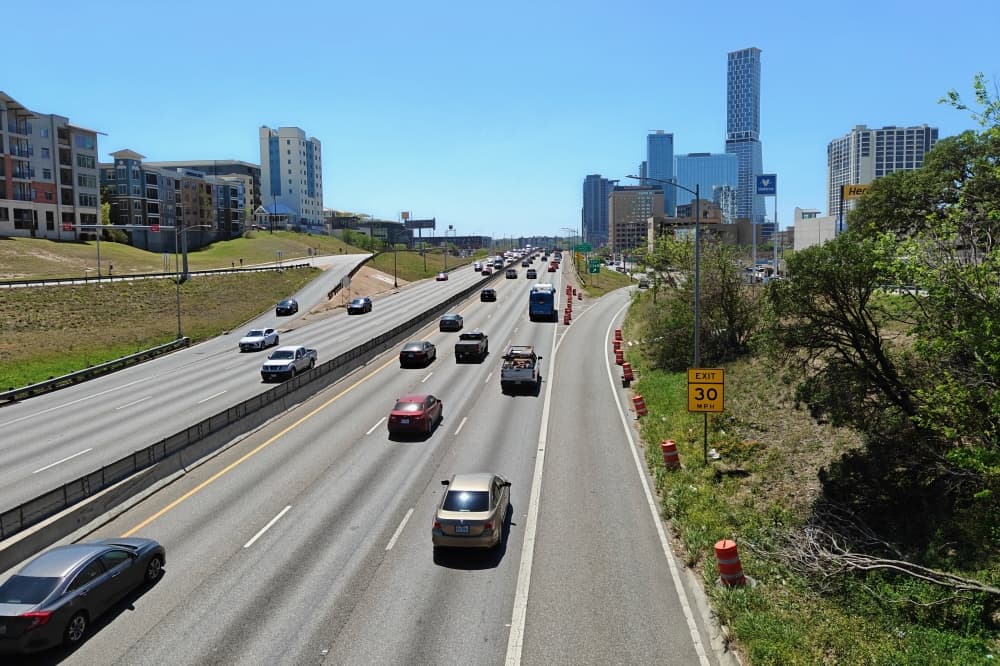
Austin officials are weighing plans to fund a series of public decks over I-35, after the highway is expanded and lowered below street level. (Ben Thompson/Community Impact)
The outlook for Austin's ambitious plans to cover stretches of the redesigned I-35 with public amenity decks remains unclear due to the high costs of constructing the project, which city staff advised not to fund as of this spring.
“Everything that we put money into that is aspirational affects us now, and we don’t have the same flexibility that we once had under different conditions," council member Krista Laine said.
The setup
The Texas Department of Transportation's multibillion-dollar Capital Express Central will widen I-35 and lower interstate lanes below street level from downtown to North Central Austin. Many locals and city officials have been opposed to TxDOT's highway expansion, and viewed a "cap and stitch" program—a series of public decks covering the roadway that could hold parks, playgrounds, small buildings and other features—as a key city response to the state project.
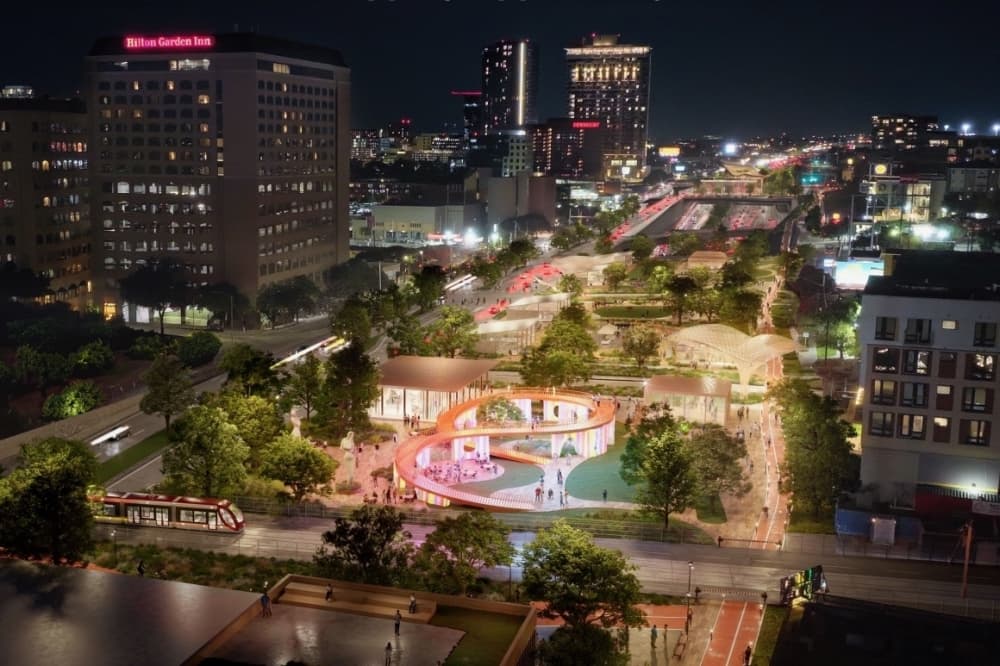
CaptionThe city is planning to add a series of amenity decks including public parkland atop a sunken I-35. (Rendering courtesy city of Austin)
Since outlines for larger caps and smaller stitches were first developed years ago, cost projections climbed while the amount of proposed deck coverage was scaled back. The city also lost a more than $100 million federal grant that was expected to support its largest proposed cap downtown.
Austin officials now hope to see nearly 14 acres of decks added in the future, including:
A 5.37-acre cap covering Cesar Chavez to Fourth streets
A 3.28 acre cap covering Fourth to Seventh streets
A 2.17-acre cap covering 11th-12th streets
More than 3 acres of stitches to the north between 41st Street and the Red Line
Austin's plans are separate from The University of Texas at Austin's own cap and stitch initiative to extend its campus over I-35 from 15th to Dean Keeton streets.
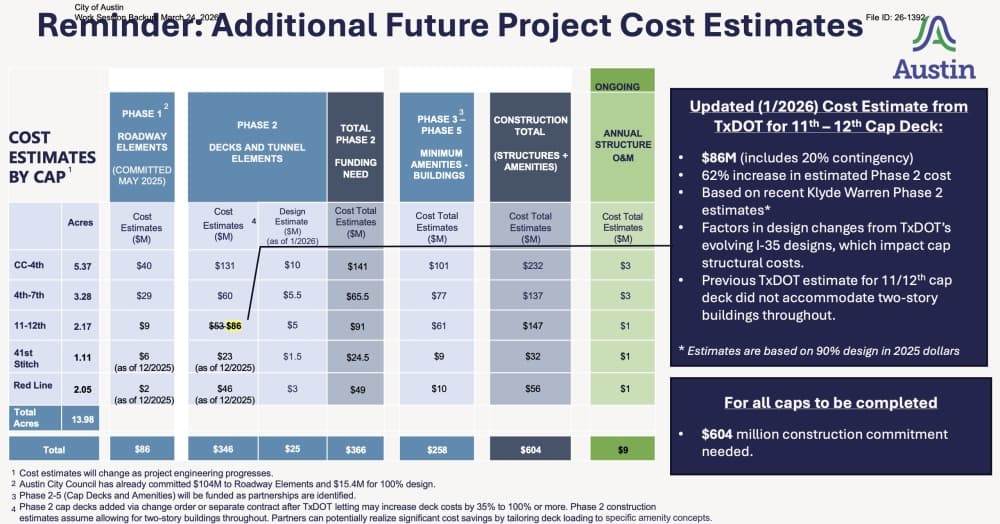
City Council committed last year to pay TxDOT $104 million to add structural supports along I-35, which are needed for any future decks to be built. But no funding has yet been set aside for the development of caps and stitches or public amenities. That main portion now exceeds $600 million, and the structures are also expected to cost about $9 million annually to maintain once they're in place.
Building out Austin's desired cap and stitch program to cover portions of I-35 will cost at least $600 million. (Courtesy city of Austin)
The 2025 decision to fund roadway elements split the council dais, with some officials strongly supporting the foundation of what they view as a generational civic amenity while others were more skeptical about the plan and its impact on Austin's strained city budget.
Those concerns were again raised by city finance staff this month, who advised council members against advancing major cap and stitch funding given a lack of finalized project plans and escalating costs.
"At this point, we just can’t recommend that you move forward with such decisions because that does create such a significant risk," Austin Financial Services Director Kim Olivares said.
Zooming in
Olivares said the city remains confident in the $104 million initiative to build the decks' structural supports, a "future proofing" effort to pave the way for caps and stitches. But a review of several financial factors led staff to advise against dedicating any city dollars to the decks for now.
That recent analysis found very little local funding will likely be available, and that federal assistance shouldn't be relied on given reduced support for highway funding including the 2025 reversal of Austin's central cap grant. The city's own potential to capture value from caps, such as increased tax revenue or monetization of some deck spaces, was also found to be limited.
“At this point, the [return on investment] just isn’t there,” Olivares said.
If Austin does end up footing the bill for caps, Olivares also said a city election to increase property taxes would be a "requirement" to fully cover costs.
What they're saying
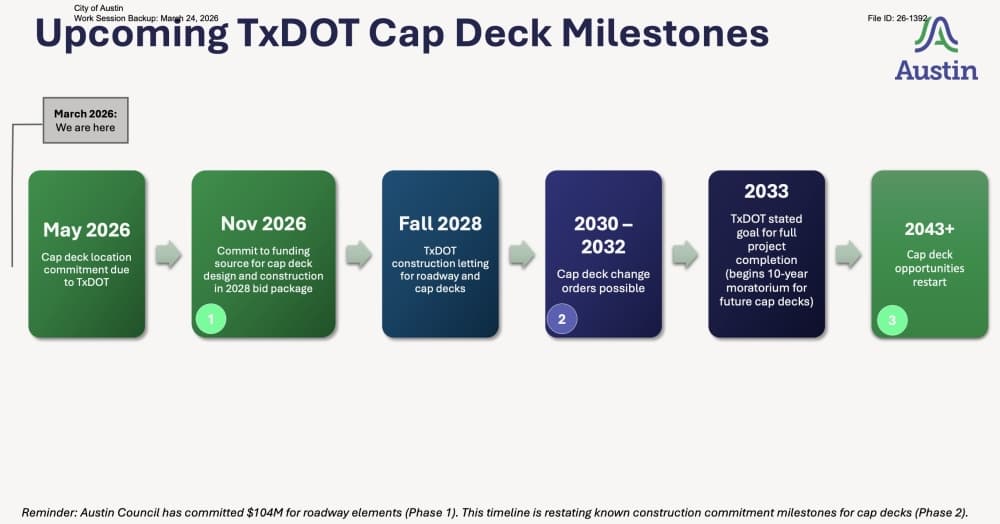
The latest staff recommendation doesn't lock Austin into a specific approach, although no further action this spring likely ensures caps won't be built until at least the 2040s. The update prompted further council discussion of how to budget for the project or revise funding commitments.
If funded, Austin's cap and stitch plan likely won't be realized for decades. (Courtesy city of Austin)
Officials who previously supported cap funding maintain the project is a critical civic improvement needed to bridge the historic gap between Central and East Austin. Mayor Pro Tem Chito Vela said the decks will benefit Austinites for decades and that an uncapped I-35 would represent a policy failure, sentiments shared by council member Ryan Alter.
“These are spaces that our community can use for decades if we are willing to stick it out. And this is the hard part, is sticking it out right now when there’s nothing to see," he said. "This is all an idea, a vision, and if we are willing to commit to that vision, we can yield something that is really going to be impactful for our community.”
Others like council member Marc Duchen remain worried about a "worst-case" scenario where Austin invests $100 million or more in infrastructure plans that'll never come to fruition. He said he'd like to explore reducing the city's commitment to roadway elements before a TxDOT deadline this year, and council member Paige Ellis said she's open to revisiting council's 2025 funding decision to avoid a path the city can't afford.
Staff and city officials also stressed the importance of finding partners to assist with cap development. Private or philanthropic partnerships have been common in other cities where cap structures were added, like Klyde Warren Park over Spur 366 in Dallas or Boston's Rose Kennedy Greenway over I-93. Council member Vanessa Fuentes said she doesn't support more cap funding until other financing is found.
While the city has been engaged in some conversations about outside funding, Assistant City Manager Mike Rogers said a lack of firm details has limited interest so far.
"If I’m an investor, I need to know how much, and where, and what. And those are the things that we just don’t have," Rogers told council. "The uncertainty now is even higher than before because of the current situations and escalations of prices of everything right now.”