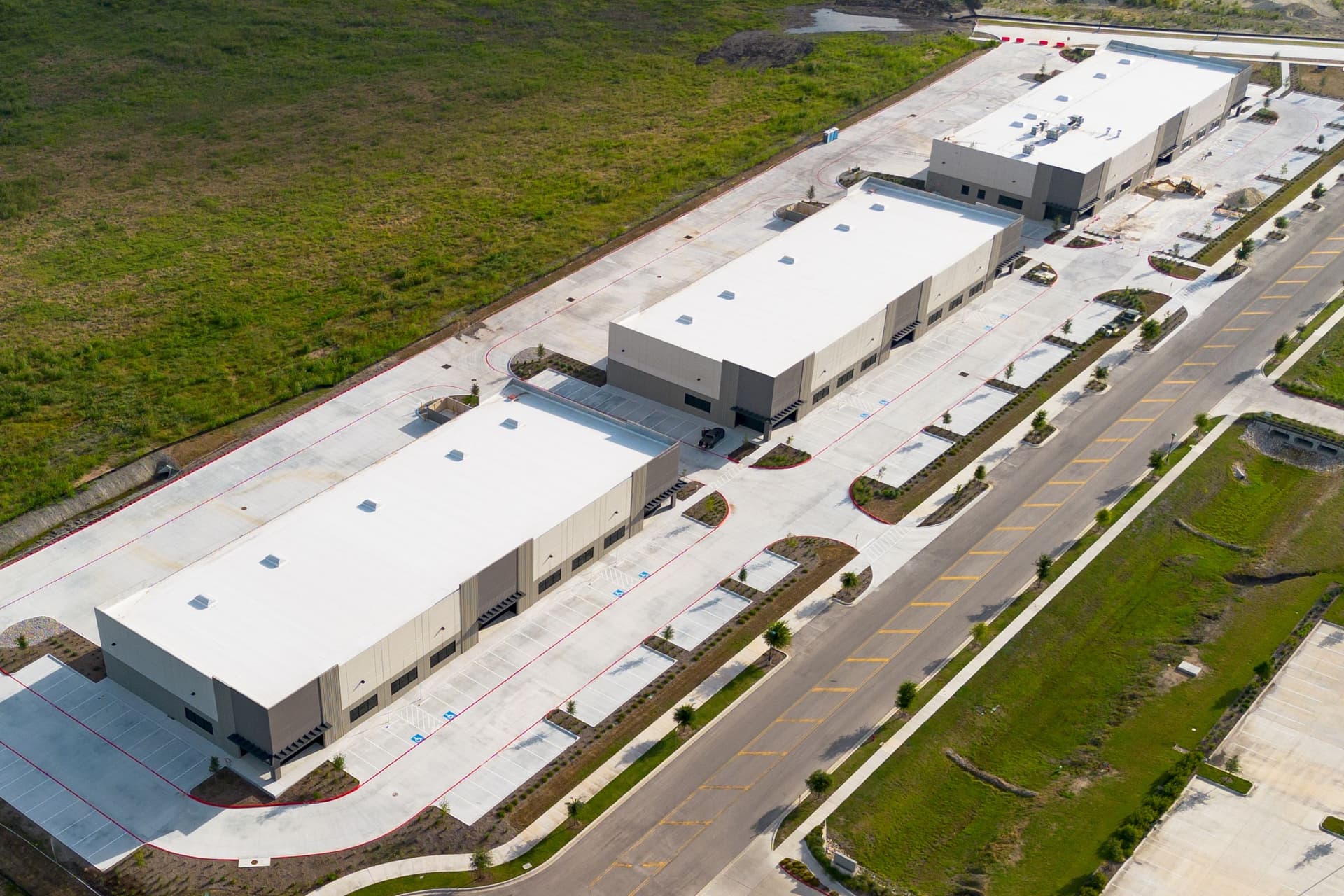
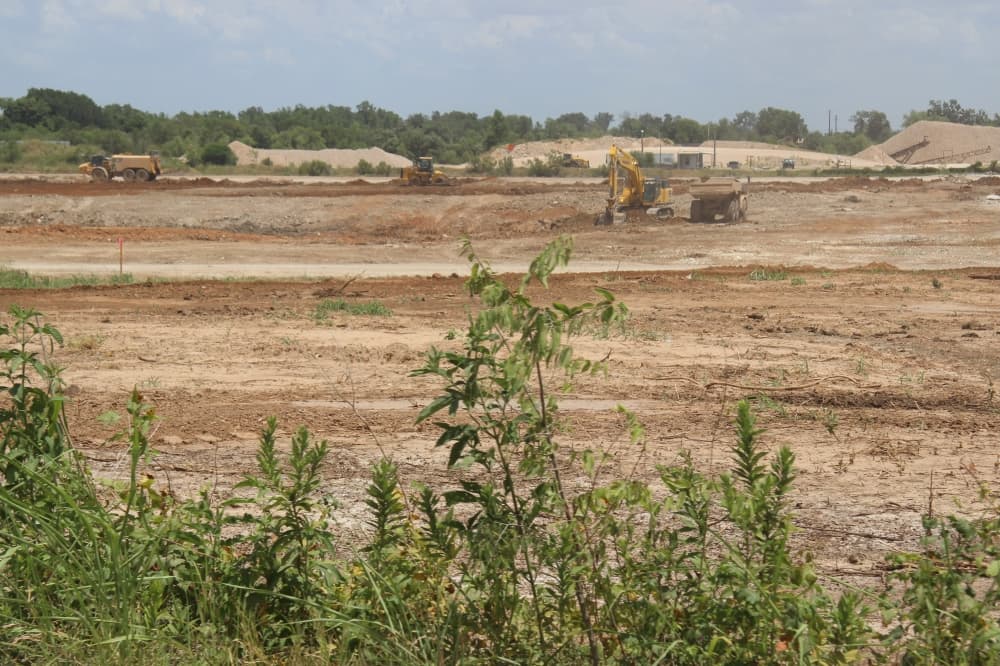
A portion of the Dog's Head is being cleared for the 300-acre "Project Toaster," an unidentified corporate industrial project. (Ben Thompson/Community Impact)
Some city officials and residents are pressing for added environmental protections and community benefits in the sprawling Dog's Head, the 4-square-mile area being primed for future development after its recent annexation into East Austin.
The big picture
Endeavor Real Estate Group is helming redevelopment of the more than 2,600-acre Dog's Head, largely an industrial mining area along the Colorado River, into a mixed-use district over several decades. Attorney Richard Suttle, representing Endeavor, likened its potential to a new city where developers "can almost do anything."
City Council annexed the Dog's Head and advanced a 45-year development agreement for the area—waiving several city environmental, building and public oversight standards—in May. And in late July, officials are expected to vote on a long-term tax financing mechanism that'd fund a share of the roads, utility lines and other infrastructure needed to support planned growth there.
Travis County leaders are also weighing that concept and could move to join the financing plan in the coming weeks.
While billed by the city as a major boost for Austin's economic development prospects and revenue generation, recent developments in the Dog's Head have been routinely criticized by community members this spring and summer. Concerns have covered from the ecological impacts of intensive construction along the Colorado, the potential for worsening flood conditions, the fast pace of city approvals with limited time for public input, and the use of tax dollars to support private projects.
Residents have also pushed back on secrecy related to the initiative, such as city staff's use of nondisclosure agreements, as well as unclear future plans for the Dog's Head. Endeavor has only stated it's pursuing an initial corporate industrial tenant, a Fortune 100 company that hasn't been identified. A future roadway network with three new bridges spanning the Colorado was also detailed, including one crossing directly toward Tesla's Giga Texas site, although Suttle labeled it as conceptual and subject to change.
Advance resident notice wasn't needed for the Dog's Head annexation in May, according to a city spokesperson, as the area wasn't within Austin's full purpose jurisdiction and proceedings only involve affected property owners. The spokesperson also said the conceptual street plan wasn't designed by city transportation staff, but that they're aware of the Dog's Head's need for new roads and bridges and that amendments to the Austin Strategic Mobility Plan are being drafted in response.
The approach
Ahead of their July review of the Dog's Head's tax financing, some city leaders said development in the area should come with guarantees of public benefits. Mayor Kirk Watson and three council members announced their support for riverside green space protections in line with Travis County's adopted plan for the eastern river corridor, and reserving some funding for parkland and affordable housing.
Council member Mike Siegel said elected officials heard residents' demands for added protections and benefits "loud and clear," leading to their request.
“We know that economic development and job creation are essential for Austin as we navigate fiscal challenges in the years ahead, but we cannot move so quickly that we lose the character of our beautiful city," he said in a June statement. "Through this proposal, we seek to ensure that the impact of Dog’s Head will not only be increased tax revenue, but also beautiful greenspaces and thousands of units of housing for our community.”
On July 1, the city Environmental Commission unanimously asked to delay council's tax plan vote, launch environmental reviews and approve a slate of ecological, building and oversight provisions for the Dog's Head.
"We recognize that this will be developed, but our goal is to get it developed in the best way possible with protections for the environment and for the people," Vice Chair Jennifer Bristol said. "What we realized in our discussions was basically, it was a total system failure by the city of Austin and eroding public trust.”
Zooming in
Bristol said the commission's slate of recommendations stemmed from multiple meetings of a roughly 20-person working group in late June when members raised issue with:
Proposed roads and bridges across sensitive environmental zones near the waterway
The placement of major development near Hornsby Bend, home to hundreds of species of birds and other animals
Potential impacts near identified historic sites around the Dog's Head
Endeavor's commitment of open space that won't be fully public parkland
The absence of neighborhood notification ahead of recent council action
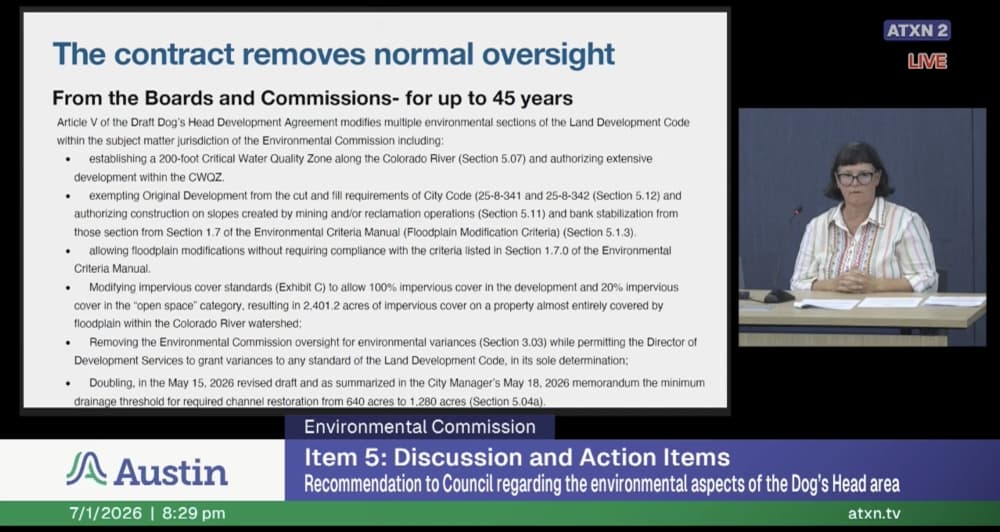
Eliminating public board and commission oversight of Dog's Head construction in the city's long-range development agreement
“The Dog’s Head agreement ... basically threw the city code, the city’s environmental criteria manual, and the boards and commission process, and the concept of public engagement, under the bus," Commissioner Richard Brimer said.
The commission formally asked to limit construction near the Colorado, set aside land for habitat restoration and parkland, require bird-friendly building design, cap building height, and include a larger share of affordable housing in any residential additions. It also calls for greater public outreach, and a ban on data centers and semiconductor manufacturing plants. Materials used to develop the plan were made available online.
Environmental Commission members and some city residents have criticized aspects of Austin's agreement with plans for the Dog's Head's redevelopment. (Screenshot courtesy city of Austin)
The city spokesperson said any variances to the Dog's Head development agreement would be subject to the director of Austin Development Services, not resident board or commission review, and didn't confirm how the agreement could potentially be amended in response to the July recommendations. They also said an environmental resource inventory, or ERI, wasn't required for the Dog's Head this spring.
"Applicants submit ERIs as part of a development application to demonstrate compliance with substantive Land Development Code requirements. An ERI is not required as part of negotiating a development agreement," they said in an email.
At the June meeting, Bristol labeled Austin and Endeavor's push for extensive development plans on the east side as "a classic example of environmental racism." She and others also stated frustrations with another civic corporate partnership without full transparency.
“This is egregious, and I don’t understand why we keep bending over backwards for Fortune 100 companies to give them tax incentives and to remove our oversight for 45 years. It is just so backwards," Chair Mariana Krueger said. "We’ve seen that with Samsung, we’ve seen that with Tesla; all we’ve gotten are ecological destruction and workplace violations. When are we going to learn?”
Put in perspective
The July recommendation came weeks after a contentious commission meeting attended by Endeavor representatives and many residents opposed to the developer's plans. Austin city management was also invited but declined, drawing negative reactions from several residents and commissioners. The spokesperson said it's not customary for city management to attend such sessions, and that leaders were aware of city staff's coordination with Endeavor and availability to answer resident questions at the time.
Locals extensively condemned Endeavor's plans and the city's approval process at that June 17 session, with many opinions echoed ahead of the July 1 vote.
Nearby resident Claudia Voyles raised concern about impacts on plants and animals in the area, which she described as a "thriving" ecosystem in need of protection. Julia Maffei, president of Southeast Colorado River Neighborhood Association, said neighbors weren't adequately notified about the annexation or planned development. She and others also highlighted their views of lax environmental considerations in the city's 45-year agreement.
“If this project moves forward with weaker protections than Austin typically requires, future generations may ask whether irreplaceable natural resources were sacrificed for development that could’ve occurred elsewhere," resident Suzanne Litz said.
Andy Pastor, Endeavor co-founder and managing principal, defended the firm's plans and said his team is aiming for an environmentally responsible build-out with public benefits.
“This is man-made mining that we’re trying to fix. I think we can do a good job of bringing it back. ... There are efforts and thoughts about this that I think are very different than are being portrayed," he said. "We’re not pursuing things just to make money. We live in Austin, we’ve been here a long time. We want to leave Austin better than where we came."