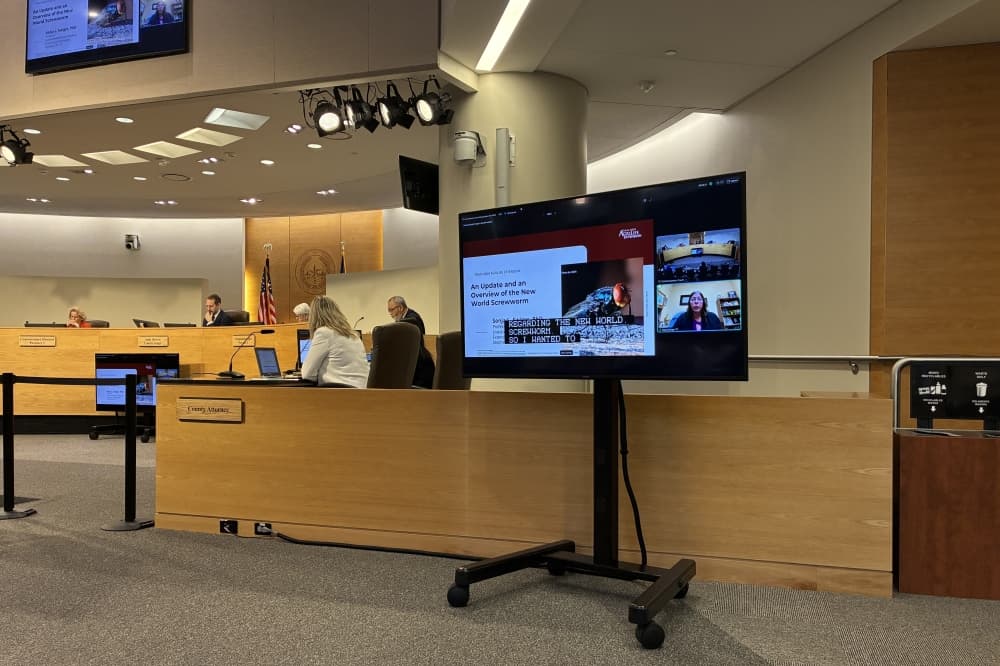
Travis County commissioners received an update and overview on the New World screwworm June 16 before extending the local disaster declaration from June 12. (Jessica McLaren/Community Impact)
Travis County Commissioners Court voted unanimously June 16 to continue the local disaster declaration County Judge Andy Brown issued June 12 over the threat of New World screwworm, a parasitic fly that can affect livestock, wildlife, pets and, in rare cases, people, according to the county's continuing order.
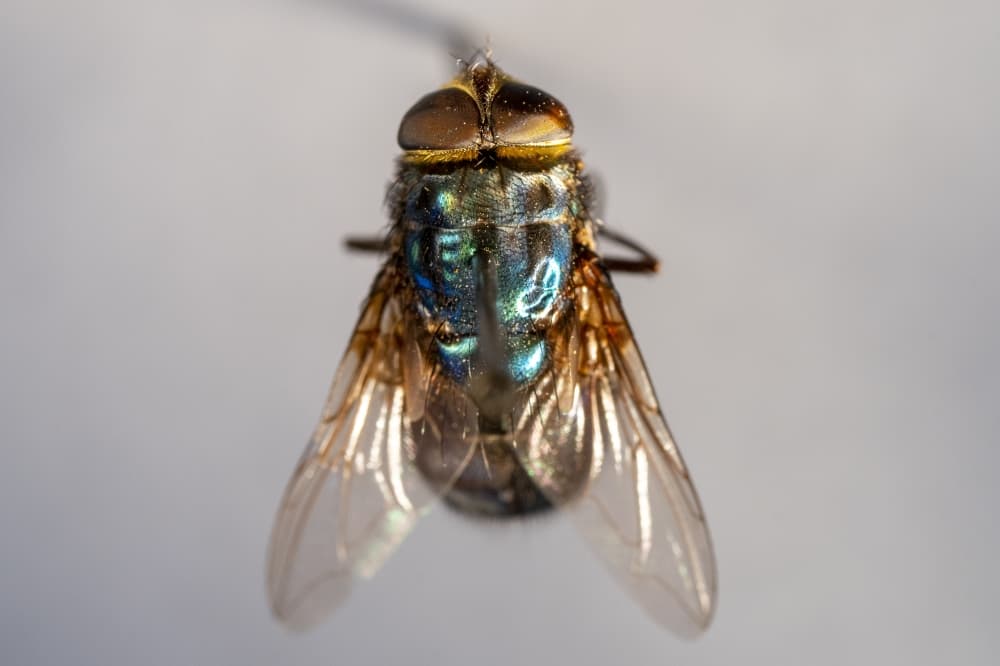
Twelve cases of the New World screwworm, a flesh-eating parasite, had been confirmed in Texas and New Mexico as of press time June 17. (Courtesy Michael Miller/Texas A&M AgriLife)
By the numbers
The original declaration would have expired after seven days without Commissioners Court consent to continue it, per the order.
As of June 17, twelve screwworm cases had been confirmed nationwide, including 11 animals in Texas and a dog from New Mexico, according to data from the U.S. Department of Agriculture. While one of the cases was in the Texas Hill Country, no infestations have been detected in Travis County or in native Texas wildlife, Community Impact previously reported.
The big picture
The first U.S. case in a decade surfaced June 3 on a calf in La Pryor, in Zavala County near the Texas-Mexico border, marking the first Texas detection in about 50 years, CommunityImpact previously reported.
Brown signed Travis County's initial local declaration alongside Caldwell County Judge Hoppy Haden on June 12, citing Gov. Greg Abbott's statewide disaster declaration, first issued Jan. 29 and renewed every 30 days since, according to the county's order.
The continuing order Travis County commissioners approved June 16 cites the same statewide proclamation, as well as the Texas Animal Health Commission’s authority under the Texas Agriculture Code to protect livestock from disease, per the order.
"This declaration is a proactive measure that allows us to better coordinate resources, strengthen communication with our state and federal partners, and ensure we're prepared to respond quickly if this pest is detected in our region," Brown said at a June 12 news conference.
Brown emphasized the action was not a response to a confirmed local case.
"It's not something to panic about," Brown said. "It's something to be scientific about and observe."
What it means
The continuing order keeps in place several measures tied to the declaration, including a provision exempting county contracts for the screwworm disaster response from standard competitive bidding requirements under the Local Government Code, and continued activation of the county's emergency management plan, according to the order.
What's next
The U.S. Department of Agriculture releases sterile flies in affected areas for 90 days after a case is confirmed, Dr. Mariah Swiger, a Texas A&M AgriLife entomology specialist, said at the June 16 meeting.
The USDA considers a location cleared if no further infested animals are found by the end of that window, Swiger said.
Asked whether the outbreak could be considered contained, Dr. Desmar Walkes, Austin and Travis County health authority and medical director for Austin Public Health, said no.
“I would not describe it as contained,” Walkes said June 16. “I would describe it as being managed efficiently at this moment.”
The county maintains roughly 40 remote wildlife cameras across preserve properties to help monitor for signs of infestation, alongside regular field observations of deer and feral hogs, Brown said.
What to watch for
The risk to humans remains low, but screwworm flies can infect people through open wounds, Walkes said.
Symptoms include visible or felt maggots, worsening painful sores, foul odor and bleeding from open wounds, Walkes said. Residents who suspect infection should contact a doctor immediately, she said.
Walkes, who raises cattle herself, said local ranchers are pausing routine practices such as castration and ear tagging to avoid creating wounds that could attract the flies.
Brown urged pet owners at the news conference to check animals daily for wounds, unusual behavior or foul odors, and to contact a veterinarian if a screwworm infection is suspected.
Residents who suspect a screwworm case involving wildlife should contact the Texas Parks and Wildlife Department; cases involving livestock and pets should go to TAHC, which is leading the state's response, Brown said.
Residents concerned about a possible human infection should reach an on-call epidemiologist through Austin Public Health at 512-972-5555, a number that has been distributed to the Travis County Medical Society.
Central Health approves $54M for mental healthcare