Some utility-related costs will increase for residential and commercial customers in Allen beginning Oct. 1, including water and sewer.
Allen City Council adopted rates and fees for water, sewer, drainage, solid waste and recycling services for fiscal year 2026-27 at a Sept. 22 meeting.
What you need to know
All three categories of city services the council discussed at the meeting are enterprise funds, which means they are not supported by the general fund or sales tax revenue, Community Services Director Steve Massey said.
“They’re supported by fees and charges made to the customers that either use the services or receive the services of these three funds,” he said.
Here’s a closer look at these city services and how fees are changing.
Solid waste and recycling fees
In May, Allen City Council approved a commercial rate change for solid waste services, so only residential customers will be impacted by the change approved Sept. 22, Massey said.
The city's expenses for residential waste services have increased by $310,224 for fiscal year 2026-27 due to rising costs from Community Waste Disposal and the North Texas Municipal Water District, as well as vehicle replacement and an increase to pay and benefits, per Massey’s presentation. The solid waste fund supports 10 employees and the department did not request any additional employees for fiscal year 2026-27, he said.
Residents will see a $0.80 increase to their monthly solid waste bills. Residents currently pay $20.09 per month for one 95-gallon trash can and one 95-gallon recycling can, per city documents. Beginning Oct. 1, rates will increase to $20.89 monthly.
Based on proposed rate increases for fiscal year 2026-27, the city of Allen will have the lowest solid waste and recycling rates out of all five North Texas Municipal Water District member cities, per city documents.
“We’d still be the lowest cost city by a small amount of money,” Massey said.
Water and wastewater
Water and sewer is the largest of the three enterprise funds and the largest element in community services with over 90 employees, Massey said.
The department is requesting a hydro-excavator machine and one additional staff member.
“We need this person to come on board to help us deal with all the information that comes out of our advanced meter infrastructure system," Massey said.
The North Texas Municipal Water District’s costs are increasing due to population growth, rising costs for construction, treatment chemicals and electricity, and federal and state mandates, per Massey’s presentation. Rising NTMWD rates and the cost of new city personnel and equipment contribute to cost increases for residential and commercial customers in Allen.
Water and wastewater rates are increasing for both commercial and residential customers by 6.9%, according to city documents.
If a resident uses 15,000 gallons of water a month, the customer’s water bill would increase from $189.55 to $202.71, representing a $13.16 increase, city documents state. A commercial customer with a two-inch water meter who uses 50,000 gallons of water in a month would see a $56.62 increase for a water bill of $880.82, per city documents.
The new rate will increase the city of Allen’s water and sewer fund revenues by $5.7 million, according to city documents.
Drainage fees
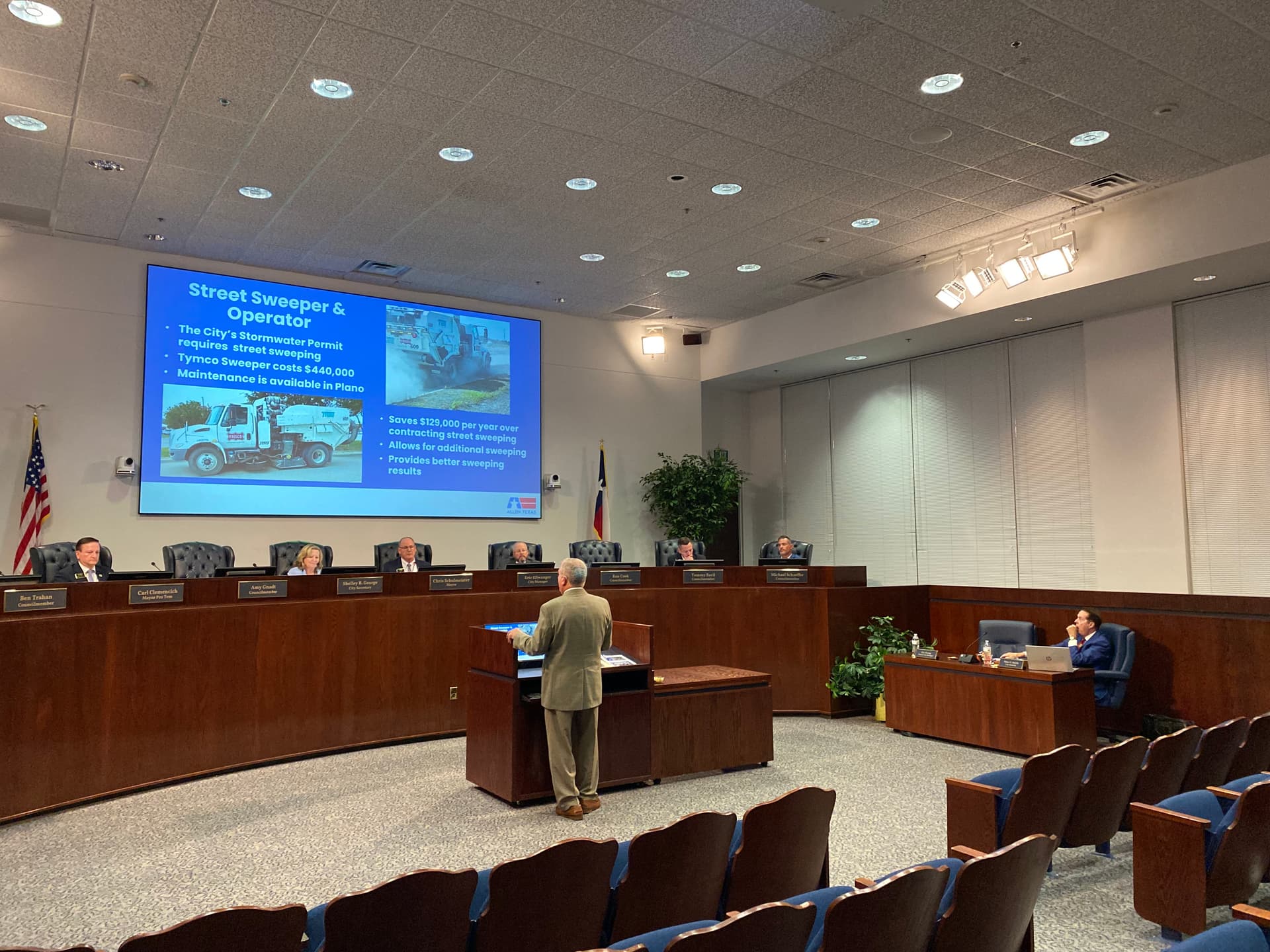
The drainage fund is the smallest of the three enterprise funds and currently supports 13 staff members, Massey said. The Community Services department requested to add one additional staff member who will be an equipment operator to operate the city of Allen’s first in-house street sweeper.
“All of our larger neighbors already have street sweepers,” he said. “They’re operated at a cost savings, and it's the time for Allen to implement that.”
Operating the street sweeper in-house instead of contracting that service out will save the city $129,000 per year, Massey said.
Residential drainage fees will increase by $0.75 to $5.25 a month per single-family residence and commercial drainage fees will increase by just over $0.02 to $0.143 per 100 square-feet of impervious surface per month, according to Massey’s presentation.
Assuming none of Allen’s neighboring cities increase their drainage fees for fiscal year 2026-27, the new rates are still competitive, Massey said.
The fee increase is projected to generate an additional $537,000 in revenue, city documents state. Of this additional revenue, $317,000 will be put into a drainage capital improvement fund that the engineering department will use for emergency repairs, per Massey’s presentation.