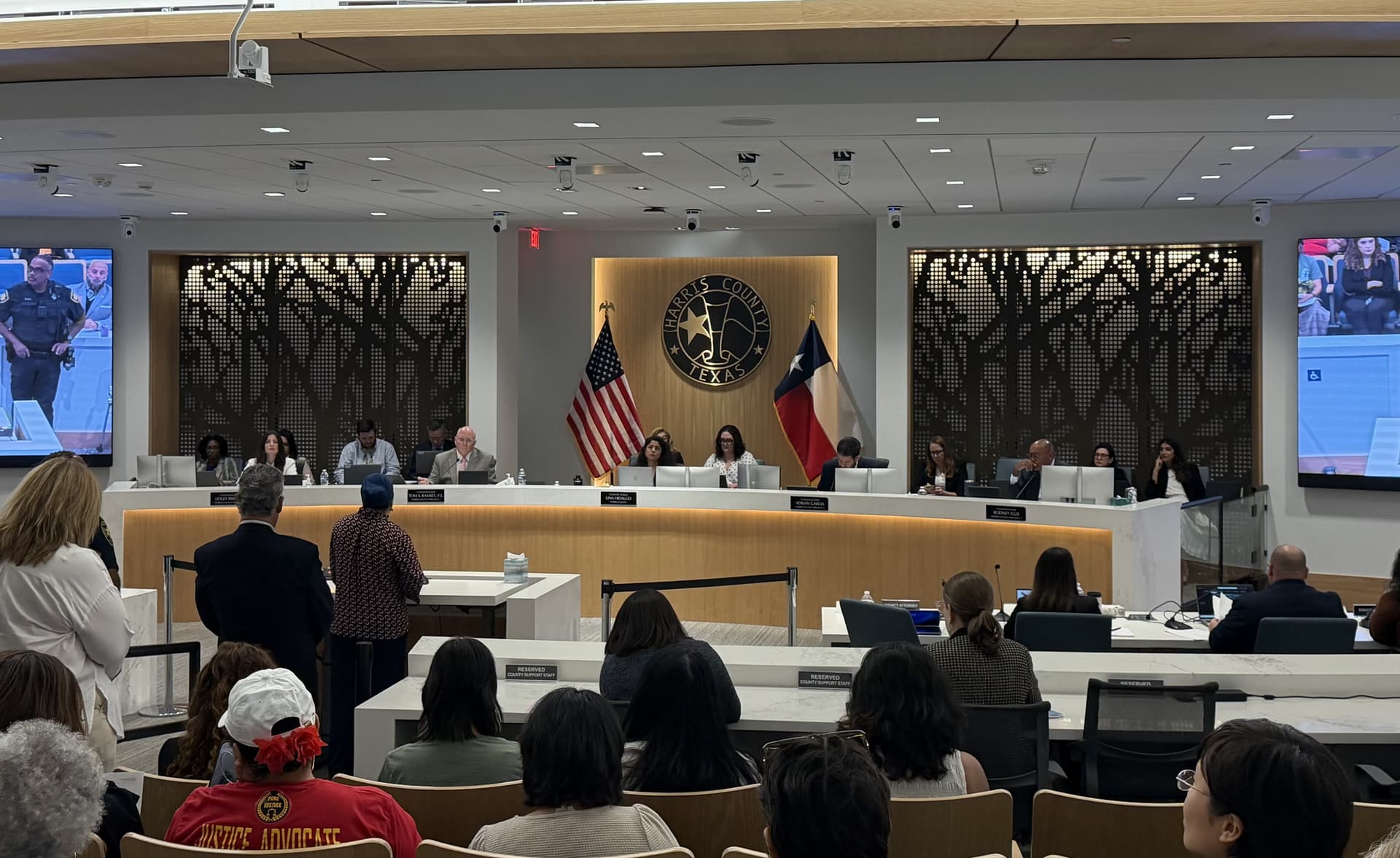
Harris Health, the county’s public healthcare provider, proposed a tax rate increase for the upcoming fiscal year to the Commissioners Court Aug. 17.
The background
Harris Health Chief Financial Officer Victoria Nikitin asked the court to consider a $0.1 increase to last year’s revenue rate. Harris Health also proposed receiving $10 million from the county, which would be broken into $6 million in “waived revenue” and a $4 million placeholder in operating expenses to support county services.
If approved, the rate would go into effect Oct. 1, when the new fiscal year begins.
Harris Health is one of four organizations the court sets a tax rate for. The court also oversees the county’s general fund, the Harris County Toll Road Authority and the Harris County Flood Control District.
The proposed rate increase comes as the county is facing a projected $181 million shortfall and Harris Health is adjusting to inflation and taking on more patients who no longer qualify for federal healthcare programs.
“This budget is a really tight one for us in the sense that we are still having a lot of processes that are in flight, related to technology and other strategic initiatives...but the majority of that is really due to inflation,” Nikitin said.
Diving deeper
The proposed budget outlines a 4.2% inflation rate built into the proposed budget, Nikitin said, in addition to a plan to increase collections 3.7% next year.
- Harris Health estimates its total operating expense for next year will increase by 7.6%, or $203.2 million, compared with 2026. These costs are expected to come from:
- Salaries and benefits budget increasing 4.5%, or $61.1 million
- Supplies and pharmaceutical expenses increasing $15.7 million
- Overall provider services increasing 4.3%, or $21.1 million
- Purchased services increasing 5%, or $15.8 million
Harris Health’s unfunded patient population has grown 5% since the federal One Big Beautiful Bill Act was passed July 2025, Nikitin said, because people are no longer able to qualify for the Affordable Care Act Marketplace, which provides health insurance to those who can’t access it through their job, Medicare or Medicaid. The additional expense compounds with 50% of the patient population designated as unfunded or significantly underfunded in terms of healthcare affordability, she said.
Harris Health focuses its care on low-income uninsured and underinsured patients, according to its website.
Per the presentation, some of the risk factors in Harris Health’s proposed budget include:
- Persistent financial instability from unpredictable federal and state policy
- Uncertainty on the size and structure of the Texas Uncompensated Care Pool
- Declining ACA Marketplace enrollment decrease payer mix and patient volumes
- Declining outpatient volumes
- Investment market volatility
- Ongoing uncertainty related to 340B pharmaceutical rebate programs
If Harris Health doesn’t receive the $0.1 tax rate increase, it would likely have to delay and reprogram some of its special initiatives, said Dr. Esmaeil Porsa, president and CEO of Harris Health. This could include planned expansions to the Lyndon B. Johnson and Ben Taub hospitals, which voters approved in a $2.5 billion bond in 2023.
“The promises that were made related to the bond project, we are going to deliver on those,” Porsa said. “The timeliness of when we can deliver on those can be extended if you do not have enough capital money to bring those projects online.”
What’s next
With the Harris County Office of Management and Budget projecting a $181 shortfall, the court is expected to set tax rates during its Sept. 8 meeting.
OMB has proposed a 3.5% tax rate increase, which, if approved, would allow voters to approve or deny it on their ballots in November. Any number below that rate would not trigger a Voter-Approval Tax Rate Election, or VATRE.
Harris Health, along with OMB, will return with more information about alternate tax rates options for the court to weigh before making a decision.
Harris County Commissioners Court meetings are held at 9 a.m. in Downtown Houston. The administration building is located at 1001 Preston St., Houston. Meetings are also available to livestream here.