New projections suggest Austin summers will continue to get hotter over the decades ahead, especially if greenhouse gas emissions rise. (Ben Thompson/Community Impact)
As Austin gears up for another hot summer, new climate projections suggest the city will continue to grow warmer with more significant heat impacts over the decades ahead—especially if greenhouse gas emissions rise.
The big picture
The findings were released by the UT-City Climate CoLab, a first-of-its-kind partnership between the city's sustainability and resilience offices, and The University of Texas.
Researchers suggested that more hot days, fewer cold days and more extreme weather swings are likely as the climate and local population continue to change.
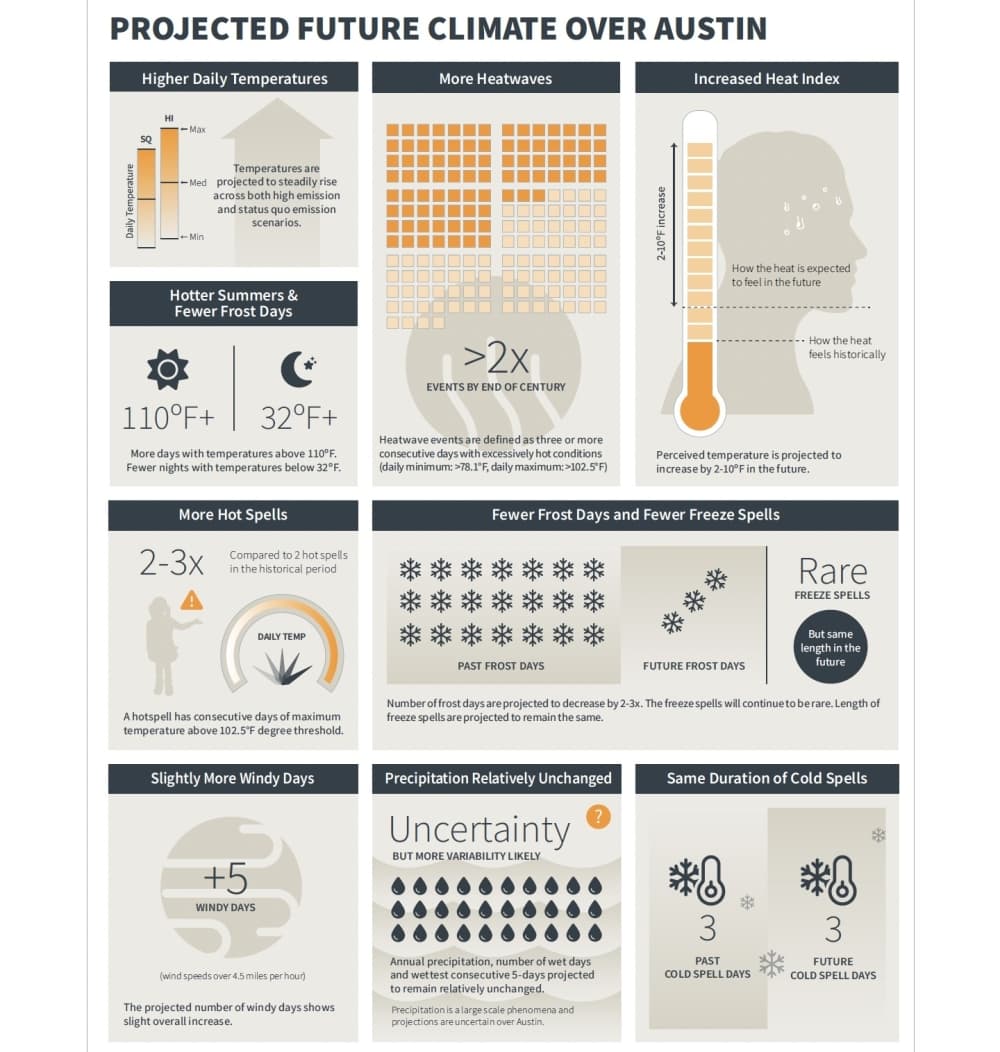
New projections from the city and The University of Texas found hotter summers are likely in Austin's future. (Courtesy city of Austin)
“As the impacts of climate change continue to affect the Austin area, proactive steps are necessary to reduce greenhouse gas emissions and ensure our city infrastructure and community members are prepared for extreme weather," Austin Chief Sustainability Officer Zach Baumer said in a memo to city officials. "The most recent Climate Projections and 2024 Summer Outlook will help the city organization make science-based, informed decisions about community preparedness and city infrastructure."
A closer look
This year, researchers said Austin's summer will likely be hotter than normal with "weather extremes and swings" from wet to dry periods stemming from La Niña conditions.
The city experienced dozens of days above 100 degrees Fahrenheit last year, and analysts expect the city to once again reach that mark for the first time in June. Traditionally, the average first 100-degree day has come in early July.
Overall, the summer could feature many days that end up in the 105-110 degree range—well above the 30-year seasonal average of 95.13 degrees.
Looking ahead, new projections from the CoLab suggest heat impacts will be intensifying through the 2000s with summer highs rising by as much as 10 degrees by the end of the century.
The outlook for Austin's summer temperatures has risen since a similar analysis was completed in 2014. Average summer highs are now expected to surpass 101 degrees by 2100 given more moderate emissions or 105 degrees with higher emissions.
Austin isn't alone in reaching higher heat levels. In every year since 2000, Texas has been hotter than it was during a comparison period of 1971-2000, according to the National Oceanic and Atmospheric Administration.
The new CoLab data also shows higher heat indices, more heatwaves, longer heatwaves and more hot spells are all expected in Austin—especially with more emissions.
Hot spells are recorded when two or more straight days are 102.5 degrees or hotter. Heatwaves are recorded over three-plus consecutive days with "excessively hot conditions," or minimums above 78 degrees and maximums above 102.5 degrees. Both types of events could double or triple in Austin by the end of the century, according to the CoLab.
Alongside those increases, researchers said the number of colder days will likely drop. Projections for other weather events such as rainy or windy days show less change.
While the CoLab team has projected "hotter and more extreme" summers for Austin, they also noted the effects could be even more significant given the city's continued urbanization and said the city's urban heat island effect would cause further "heat stress."
The city said its involvement in the CoLab will be continuing, and Austin's first "Heat Resilience Playbook" is helping city departments and staff manage summer response. The new guidebook includes plans for:
Safety measures and communications about heat risks, especially during extreme heat
Cooling community spaces, homes and other facilities
Adapting local infrastructure and ecology, such as the energy grid and natural areas, for extreme heat
“As we move into summer, we must acknowledge the increasing temperatures affecting our community," Baumer in a statement. “These documents provide essential science-based information to help our city departments and community members understand the climate impacts affecting Austin now and in the future—and how we can address them.”