As New Braunfels continues to grow, one issue is increasingly shaping the city’s workforce and economic future—child care.
The Greater New Braunfels Economic Development Foundation, or GNBEDF, and the McKenna Foundation are working to assess and address gaps in access, affordability and quality of care for children ages 0-5, following a resolution from City Council to match startup funds at a meeting Jan. 26.
Early Matters Texas operates as a policy and advocacy framework at the state level, focusing on streamlining regulations, improving licensing processes and supporting quality standards such as Texas Rising Star, or TRS, ratings, said Mike Crowley, vice president of the Greater New Braunfels Chamber of Commerce. What started as a conversation about working parents evolved into a broader discussion about the workforce, and in 2023, the chamber began examining child care more closely, Crowley said.
In 2024, GNBEDF engaged Early Matters San Antonio to help study the local child care landscape. The goal was not to replicate another city’s model but to understand the unique needs of families in New Braunfels and Comal County, Crowley said.
Local employers report difficulty recruiting and retaining workers due to limited child care options. At the same time, providers cite sta�ng shortages, thin pro�t margins and regulatory complexity, according to an early childhood education report by Early Matters San Antonio.
“We learned this isn’t just a young family issue,” Crowley said. “It’s an economic issue that affects everyone.”
)
Assessing the need
Through surveys and listening sessions, New Braunfels child care providers and business leaders convened to assess the gap in care. Employers shared concerns about workforce participation, while providers detailed operational challenges, including staffing shortages and rising costs, according to the early childhood education report.
Early Matters New Braunfels aims to fill a lack of available subsidized seats, which can have a tangible effect on families in which both parents working is a necessity, Crowley said.
Many families face long waitlists, particularly for infant care, which requires lower staff-to-child ratios and higher operating costs. Meanwhile, some centers are licensed for higher capacities but operate below that level because they cannot hire enough staff, said Alice Jewell, CEO of the McKenna Foundation.
Wages for child care workers typically range from about $13.50 to $15 per hour, competing with retail and grocery positions that may offer higher pay and more predictable hours, Jewell said.
“You could go to H-E-B and pick groceries for $19 an hour. So there’s a lot of competition in that wage range. And this is a high-stress, [high-demanding] job, to be taking care of babies all day,” Jewell said.
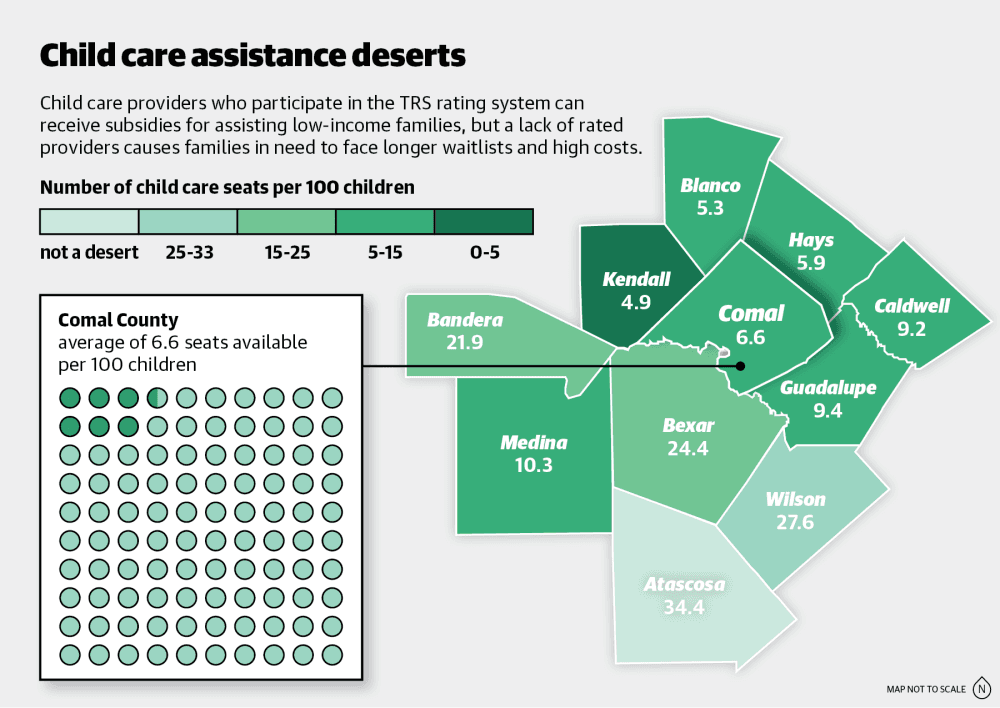
Sections of Comal, Guadalupe, Bexar and Kendall counties are designated as child care “deserts” for families requiring financial assistance, according to Children at Risk, a national nonprofit organization that focuses on children’s education and development.
The nonprofit lists “deserts” as areas with 0-33 seats per 100 children. The entirety of Comal County is listed as a desert, while surrounding Bexar, Kendall and Guadalupe counties have some areas that have more than 33 seats available, according to the nonprofit.
Digging deeper
Early Matters New Braunfels will act as both an advocacy and a coordination effort, Jewell said. At the state level, child care regulations are overseen by multiple agencies, creating a complex and difficult-to-navigate system for providers. The focus now is on aligning policy, funding and business support, Jewell said.
“The child care industry is regulated by six different state entities,” she said. “It makes it difficult for your child care providers to navigate that.” To address this, a steering committee—composed of representatives from local school districts, businesses, community organizations and former providers—has been meeting for several months to outline priorities, Jewell said. One early goal is increasing participation in the TRS system, which offers up to four levels of quality designation.
While participation is voluntary to operate in Texas, centers must hold a TRS rating to accept certain child care subsidy funds administered through the Texas Workforce Commission, Crowley said.
The funds are paid by TWC to child care providers through the Child Care Services program, which supports families in need pay for care, according to the TWC website.
Raising the number of rated providers could expand access for lower-income families while also promoting higher-quality early learning environments, Crowley said.
The foundation also examined the TRS system, which determines eligibility for certain state child care subsidies. Currently, only five centers in Comal County participate in the program, limiting options for families who rely on assistance. The list includes The Goddard School, Kids ‘R’ Kids Learning Academy, The Morgan Center LLC, Methodist Preschool and The Children’s Courtyard Inc.
TRS designates one to four “stars” to providers using performance, employee training and amenities, including indoor and outdoor play spaces, educational training for employees, kitchen and cooking amenities, and curriculum, according to the TRS website.
By the numbers
Program funding comes from the McKenna Foundation, the GNBEDF and the Kronkowsky Foundation. The McKenna Foundation donated $100,000 annually for three years and has been matched by the GNBEDF. The Kronkowsky Foundation has also given a one-time $25,000 grant to kickstart the program, Jewell said.
The funding will total $225,000 in the first year, and $200,000 in the second and third years, Jewell said.
The average cost of child care can range from $149 per child for a five-day workweek to $212, totaling $7,748-$11,024 annually, according to a study conducted on behalf of the TWC by the University of Texas.
Public input
The process to get a higher TRS rating takes away from the job of child care providers, Summer Bolado, director of Triple L Ranch Child Development, said.
Although Triple L Ranch is not TRS rated, Bolado said having a system in place to streamline the process would give caretakers more time to do what they are passionate about.
“[Providers] don’t want to have many more things taking up their time. It adds more to our plate and takes away from us really caring for the children,” Bolado said.
What’s next
An executive director for the program is expected to be hired by early summer, Crowley said. The role will focus on establishing measurable goals over the next three years. Long-term goals include growing the number of TRS providers and the number of available seats.