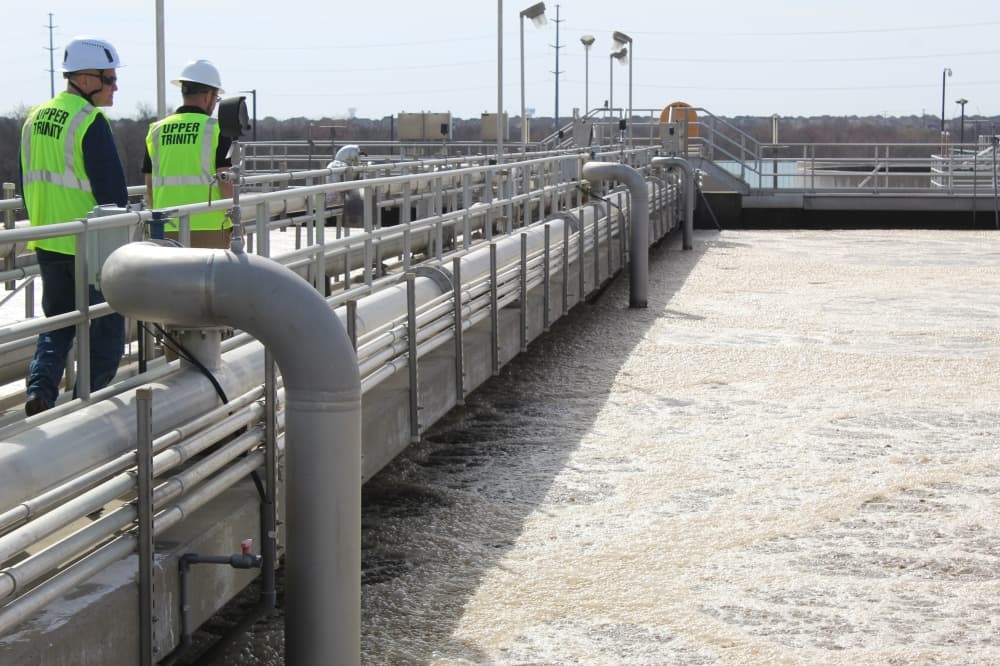
With populations rising in Prosper and Celina, local officials and the Upper Trinity Regional Water District are expanding water infrastructure to meet growing demands.
In 2024, both municipalities agreed to fund a $269 million expansion of the Doe Branch Water Reclamation Plant, which serves both communities.
The gist
The Doe Branch project will expand the water reclamation plant’s capacity from 4 million gallons per day to 12 million gallons per day, or mgd, and add a pipeline extension from the plant to Fishtrap Road.
The plant was previously expanded in 2021, but local officials said continued population growth in both municipalities prompted the need for another expansion.
“We finished construction and immediately started expansion,” UTRWD Communications Director Jason Pierce said.
Construction was estimated to cost $209.9 million, but the project has seen price increases, primarily due to inflation. Celina’s share, which has seen increases in recent months, of the plant increased by $13.5 million, while Prosper’s portion decreased by $20.5 million after the town reduced its flow allocation.
Breaking it down
Doe Branch has a permit to process 4 mgd, but UTRWD Operations Supervisor Steven McHenry said that with the rapid growth in Prosper and Celina, Doe Branch is currently treating about 6 mgd, or 150% of its permitted capacity.
Doe Branch treats 1.64 mgd of wastewater from Celina and 1.13 mgd from Prosper. The plant also helps provide wastewater treatment services for smaller communities such as Savannah and Arrowbrooke.
The expansion will add 8 mgd of treatment capacity, bringing the plant’s total capacity to 12 mgd. Doe Branch will treat an additional 4 mgd from Celina and 3 mgd from Prosper, leaving 1 mgd of new treatment capacity unclaimed.
“We’d like to see what the actual usage is before we’re funding capacity that the town’s not going to use,” said Chuck Ewings, Prosper assistant town manager.
Celina and Prosper will split the cost of the remaining 1 mgd until it is claimed, said Kim Brawner, Celina assistant city manager.
Zooming out
Prosper and Celina officials said the wastewater expansion is needed to keep up with growing population and development demands. Prosper’s population is expected to increase nearly 10% by 2030, while Celina’s could increase 80%.
Prosper has experienced rapid development in recent years, but Ewings said the town is seeing a slowdown.
“We’re playing a little bit of wait and see how we grow,” Ewings said.
Why it matters
Prosper and Celina officials are projecting water and wastewater rate increases over the next several years, particularly due to funding the Doe Branch expansion project.
For fiscal year 2026-27, Prosper officials are projecting a 13.77% increase for water rates and 17.96% increase for wastewater rates.
Ewings said Prosper’s rate increases have been partially driven by the town’s decision to issue over $60 million in debt to fund the plant.
Brawner said Celina residents could see “modest increases” in water and wastewater rates over the next few years.
“Our goal has been, and continues to be, to plan responsibly for Celina’s growth while keeping rates as stable and predictable as possible,” she said.
Looking ahead
While the Doe Branch expansion will address improving wastewater capacity, officials are also planning for increasing future water supply alongside development.
Work is underway on Lake Ralph Hall in Fannin County, which UTRWD officials said is expected to begin delivering water to Celina and other communities by late 2026.
“While projects like Lake Ralph Hall focus on securing future water supply for the region, Doe Branch addresses the wastewater treatment side of that equation,” Brawner said.
McHenry said as the latest expansion at Doe Branch is expected to finish in 2028, officials will start planning the plant’s next expansion once it hits 75% of its rated flow capacity.
“We had asked the towns to project up to 2030 [and] what their needs would be,” McHenry said.
Dates to know
- Late 2026: Lake Ralph Hall expected to deliver water to Celina
- Fall 2027: Projected completion of pipeline construction
- Fall 2028: Projected completion of plant expansion
- 2030: UTRWD could begin planning for a potential future plant expansion