Pearland’s charter school presence began in 2019 with Horizon Montessori, followed by International Leadership of Texas’ Pearland campus, which opened for the 2024-25 school year.
What's new
Construction began in July on Harmony Public Schools’ first Pearland campus, which is an open-enrollment charter elementary school set to open for the 2027-28 school year.
The 825-student pre-K through fifth grade campus is the first phase of a broader plan that includes an adjacent intermediate and high school campus expected to open for the 2030-31 school year.
The expansion was driven by Pearland’s population growth and strong interest from local families, said John Boyd, Harmony Public Schools’ chief communications officer.
“We’re excited to partner with Pearland families and contribute to the community’s future,” Boyd said.
What parents should know
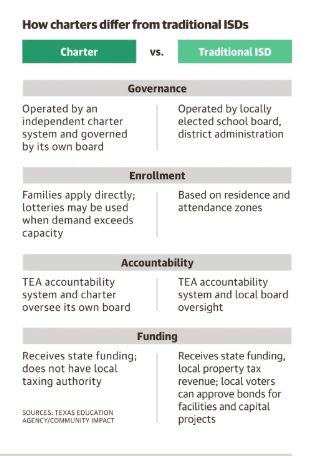
Traditional independent school districts and open-enrollment charter schools are both part of Texas’ public education system and free to attend at the point of service—but they differ in educational models and structure.
Unlike ISDs, which are governed by locally elected boards and serve defined attendance areas, charter schools are governed by appointed boards and accept students from across district boundaries through an application process.
Charter schools must meet Texas Education Agency standards, but can offer specialized programs, including science, technology, engineering and mathematics, or STEM, language immersion and Montessori models, said Brian Whitley, vice president of communications for the Texas Public Charter Schools Association.
“Charter schools are public schools,” he said. “They follow the same curriculum standards, graduation requirements and administer the same state exams.”
Zooming out
Public charter schools have historically been concentrated in larger cities, but operators have increasingly expanded into surrounding suburbs as communities develop, Whitley said.
Population growth, district enrollment and available land can signal opportunities for new campuses as charter operators look for locations where they can sustain enrollment, said Tiffanie Thoman-Rodgers, director of operations at Population and Survey Analysts, a demographic consulting firm.
Measuring the impact
While charter campuses have expanded in Pearland since 2019, district officials say the growth has not yet had a significant or sustained impact on Pearland ISD or Alvin ISD enrollment.
Before the 2020-21 school year, fewer than 0.5% of students in either district transferred to charter schools annually. By 2025-26, that share had increased to over 2% in PISD and nearly 1.3% in AISD, data shows.
Charter transfers remain a small share of overall district enrollment, but student attendance is a major factor in state funding formulas, meaning shifts in enrollment can affect budgeting, staffing and future planning, PISD Superintendent Larry Berger said.
“If you’re in an environment where enrollment goes down because students have chosen another option, whether it be charter school, private school or homeschool, then that reduces the biggest variable that drives your revenue,” Alvin ISD’s Chief Financial Officer Daniel Combs said.
District officials said they will continue monitoring charter growth, but noted it is just one of several factors, including housing patterns, birth rates and population shifts, all of which ultimately affect enrollment projections.
What parents are saying
Samantha Rincon De Benites, a former Pasadena ISD parent who resides in Pearland, transferred her children to ILTexas’ Pearland, and said the school’s smaller class sizes are a positive part of her children’s experience.
"I don't think I would ever go back to [traditional ISDs]," Rincon said. "The class sizes are way too big."
AISD parent Dayahna Segura also enrolled her children at ILTexas, but later returned to AISD due to concerns about staffing, organization and academic progress.
"I just wanted them to learn the curriculum in both English and Spanish," Segura said. "They sadly didn't learn anything in any language."
The big picture
As families continue to consider different education options, school districts and charter operators are watching how those choices may shape local public education.
“There has been so much talk about ... the proper way to educate children in the state of Texas, and I think it really has to do with how families are receiving that and what they determine is the best way,” said Laura Lawless, projections coordinator at Population and Survey Analysts.
Lawless said those conversations became more visible during the COVID-19 pandemic, when many parents gained a firsthand look at different approaches to education.
“Families were able to see what education could look like ... and be in the classroom with their children. That became a major catalyst for many families to start thinking differently about how they wanted to educate their children,” she said.
As school choice expands, Lawless said districts should continue listening to families and understanding what programs and educational models their communities are seeking.
“Charter schools are public schools and will remain part of an expanding educational landscape in Texas,” Berger said. “When a family chooses another option, we should not dismiss that decision. We should seek to understand it.”
“Public charter schools are not a replacement for ISDs. They simply create more options within the public school system so that more students’ needs can be met,” Whitley said. “There is no one kind of Texas student.”