Editor's note: this story was updated to clarify that the resident survey is not being distributed by the 2222 Coalition of Neighborhood Associations, as previously reported.
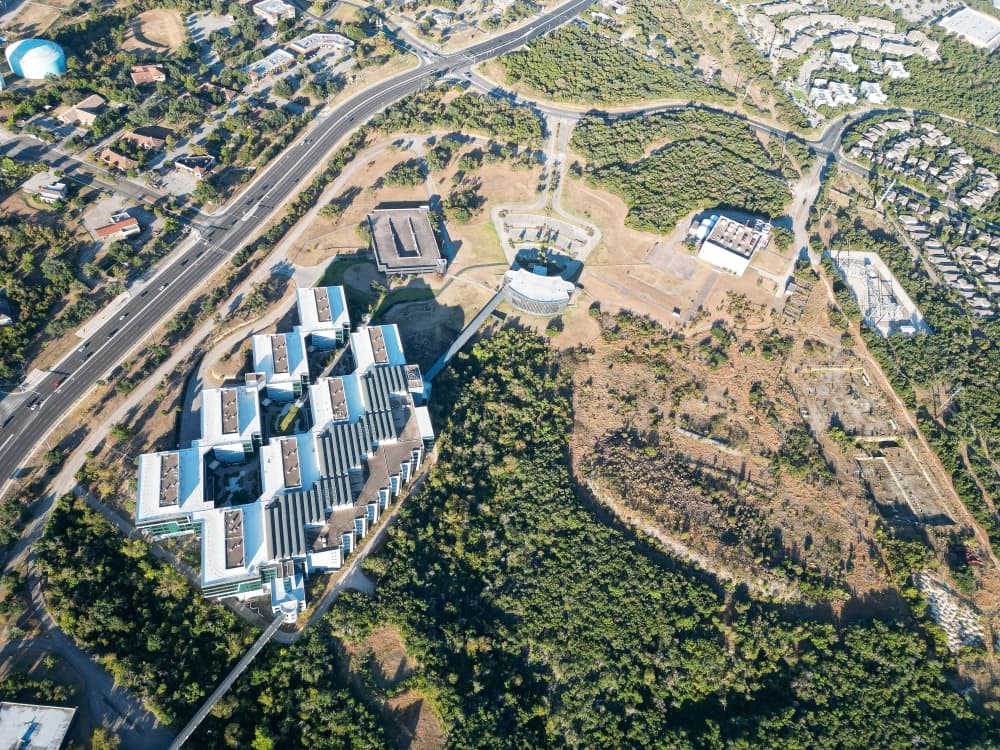
Dozens of residents in the Four Points area gathered for a town hall Sept. 17 to discuss the future of the former 3M campus off River Place Boulevard, which is now slated to house an artificial intelligence manufacturing company.
City of Austin officials and a representative from SB Energy attended the town hall to provide the latest updates on the site.
Some context
Manufacturing and tech company 3M previously occupied the campus, which was purchased by investment firm Karlin Real Estate in 2021 and renovated in 2024.
The site became known as Highpoint 2222 and was slated to transform into a mixed-use property featuring retail space, a variety of housing options and space to support tech and life science tenants, as previously reported by Community Impact.
Travis County documents show that Karlin sold the property to SB Energy in early 2026. Per SB Energy's website, the company develops and builds infrastructure used to power AI data centers.
The update
United Kingdom-based semiconductor manufacturer Graphcore was recently announced as the site's first tenant. According to Jaime Carlson, head of commercialization and risk at SB Energy, the company will utilize the River Place campus as its United States engineering headquarters to research, develop and test power-dense semiconductor chips for advanced computing and robotics.
Carlson said the company's takeover of the site—known as Project Cosmos—has been different from other SB Energy investments, which she said has caused issues with community transparency.
"We're not usually coming in and renovating a site," Carlson said. "Typically, we spend years on the ground getting permits, talking to fire departments, talking to local school districts, getting to know local stakeholders, so by the time we're breaking ground, folks know us."
Diving in deeper
Carlson said there has not been a change in zoning for the site. Additionally, the site will comply with existing noise ordinance limits; its water use is expected to be at or below what 3M utilized due to the use of closed-loop chillers; and its electric use will have a max capacity of 50 megawatts.
"Our focus right now is on our tenant's current needs," Carlson said. "If the nature of their needs changes, if there is a change in customer, we would have to have all of those conversations with the city to make any changes."
Austin Water
Austin Water Chief Administrative Officer Heather Cooke said the department learned that SB Energy submitted a revised site plan earlier this week. The department is currently reviewing the plan, and so far, is expected to require the company to submit a water benchmarking application.
"This process is used to assess the projected water use and identify water conservation and reuse opportunities that might apply for this proposed project," Cooke said.
As a reference, Cooke said 3M used between 24 million and 36.6 million gallons of water per year between 2012-18 when it was operational.
An earlier site plan application reviewed this summer did not reference any data centers and stated there would be no change in uses, no increased building square footage and no changes in water demand, Cooke said.
Austin Energy
Amy Everhart, Austin Energy's director of local government affairs, said Austin Energy customers are not required to disclose what they are using electricity for and there are no regulations in place.
"Having said that, we do ensure the electric system can handle each customer's needs and that it doesn't impact the reliability or affordability of existing customers," Everhart said. "There were questions related to the amount of power that this campus will be using, but any customer's right to use the information is legally protected. That would have to be addressed by the owner or tenants of the property. But I can say that any customer would not be able to come online if their level of use negatively impacted the neighbors."
Policies are also in place so existing customers are not subsidizing new, large customers that want to join the system, Everhart said. Large customers must pay for an engineering study to review any potential reliability impacts, and must pay for infrastructure upgrades if needed.
What they're saying
Residents have voiced concerns about the project's wildfire risk, underground vibrations that could impact local wildlife, and whether or not the site will become a data center or remain a research and development, or R&D, facility. An Aug. 31 filing with the Securities and Exchange Commission lists Cosmos as a data center.
"We are not here in opposition; we are here to get facts," resident Linda Bailey said. "We still don't fully understand the effect on nearby neighborhoods, schools and the preserve from potential noise or vibration, environmental impacts, utility demand, infrastructure impacts and long-term costs."
Something to note
According to previous Community Impact reporting, a 2013 law waived state sales taxes for certain data centers, allowing qualifying companies to purchase electricity, cooling systems, software and related technology infrastructure tax-free.
During the town hall, Texas House District 47 Representative Vikki Goodwin said the state gave out $1 billion worth of tax incentives in 2025 to data centers, which is expected to increase to $3.5 billion over the next few years if this subsidy continues.
"We need to give counties land use authority because right now, they have very little to nothing that they can do about the data centers. There is bipartisan agreement about the need to have transparency so that these companies are providing information about how much energy they're using, where they're getting it from; how much water they're using, where they're getting that from; making sure we have regulation in place so that the companies can't push the cost for new transmission onto us ratepayers and our households; and ending the subsidy." Vikki Goodwin, Texas House District 47 Representative
Locally, Austin City Council has been working toward enacting a new regulatory framework regarding how and where data centers can be built in the city, as recently reported by Community Impact.
Get involved
A group of residents are conducting a survey for Four Points-area residents to provide feedback on Project Cosmos. The survey will remain open until Oct. 5.