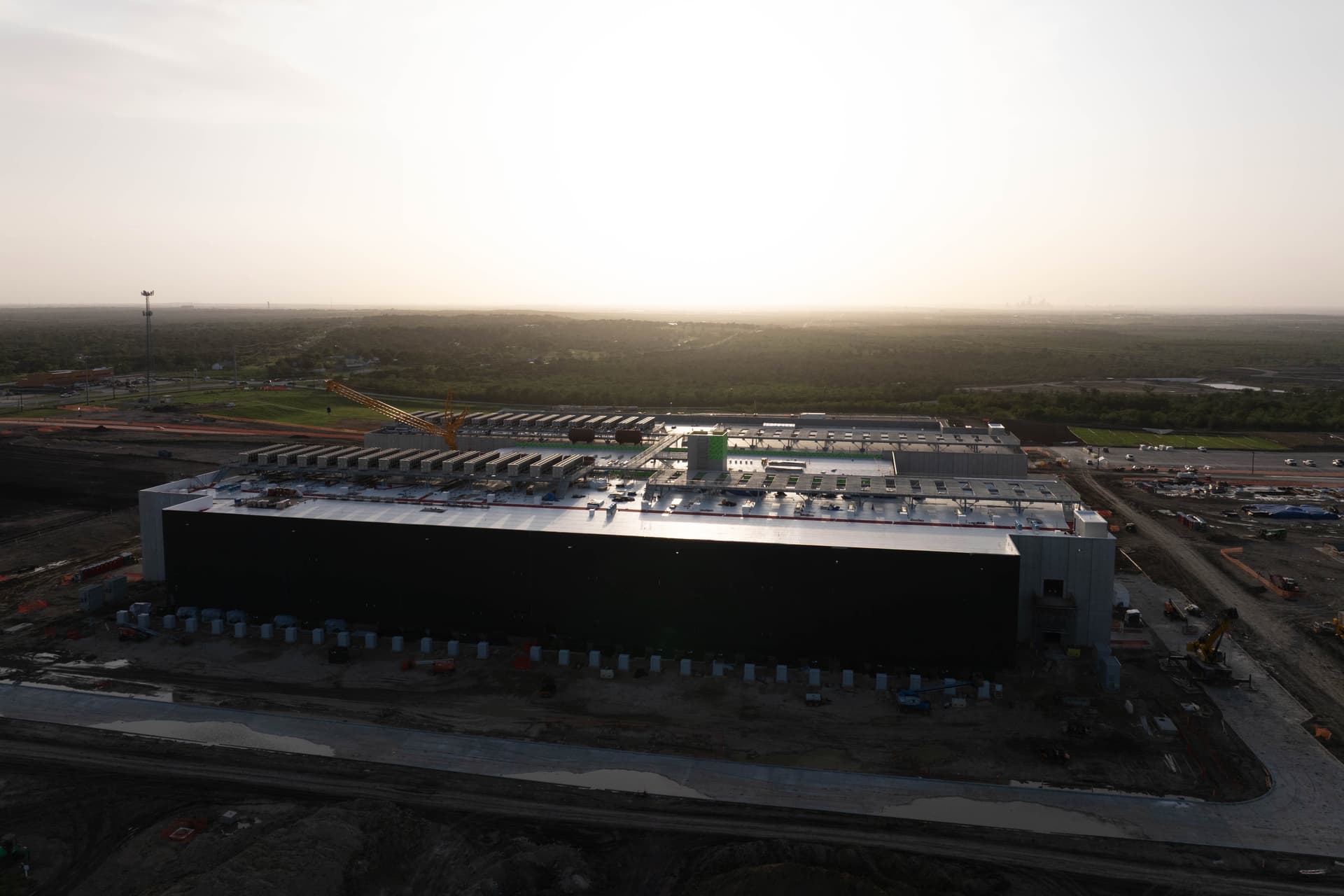
Data center development is taking place around Central Texas, including new EdgeConneX facilities in Bastrop County. (Xorin Aeronautics/Community Impact)
Austin is moving to enact a new regulatory framework covering how and where data centers can be built in the city, and block the development of the largest and most resource-intensive facilities.
“We’re looking to have a complete, legally viable means of regulation, prevention and protection," Mayor Kirk Watson said.
The big picture
Today, data centers are generally allowed in Austin's commercial and industrial areas and there are no specific rules in place to control or monitor their development. As data centers have proliferated across Texas, including in Austin, city leaders are seeking ways to oversee any new facilities that may be built locally.
An analysis of current conditions related to data centers was released this summer by Austin Energy, Austin Water and other city departments, which also proposed ways to manage the centers' impact. On Aug. 27, City Council unanimously voted to launch a regulatory update that'll revise Austin's zoning rules by limiting the facilities to certain locations; establishing new standards for data center construction; and adding permitting, planning and monitoring requirements.
A targeted land-use policy framework was identified by city staff as the most effective way to enact local oversight of data centers, and to mitigate any negative effects on residents and public resources. Some new policies, including a ban on large data centers, could go into effect by the end of the year after code updates are drafted and considered through public reviews.
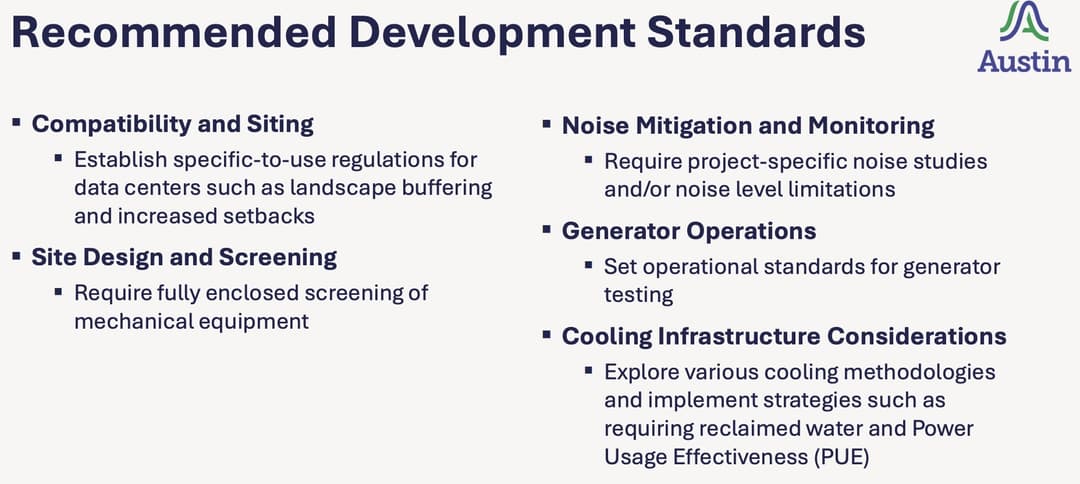
Austin could enact development standards for all new data center projects. (Courtesy city of Austin)
The approach
Austin leaders said they aren't moving to fully restrict all data centers, and didn't take issue with some of the smaller-scale facilities that can come with lower land and utility demands. But council members generally expressed alarm and skepticism about the biggest centers: wholesalers and "hyperscalers" that can cover many acres and use significant amounts of power and water, and which are more associated with artificial intelligence companies.
Council members said they hope to stop any such centers from being built in Austin. They also said the city should move its process along to head off new hyperscale construction.
“I do think we really have a united front here on council, that we don’t want big data centers in our city," council member Mike Siegel said. "We want to create durable, enforceable regulations to make that happen.”
For now, Austin is effectively pausing new data center development while the regulatory updates move forward. City departments that may need to sign off on such project plans will hold off on approvals while the process plays, officials said. Austin Development Services Director Keith Mars confirmed his department will be looking out for data center indicators during plan reviews, and investigating any potential projects.
In addition to requesting new regulations, council also asked staff to:
Report on applications for data centers using over 20 megawatts power or 85 million gallons of water annually
Require data centers to use carbon-free generation and energy storage, and push for on-site reclaimed water use
Stop data centers from expanding on a site without approval, and keep smaller center from clustering together to form a larger complex
Set rules related to landscaping, heat mitigation, impervious cover and flooding as well as added permitting standards
Consider the creation of a public data center advisory task force
Analyze historic environmental racism and inequities in East Austin to avoid concentrating data centers east of I-35
“The members of the council, individually and collectively, have spoken pretty clearly about what it is they hope to see," Watson told city staff. "Read the room. Help bring to us what it is that the council is indicating it wants to do to be legal viable, to be protective and to be preventive. That is what we’re hoping to see, to the fullest extent that the law allows a municipality to act under these circumstances.”
What they're saying
Stating that the new regulations are an urgent matter, council members also pressed staff to return with next steps as soon as possible. An amendment from Siegel was aimed at streamlining and accelerating the new policies through public review, and officials could consider some initial zoning updates in December.
City leaders are appropriately "throwing the kitchen sink" at private development that could bring profound negative impacts to residents, council member Marc Duchen said. He also urged Austin's utilities to provide more regular reporting on their largest users—which could indicate data center operations—to improve visibility of major technology and manufacturing projects across the city. And he proposed making larger compute centers a conditional use in city zoning that'd require added approval.
Council member Paige Ellis said new data center rules would fall in line with local environmental goals to provide affordable and reliable power, clean drinking water and a reliable food ecosystem. She also noted that while Austin and Texas leaders frequently disagree, the state is also now pursuing more oversight of data centers' rapid growth.
While supporting the overall framework, Mayor Pro Tem Chito Vela also cautioned his colleagues to ensure final policies are sustainable against pushback from data center-aligned entities.
“I understand the urgency, but I don’t want to pass something that then gets quickly overturned and then we’re back to square one," he said. "I’d really rather work through this slowly, deliberately and get something that we can defend against any kind of legal challenge.”