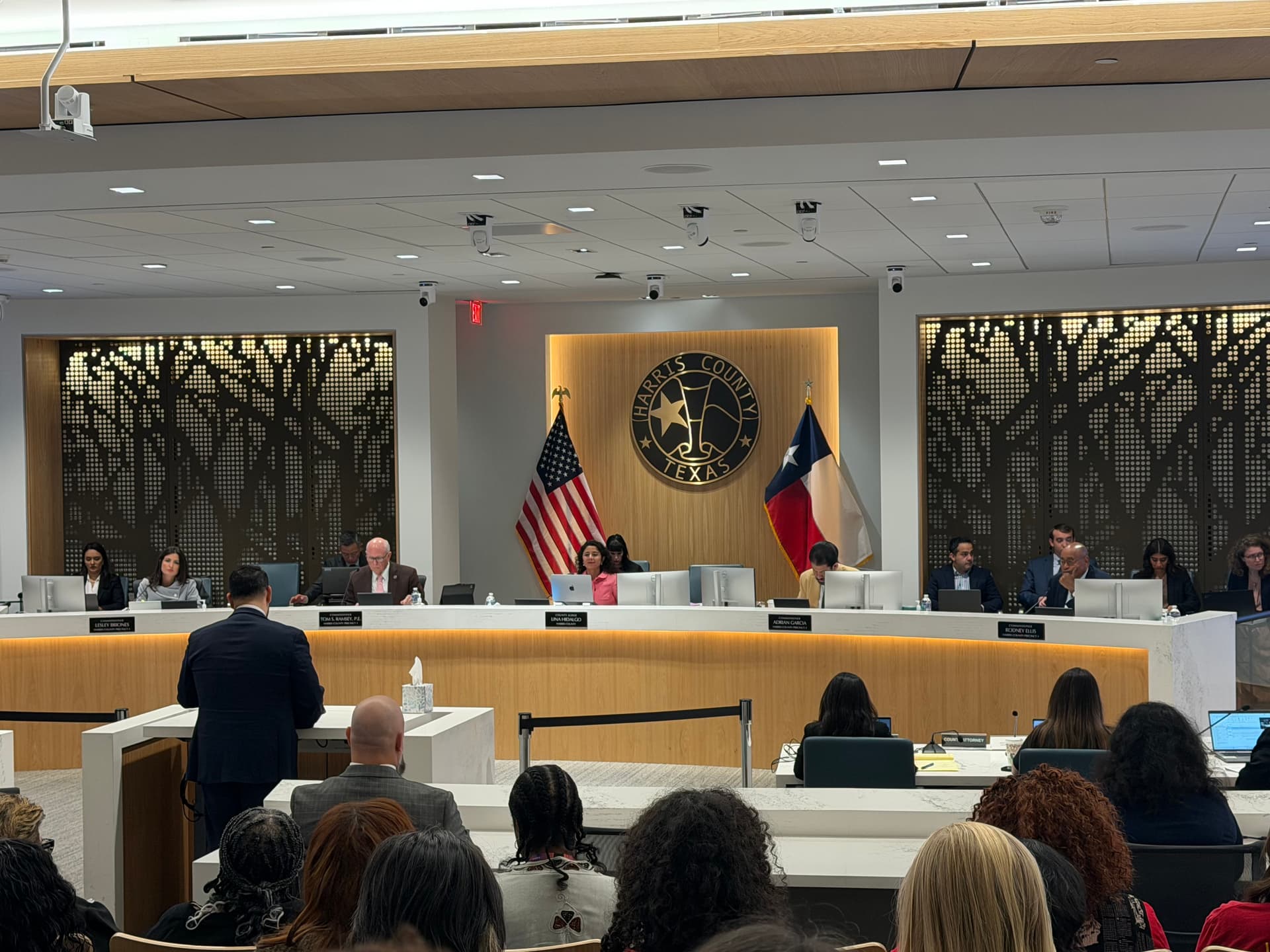
Harris County Commissioners Court on April 16 greenlit a business development program for child care providers that aims to help more centers qualify for federal subsidies, part of a large-scale effort to increase affordable early education options in the Greater Houston area.
Precinct 4 Commissioner Lesley Briones and Precinct 2 Commissioner Adrian Garcia—who recently launched the Harris County Coalition on Early Childhood Education and Care—proposed the program as one of several policies addressing the tens of thousands of local children on a wait list for child care scholarships.
The action taken
The April 16 vote directed the county’s Department of Economic Equity and Opportunity to create an early child care business accelerator program in partnership with the University of Houston and the Gulf Coast Workforce Board, the two entities developing curriculum for providers.
Garcia said the program will provide mentoring and business support with the goal of expanding available child care seats and improving compliance with local and state regulations.
Briones also said the county will specifically focus on assisting providers who lack Texas Rising Star certifications—a quality recognition from the Texas Workforce Commission that’s required for centers to qualify for federal support.
“The business accelerator ... will enable those facilities to be stronger, maybe learn how to expand their capacity, maybe learn where to go to access more capital, [and] learn the regulation so they can be thoughtful on the processes that are in front of them,” Garcia said.
On top of launching the program, Commissioners Court approved three other motions from Garcia and Briones, including:
- Directing the administration to review local procedures and associated costs for child care providers involving accounting, permits, inspections and other regulatory processes
- Directing the administration to analyze how the county already connects families with young children to early learning and develop a plan to address gaps
- Directing the Intergovernmental and Global Affairs department to develop recommendations for state-level advocacy and return with priorities
Both commissioners emphasized the tie between availability of subsidized care and workforce participation, noting that approximately one in four adults in Texas do not enter the workforce or leave their job or education due to high child care costs.
“There are thousands that remain on the wait list, and employers are absorbing the costs with turnover, absenteeism and reduced productivity,” said Julie Stipeche, executive director of the Gulf Coast Workforce Board. “When access to child care increases, workforce participation follows. This is one of the most immediate levers that we have to expand the labor market.”
More details
Only about 55% of Harris County child care and early learning centers carry a Texas Rising Star certification, meaning 45% of local providers cannot qualify for federal subsidy, according to a presentation from Garcia and Briones’ offices.
“Some providers may not want to be TRS-certified,” Briones said. “However, we have heard loud and clear, and the data shows that many of [them] cannot get the designation because it’s a complex way to apply.”
As for potential state-level reform, Briones pointed to Louisiana as a model. In 2017, the Louisiana Legislature created a state-controlled Early Childhood Education Fund that provides a one-to-one match for local investments in early childhood programs and scholarships, effectively doubling their funding.
The state of Texas doesn’t have such a fund. However, the 89th Legislature in 2025 did increase funding for child care scholarships by $100 million as part of the state’s $337 billion budget for the 2026-2027 biennium.
Briones said there are still funding gaps to close, as many small business providers are “operating on razor-thin margins.” Even those that do earn state reimbursements—about $42 per day—don’t receive enough to provide high-quality care, she said.
The discussion
Precinct 3 Commissioner Tom Ramsey voiced support for streamlining regulations for providers, saying while many exist for a reason, some are “so oppressive that you can’t get anything done.” He also recommended involving more local churches in the coalition, as they historically have led the charge on early childhood education issues.
“Let’s go ahead and make this bipartisan starting here,” said Ramsey, the sole Republican on Commissioners Court.
County Judge Lina Hidalgo, who voted to approve the motions, posted a statement on social media several hours before the court’s vote saying the action “proposes initiatives that already exist and does not allocate significant funding to continue those initiatives.”
Over the summer, Hidalgo tried to seek voter approval of a penny property tax increase that would continue funding for existing early childhood education programs, such as Early REACH, which was established in 2022 using one-time American Rescue Plan Act dollars. The county’s funding for Early REACH and similar ARPA-funded initiatives will wind down in August, she said.
However, the proposed ballot item did not receive enough traction at an Aug. 7 Commissioners Court meeting and failed without commissioner support, Community Impact previously reported.
“I am convinced that the reason we are seeing this sudden proposal to ‘improve access’ to early childhood education is that the community is holding this court accountable for its vote last year, keeping the public from opining on this issue,” Hidalgo’s statement reads.
Briones said a local tax increase would be “highly counterproductive” without addressing the systemic obstacles that prevent more Harris County centers from receiving federal funds.
“At a time where we have an affordability crisis, the last thing we want to do is go ask to raise taxes to address a system that is already too expensive and too unsustainable,” she said during the April 16 meeting.
By the numbers
Children At Risk, a bipartisan policy and advocacy organization, analyzes child care demand across Texas ZIP codes annually. As of September, 413 Texas ZIP codes are considered child care deserts, or areas where the number of children under age 6 with working parents exceeds three times the licensed capacity of local providers, according to an April 9 report.
According to a Children at Risk map updated last April, nine Harris County ZIP codes are considered chronic child care deserts, meaning they were identified as lacking seats three years in a row.
- 77506 (Pasadena): 0 child care seats per 100 children of working parents
- 77093 (Houston): 0 child care seats per 100 children of working parents
- 77076 (Houston): 11 child care seats per 100 children of working parents
- 77587 (South Houston): 18 child care seats per 100 children of working parents
- 77040 (Cy-Fair): 19 child care seats per 100 children of working parents
- 77060 (Aldine): 23 child care seats per 100 children of working parents
- 77038 (Houston): 27 child care seats per 100 children of working parents
- 77048 (Pearland): 27 child care seats per 100 children of working parents
- 77029 (East Houston): 29 child care seats per 100 children of working parents
Additionally, 884 ZIP codes in Texas are considered subsidy child care deserts—a designation that uses the same threshold to measure local availability of federally subsidized care.
“The need is urgent,” said Ernest Lewis, vice president of community impact and vitality at BakerRiply, one of the nonprofit partners on the county’s Coalition. “More than 28,000 families in our region are waiting for child care assistance, and families are ready to move forward but [are] unable to do so without stable care. When care is unstable, families fall behind, providers struggle to stay open and children miss critical early learning moments.”
Going forward
The Coalition will hold another subcommittee meeting April 20, followed by a third steering committee meeting in June, Briones said.
Additionally, the Office of County Administration and the Intergovernmental and Global Affairs department will present their recommendations to commissioners by June 11.