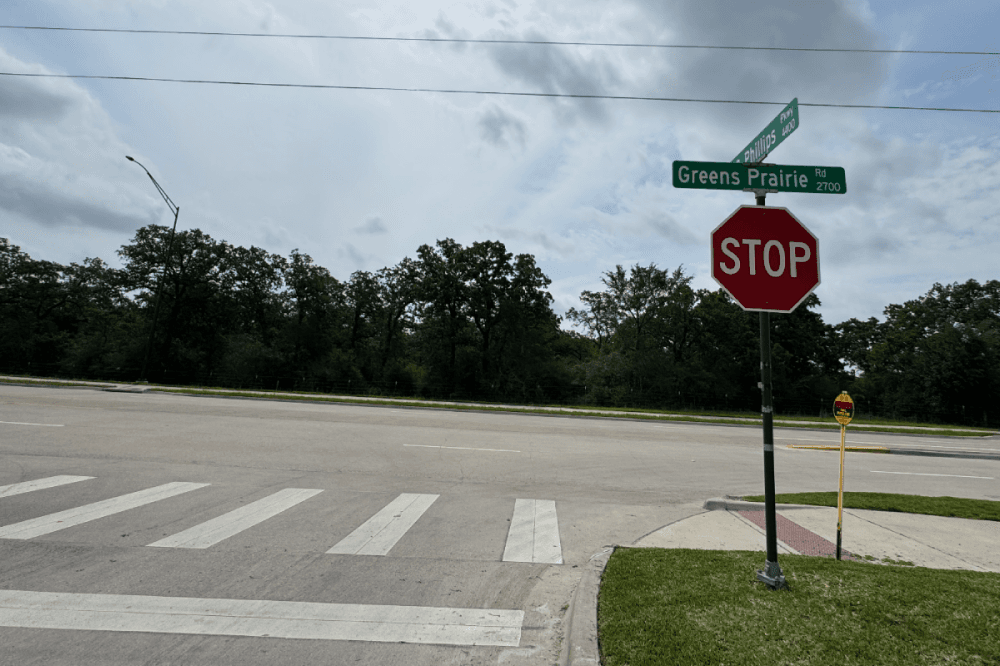
College Station City Council approved a rezoning request for 222 acres along Greens Prairie Road, making way for a large future single-family subdivision in the area. (Karley Cross/Community Impact)
After debate and strong neighborhood opposition at its April 23 meeting, College Station City Council approved a rezoning request for 222 acres along Greens Prairie Road, advancing plans for a large future single-family subdivision in the area.
The area is being called the Windham Tract, but is located along Greens Prairie Road, just east of the intersection of Greens Prairie Road and WS Phillips Parkway near the Castlegate II neighborhood.
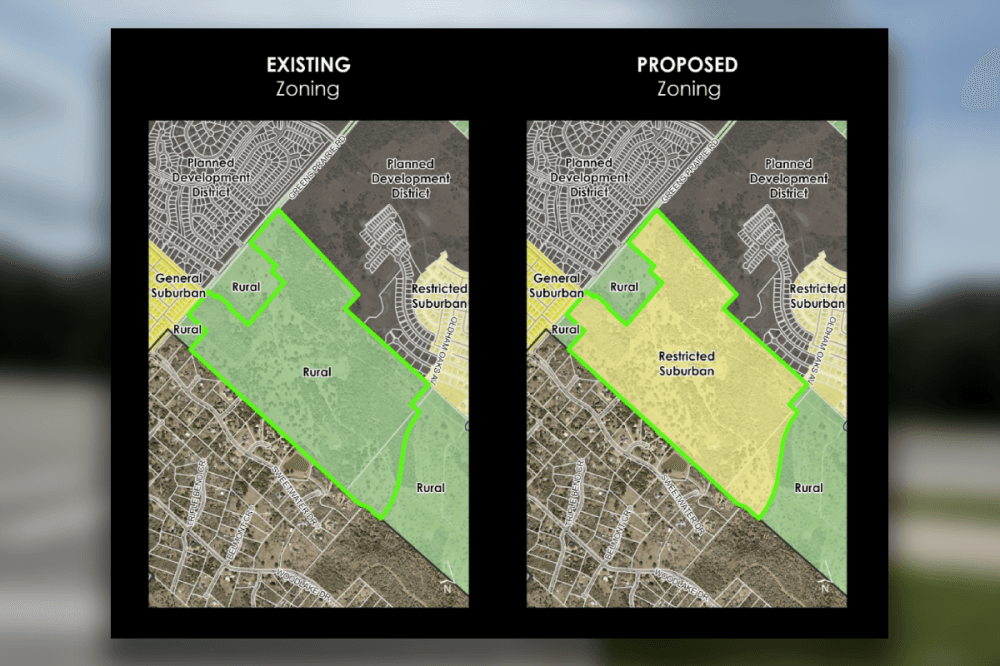
The council voted to rezone the property from rural to restricted suburban zoning following the extended public hearing, which was dominated by concerns about traffic impacts, infrastructure capacity and the possibility of a large build-to-rent neighborhood.
The area is being called the Windham Tract, but is located along Greens Prairie Road, just east of the intersection of Greens Prairie Road and WS Phillips Parkway near the Castlegate II neighborhood. (Courtesy city of College Station)
What readers should know
The rezoning request came before council in November 2025 for general suburban zoning, which would have allowed up to eight homes per acre.
Robin Macias with city planning and development services said that proposal came with significant pushback from residents and council members worried about density, as the plan was to create 1,776 lots.
The developer returned with a revised request for restricted suburban zoning, cutting the maximum density to four homes per acre.
Under that zoning:
Maximum yield: 888 lots
Average lot size: 10,000 square feet
Minimum lot size: 6,500 square feet
After accounting for streets, drainage, parkland and open space requirements included in the zoning request, council member Bob Yancy clarified with Macias that real-world development will typically produce fewer homes, estimating the final number could fall closer to 575-650 homes.
"Due to infrastructure and parkland dedication, it is very hard to achieve the actual allowed density in a subdivision," Macias said.
College Station's Planning & Zoning Commission unanimously recommended approval at its April 2 meeting.
The framework
The council's discussion at the April 23 meeting focused on infrastructure readiness—particularly traffic and sewer capacity.
Macias said a traffic impact analysis met city requirements, though some neighbors argued the study failed to fully account for congestion near the intersection of Greens Prairie and Arrington roads and nearby school traffic.
"There is an elementary school there," said Greens Prairie neighbor James Hagan. "That has not been addressed as part of the potential to bring ... up to 880 starter homes, which we can assume would include a large percentage of young families."
Brazos County Precinct 1 Commissioner Bently Nettles spoke as a resident, urging stronger coordination between the city and county, warning that county roads were not originally designed to handle hundreds of additional vehicles.
Macias said detailed drainage, road connections and engineering reviews would take place during the subdivision platting process, when developers are required to show no adverse impacts to neighboring properties.
On utilities, Macias said development would initially be limited to fewer than 200 homes until a sewer line project is completed. Anthony Armstrong, director of planning and development services, confirmed a capital improvement project is currently under design and expected to be finished in 2027.
Breaking down build-to-rent concerns
Much of the meeting centered on addressing residents' fears over the subdivision becoming a large build-to-rent community, which is a neighborhood where homes are constructed specifically for long-term rental rather than ownership.
For some context, Yancy said College Station is 64% renter-occupied housing and 36% owner-occupied housing.
US News estimates 82% of Texas A&M University students enrolled as of fall 2024 lived in off-campus housing. According to the university, its College Station campus has more than 74,000 students as of fall 2025 and employs nearly 4,400.
"That's among the highest in the country," Yancy said. "Were this to be a build-to-rent community in totality, it would not serve our city well."
He asked Armstrong whether the city could legally prevent a developer or investor from renting out large numbers of homes. Armstrong said Texas law provides limited authority.
Once individual lots are mapped as single-family homes, the city cannot regulate whether owners sell or lease those houses.
"If someone is buying one lot or if someone is buying 200 acres ... we do not regulate that," City Manager Bryan Woods said.
Armstrong revealed a letter from developer D.R. Horton—which also has a hand in Midtown development—stating that there is no intention to create a build-to-rent community. Joe Crawford, representing the applicant, corroborated that intent and added that the developer is in talks over potential deed restrictions with the landowner. However, Armstrong and Woods both acknowledged that private restrictions would not be enforceable by the city through zoning alone.
Public input
More than a dozen residents spoke during the public hearing, many from the Greens Prairie neighborhood.
Common concerns included:
Increased traffic and construction impacts
School capacity pressures
Drainage and flooding risks
Preservation of owner-occupied, family-oriented neighborhoods
Several speakers presented petitions opposing the rezoning and asked the council to delay any action until protections against build-to-rent development could be made.
"We have close to 400 signatures in opposition from the surrounding neighborhoods," Hagan said about the petition.
Others, like Bryan resident Martha Vilas, emphasized the importance of homeownership for neighborhood stability and long-term property values.
"What I am cautious of and here to fiercely advocate for is our homeowners and their home values," she said. "The neighborhoods surrounding this tract were built around long-term investment, quality construction and strong neighborhood identity ... just because something can fit within a zoning category does not necessarily mean it is the right fit for a particular location."
What's next
The council's vote approves only the zoning classification, not a subdivision layout, as confirmed between Macias and council member David White.
The project must still undergo multiple additional steps within the preliminary plan stage, which, according to Macias, will include:
Drainage concerns
Subdivision grading
Street connections
Other technical requirements
The rezoning decision establishes a framework for future development but does not immediately authorize construction.
Also on the agenda
Flock safety cameras: The council approved an agreement allowing the College Station Police Department to apply for a grant to install automatic license plate reader cameras throughout the city. Chief Billy Couch said the cameras will be used by law enforcement to help investigate crimes.
Shared housing ordinance update: The council unanimously adopted updates to the city's shared housing ordinance, redefining shared housing as a "congregate living facility." The change brings local regulations into compliance with Senate Bill 1567, which prevents Texas cities from limiting how many unrelated people may live in a home.